

Shipyards Integrating Artificial Intelligence Into Processes
Could some U.S. shipyards see robotic welders powered by artificial intelligence working alongside humans within a few years — or fewer?
In February, Italian shipbuilding giant Fincantieri announced an industrial partnership with Generative Bionics to begin work on a humanoid ship welding robot for shipyards, with AI capabilities.
The project, part of Fincantieri Group’s innovation and robotics strategy, aims to strengthen the operational excellence and technological leadership of European shipbuilding.
The collaboration is based on the integration of Fincantieri’s industrial expertise with the robotic platform developed by Generative Bionics, with the goal of increasing safety and operational efficiency, improving production quality and enhancing the sustainability of work in shipyards, the company said.
As an initial area of collaboration, the project involves the development of a humanoid robot designed to support welding activities in naval manufacturing. The humanoid will be equipped with artificial intelligence as well as advanced manipulation, perception and vision capabilities dedicated to monitoring the welding seam, along with optimized locomotion to operate in complex environments, Fincantieri said. The system will prioritize safety, allowing collaboration with workers while fully complying with regulations and without limiting work areas.
The collaboration is expected to span four years, with a strong focus on rapid deployment in operational settings. However, initial on-site tests are scheduled as soon as the end of 2026, with the objective of making “operational functionalities” available within the first two years, followed by “further refinement, expansion and industrial certification activities thereafter.”
Development and testing activities will take place at Fincantieri’s Sestri Ponente shipyard, which will serve as the reference environment for industrial validation and certification of the technology. Pierroberto Folgiero, chief executive officer and general manager of Fincantieri, said in a statement, “Advanced robotics and artificial intelligence applied to industrial processes represent a strategic lever for the evolution of shipbuilding and for the competitiveness of the European industrial system. The collaboration with Generative Bionics is part of the transformation journey we are undertaking to strengthen our operational excellence, enhance the work of our people and address in a structured way the challenges related to growing production complexity and the availability of specialized skills. In this context, the Sestri Ponente shipyard plays a central role as an industrial laboratory where technology, safety and skills evolve together, allowing us to integrate advanced robotics solutions in support of the most demanding and repetitive tasks, while maintaining high standards of quality, sustainability and labor protection.”
The partnership between Fincantieri and Generative Bionics also has “strategic value within the framework of European technological sovereignty, leveraging excellence developed across the research and advanced industrial supply chain,” according to the company. The project complements other ongoing robotics validation initiatives within the Fincantieri Group, expanding the range of manufacturing activities that can be carried out using advanced solutions.
Daniele Pucci, CEO and co-founder of Generative Bionics, said, “The collaboration with Fincantieri is part of our path toward industrialization and market deployment. Shipyards represent a strategic asset for global manufacturing, which is why we chose Fincantieri to demonstrate how our Physical AI solutions can translate into reliable, safe and truly useful systems. This project enables us to develop humanoid robots designed around human work, capable of operating side by side with people and contributing to the long-term sustainability of highly intensive and specialized activities.”
These advances won’t be limited to Europe. Francesco Greco, vice president of Industrial Integration, told The Waterways Journal, “The strength and added value we aim to offer to the United States lies in our ability to leverage the technologies, solutions and innovations conceived and matured across the global Fincantieri Group. In this context, our U.S. operations should not be viewed as a standalone entity, but rather as an integral part of a broader industrial and technological ecosystem. As ongoing studies, proof-of-concept efforts and testing activities are successfully completed, these advancements — including the one related to the AI-powered humanoid you touched upon— will be progressively integrated into our U.S. operations.
“A tangible demonstration of this global approach to shipbuilding innovation is already visible within our Wisconsin shipyard system,” Greco added. “Examples include a fully automated and robotized panel line, multipurpose collaborative robots (cobots) and the application of augmented and virtual reality to engineering and production processes, among many other initiatives currently underway.”
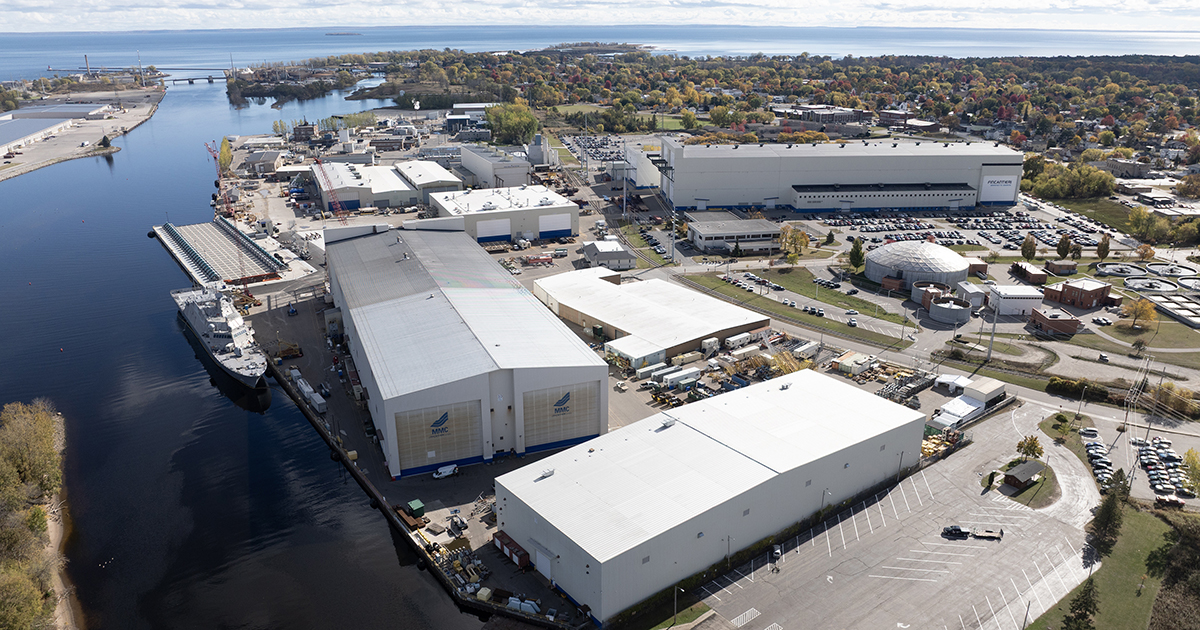
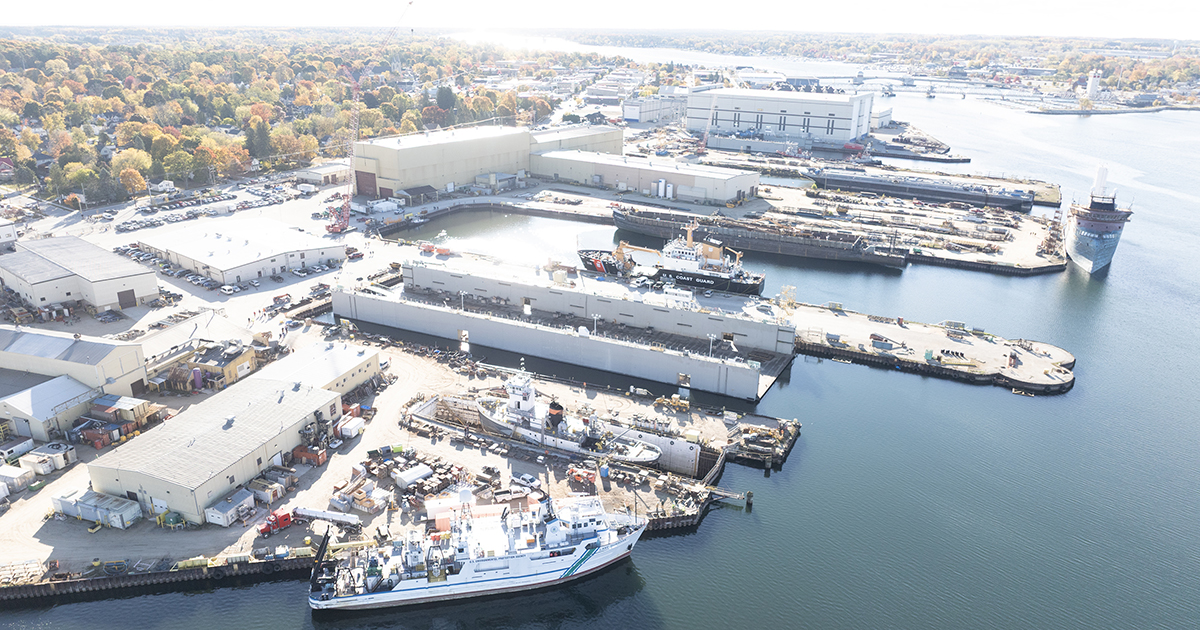
Fincantieri Marine Group, the U.S. division of Fincantieri, has three facilities, all within Green Bay on Lake Michigan. Fincantieri Marinette Marine builds the U.S. Navy’s future guided-missile frigate, as well as the Freedom-class Littoral Combat Ships. Fincantieri Bay Shipbuilding specializes in the construction, repair and conversion of Coast Guard and commercial vessels, including ATBs and OSVs. FBS is building the two largest LNG bunker barges ever built in the United States. Fincantieri ACE Marine is an aluminum construction facility that builds the Coast Guard’s medium-sized Response Boats and specializes in the design and construction of high-speed coastal intercept and patrol vessels.
Saronic AI Partnership
Although Fincantieri’s humanoid robot is unique so far, other shipbuilders are also integrating AI into their robotics and operations as the Trump administration pushes to rapidly jumpstart America’s shipbuilding sector. A startup called Saronic Technologies, founded in 2022 and based in Austin, Texas, specializes in building autonomous (pilotless) surface vessels for the Navy. After several rounds of fundraising from tech investors, including former Google executive Elad Gil, Saronic has an assessed valuation of $4 billion.
In February, Saronic announced a partnership with an AI company called Path Robotics. The collaboration will integrate physical AI for welding robotics into Saronic’s Franklin, La., shipyard. The initial rollout will focus on intelligent welding cells, combining Path Robotics’ proven welding models with Saronic’s welders to deliver “significant advancements in production efficiency, quality and repeatability,” the company said.
Path’s welding models combine computer vision, machine learning, AI and robotics to automate complex welding tasks in heavy manufacturing environments. To date, Path has trained its physical AI on tens of millions of welded inches. The initiative will integrate Path’s physical AI systems directly into Saronic’s shipyard workflow.
Last April, Saronic bought Gulf Craft, a shipbuilder in Franklin, La., to accelerate its growth into autonomous shipbuilding. Through this acquisition, Saronic gained a shipyard on the Gulf Coast that will serve as the prototyping and production hub for its medium unmanned surface vessel fleet, starting with Marauder, Saronic’s 150-foot Autonomous Surface Vessel.
Gulf Craft has a 60-year history of developing manned and unmanned ships for defense and commercial customers. The acquisition provided Saronic with the infrastructure and skilled workforce needed to develop, rapidly iterate and scale production of a new class of medium unmanned surface vessels to bolster America’s maritime dominance and national security. Saronic retained Gulf Craft’s experienced workforce and said it expects to create more than 500 new jobs over the next three to four years. In addition to bringing on skilled shipbuilders, welders and electricians, Saronic anticipates creating new roles for engineers, technologists and naval architects to develop and scale production of its MUSVs.
“The investment of Saronic in Louisiana’s shipbuilding industry will grow our economy, create high-quality jobs and bolster America’s maritime strength,” said Rep. Mike Johnson (R-La.), speaker of the House of Representatives, at the time. “By revitalizing our industrial base right here in Louisiana, we are taking a critical step toward building our own supply chains and countering foreign competitors like China. All of this is essential to our national security. We are grateful to Saronic for their commitment to this industry and our great state.”
Port Alpha Project
Saronic is also scouting locations for what it terms a “shipyard of the future,” a fully automated, $3.2 billion super-shipyard it is calling Port Alpha. After the Gulf Craft acquisition, Saronic CEO Dino Mavrookas said, “We don’t wait—we build for what our customers need, when they need it. While we actively search for a home for Port Alpha, this acquisition (of Gulf Craft) gives us the immediate capacity to meet urgent customer needs for larger autonomous vessels and the flexibility to scale to address emerging commercial and defense applications of these advanced systems.”
While no final location for Port Alpha has been announced, the Port of Brownsville, Texas, has been mentioned as a prime candidate. Saronic’s founder said at a February news conference that workforce development will help decide the location.
Featured image caption: An aerial view of one of Fincantieri’s shipyards in Green Bay, Wisc., with Green Bay in the background. (Photo courtesy of Fincantieri)