
Moon Mission Begins On Inland Rivers
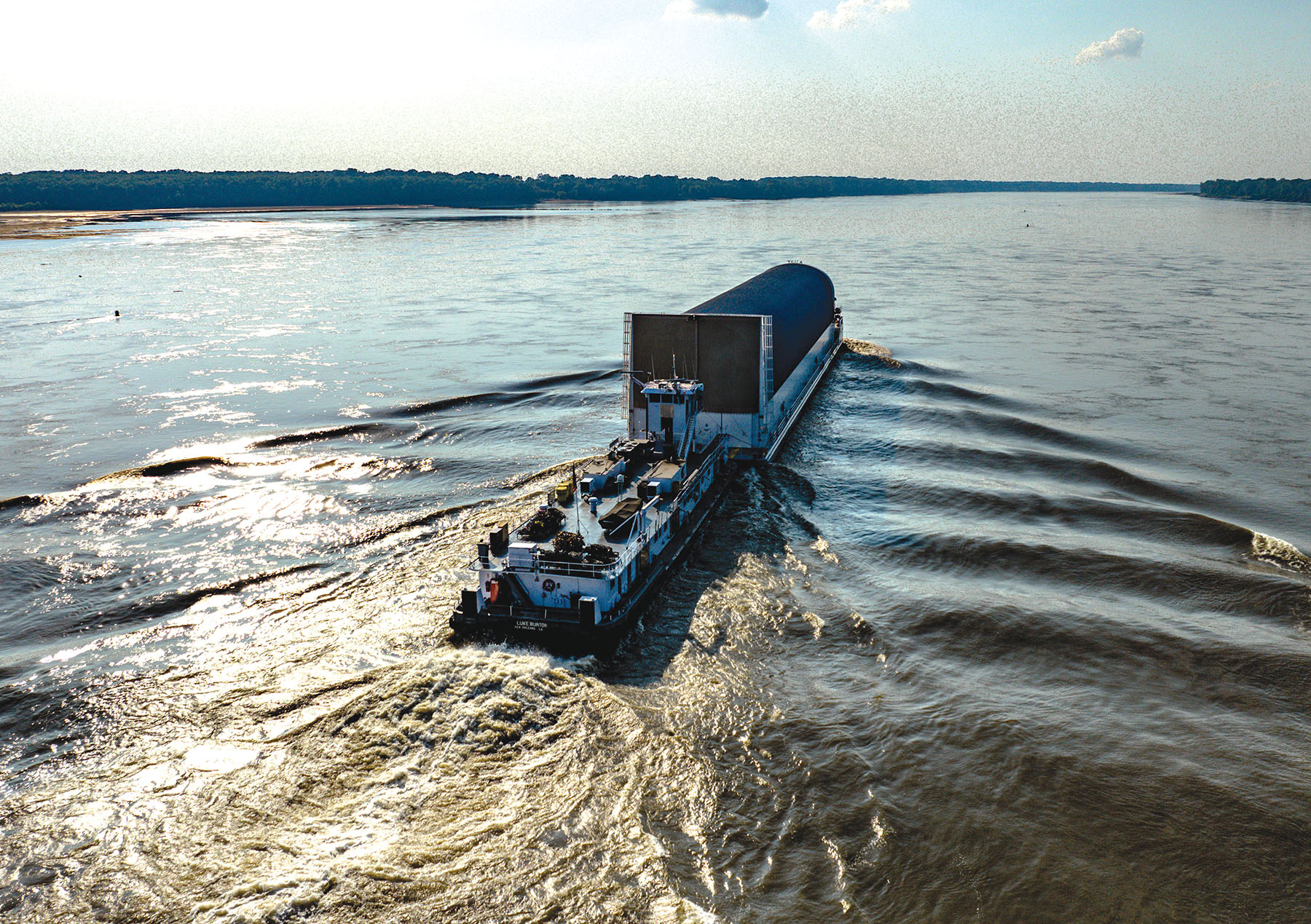
Some of the technology that recently brought four astronauts around the moon and back as part of NASA’s Artemis II mission first took a very different ride – pushed by a towboat on a specially made barge on the nation’s rivers.
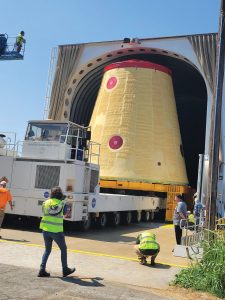
Canal Barge Company has managed the marine transportation of NASA’s Pegasus barge since the 1970s, said Hal Braden, offshore/special projects manager for the Canal Barge Deck Cargo Services Group. NASA cargoes have most recently included Orion spacecraft structures and Space Launch System (SLS) rocket core stages that are key components of the Artemis missions, but the barge has also carried various other rocket stages and the external tanks of space shuttles over the years.
Jim Turner, Canal Barge port captain, said Canal Barge Company uses its own towboats to transport the Pegasus between the Michoud Assembly Facility in New Orleans and the Redstone Arsenal, which includes NASA’s Marshall Space Flight Center, in Huntsville, Ala.
“We are either transporting something from Michoud for testing at Redstone or something from Redstone to Michoud that has been tested,” Turner said.
For moves between the Michoud Assembly Facility and NASA’s Stennis Space Center on the Pearl River in Mississippi, as well as moves to NASA’s Kennedy Space Center along the Banana River in Florida, Canal Barge Company works with a select few third-party towing partners working on the Gulf Intracoastal Waterway and offshore to ensure the Pegasus is transported safety and efficiently, Braden said.
These moves typically take place three to five times a year.
Canal Barge towboats that have been selected for previous moves have included the mv. Susan L. Stall, mv. Lydia Campbell, mv. Ned Merrick, mv. Luke Burton and mv. Elizabeth Lane.
Guntersville Marine Inc. assists with docking at the Redstone Arsenal.
The tow itself is a small one for the route between New Orleans and Huntsville. Typical tows in the region consist of 15 to 30 barges and are 1,200 feet long. The Pegasus barge is one barge and 310 feet long by 50 feet wide, Turner said.
There are some special considerations when the Pegasus barge is in tow, however. The barge has a 50-foot air draft.
“Wind is the biggest concern when towing this barge,” Turner said. “It is fine if we are moving, but when you have to stop along the route and wait for traffic or locks, it has to be well planned to keep the wind exposure to a minimum.”
Crews must keep close track of the weather, including thunderstorms that can produce high winds.
A second concern is the lack of visibility from the towing vessel, an issue overcome by a unique barge feature, remote steering from the wheelhouse on the Pegasus itself.
“This wheelhouse is equipped with a steering station that we remote into, forward facing radar, depth sounder, electronic navigation charts and VHF radios,” Turner said.
Other challenges can include making sure the right vessels are available with the right crews and timing bridge curfews on the Pearl and Banana rivers, Braden said.
Moving these specialized cargoes via the nation’s waterways makes the most sense, though, Turner said.
“The components are often quite large and require the type of protection that the barge Pegasus offers,” he said. “This barge can transport the entire rocket in one move, and the infrastructure that NASA has built at their facilities is specifically designed for loading and unloading the components via waterfront access.”
The Pegasus barge does tend to get a lot of attention from other vessels when in tow, however, with radio traffic asking what is being hauled.
“Everyone is always interested in how we are driving the vessel remotely from the bridge of the Pegasus,” Capt. Jamie Axthelm added. “I feel very fortunate to have been part of some of the redevelopment of the Pegasus bridge throughout the program.”
Axthelm has also become a bit of a “space buff,” with a collection of Space Force attire to prove it.
“Docking the Pegasus at Marshall and Michoud gives a unique sense of accomplishment, knowing that you have completed an important mission for the United States of America,” he said.
When the 10-day Artemis II mission launched April 1, both Turner and Braden said they were able to watch on TV.
“The feeling of knowing that we had a direct impact on making this mission possible was overwhelming,” Turner said.
He added that his sense of accomplishment has been multiplied because two of his sons, Seth and Dylan Turner, have been crewmembers on two of the tows involved. “As a father, this has been one of the most rewarding experiences in my career,” he said.
Braden’s son is 6, but he is enthused, too. He knows “his Dad helps to move rockets for NASA.”
NASA’s Artemis missions call for the eventual return to crewed landings on the moon and the building of a moon base that is part of the expected goal of one day sending flights to Mars.
“It is very satisfying knowing that we are moving components for NASA that will help make the manned flight to Mars possible,” Turner said. “The mariners involved take a lot of pride in making this move.”
Braden said he was “extremely proud to be a part of it in any way, shape or form.”
“Being part of the Artemis program has been an honor,” Axthelm said.”
More than reflecting on their individual roles in helping NASA accomplish the Artemis II mission, however, all three men wanted to use the opportunity as an example of the importance of the maritime industry to the country.
As Turner summed it up, “This is an industry that literally keeps America moving, and every day there are professional mariners working away from their families, doing a job that rarely gets noticed. Simply put, this mission to space could not have happened without the professional mariners making this happen.”