IRPT Director Aimee Andres Outlines Legislative Priorities
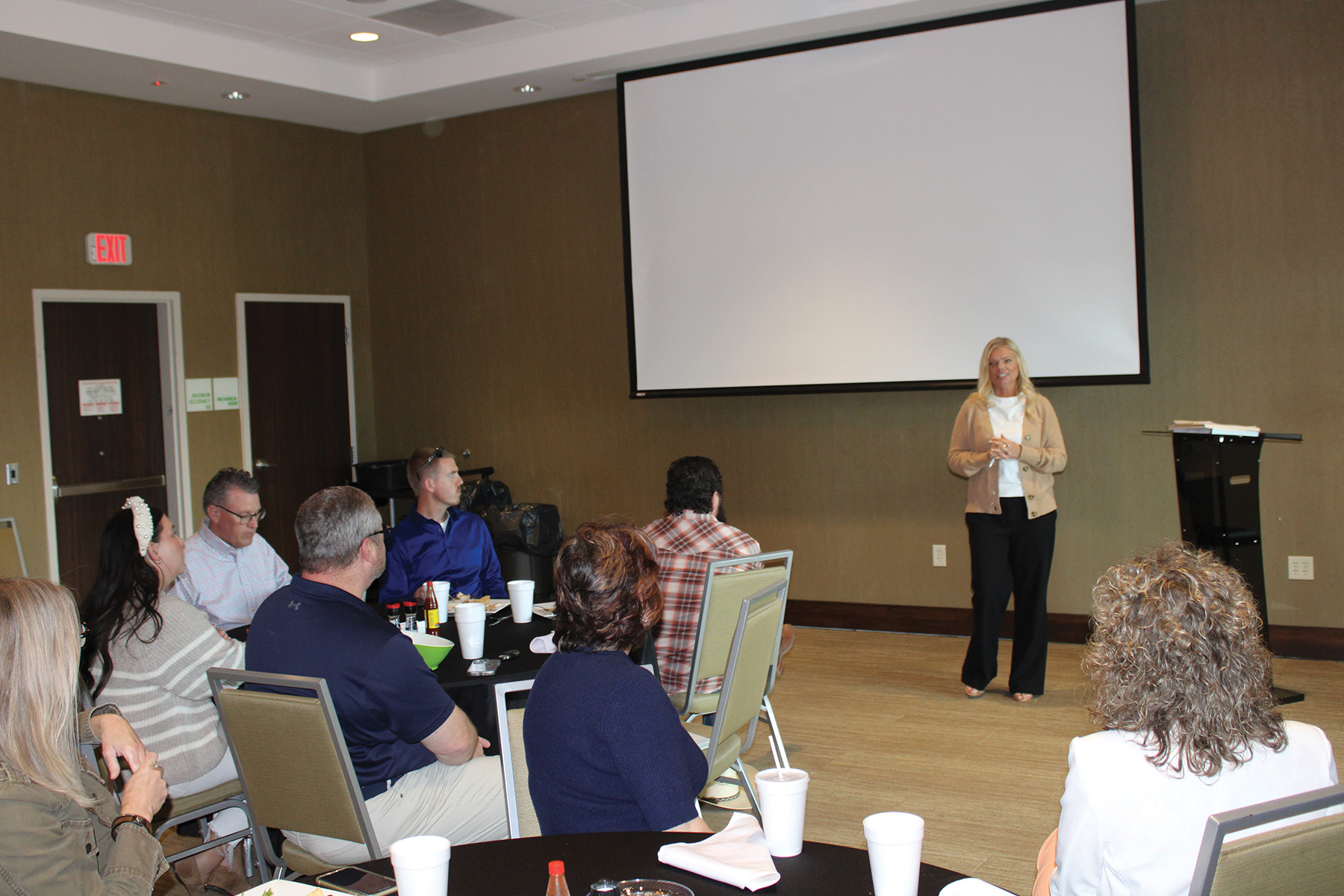
Aimee Andres, executive director of Inland Rivers, Ports & Terminals Inc. (IRPT) detailed the organization’s history, accomplishments and priorities for the future at the April 8 Paducah Propeller Club meeting.
Andres was in town a day before IRPT’s Ohio Basin meeting, held in Paducah April 9. She served as guest speaker for the club’s meeting.
Andres has been in the maritime industry her entire career, and, really, got some of her experience even before that as she observed the work of her father, a terminal operator, port engineer and riverport director in the St. Louis area. When Andres came to IRPT in 2013, it was essentially a social networking group, but the president at that time told her, “This is going to be what you make it.”
So, over time IRPT’s mission has expanded to include education, business development, legislative affairs and funding opportunities under its umbrella.
“When I could make that conscious decision on what I could do as an adult, I knew it was to provide resources to folks like you, private terminal operators and public port directors,” Andres said.
Business Development
Her favorite role, she said, is in business development. One key tool for that is on IRPT’s website, where the organization has mapped out 700 member facilities. Clicking on the facility provides a menu of additional information, including an aerial view of the property, the capabilities of each site and contact information.
A recent initiative is that IRPT is organizing a 10-day trip for members to Europe to attend the Breakbulk Europe conference, which Andres said typically draws about 11,000 shippers. The tour also includes stops at ports, including Duisburg, in Germany, the largest inland port in the world, and at a new, 66-mile-long manmade canal. A North American booth has also been reserved for the conference.
“We’re letting them know our members are open for business and welcoming of your cargo,” Andres said.
Legislative Affairs
Turning to its legislative activities, IRPT also had an instrumental role in 2019 in the establishment of the federal Small Shipyard Grant Program set aside within the Port Infrastructure Development Program, Andres said.
“One of our members said, hey, I can’t compete with LA and Long Beach anymore. I have improvements that I need at my property, and I can’t compete with them. Do something about it.”
Before Andres wrote a bill calling for the set aside, no money was going to small and inland port projects for infrastructure, she said. Since the program was funded in 2020, she said, $601 million has gone to small ports and terminals, both public and private.
Addressing upcoming legislative priorities, Andres noted that for the first time ever, the U.S. Department of Transportation (DOT) is developing a national freight plan that will help to determine how freight moves in and out of communities. One thing that concerns Andres, however, is that to develop that plan, the government determined it would look at public ports that carry a certain amount of tonnage.
“Fun fact,” she said. “We have 335 public ports in the nation. Only 100 or so are on the map. We have tens of thousands of private terminals that are moving the nation’s freight, and zero of them are on the map.”
At the same time, she said, short-line railroads are on the map, which means the government can’t say it isn’t planning for privately owned entities as those are privately owned.
“These facilities are moving cargo, but if we’re not going to consider how their freight intercepts with our community, we are doing a disservice to our community.”
Additionally, she said, “Whether I handle 1.5 million or 1.4 million tons, that is still 62,000 trucks that are moving in and out of that stoplight. You know which stoplight I’m talking about, the problem stoplight in every one of our communities.
“So what we’re saying,” she continued,” is “Dear Department of Transportation, we matter. Large and small, private and public, our freight matters, so when our metropolitan planning organizations are prioritizing freight movement and discretionary funding, we should be included.”
She asked those present to call their legislative representatives and to ask them to call the DOT. “Tell them we matter,” she said.
Additionally, Andres drew attention to President Donald Trump’s call to restore America’s maritime dominance and the recently released Maritime Action Plan. That plan calls for Maritime Prosperity Zones, which are expected to look much like the existing federal Opportunity Zones.
Those zones would include potential for tax incentives and regulatory relief, Andres said. The regulatory relief, in particular, could be useful in building shipbuilding and ship-repair facilities, she said. However, she noted that the plan calls for only 100 Maritime Prosperity Zones.
“The state of Kentucky alone has 144 Opportunity Zones,” she said. “So if we going to mirror MPZs after Opportunity Zones, our state of Kentucky and more specifically this region is going to be forgotten.”
She added, “You can see you are off the map. You’re not being in considered in all the regulatory and legislative discussions.”
In concern to what IRPT is asking for to be included in the 2026 Water Resources Development Act, Andres also mentioned that IRPT is calling for the implementation of section 1154(A) within the 2018 WRDA that called for the Corps of Engineers to create a searchable and downloadable list of projects that have been authorized but not constructed. That list was to have been created by 2020 and updated every two years, but that has not occurred, Andres said. As a result, she said, it is impossible to fund the full backlog of projects because the Corps doesn’t have that list available. It is known to be large, however, as Andres said the backlog in the Mississippi Valley Division alone has been determined to be $7 billion.
“We are pushing for the implementation of that so that we know and that we can make better decisions moving forward,” she said.
Bringing inland interests together will be key, Andres said, which is why another major point was the need for an Inland River Transportation Caucus within Congress “that will all have our back. While various federal committees exist to advise on policy, they don’t always have inland interests at top of mind, she said, noting that on the Coast Guard’s Maritime Transportation and Infrastructure Committee, for example, of 16 committee members, only one has an inland background.
“You need the entire Congressional delegation fighting for you, here on the Ohio River and more specifically in this region, to make sure that your private terminals are being considered and that your boat companies, your repair facilities, your construction facilities are being considered,” Andres said.
She added that IRPT has already gotten a sponsor for a bill that would create the caucus and is approaching other potential sponsors.
Featured photo caption: Aimee Andres, executive director of Inland Rivers, Ports and Terminals, Inc., addresses the Paducah Propeller Club April 8 in Paducah, Ky. (Photo by Shelley Byrne)