SCI, Corps Announce Simulation Partnership
The Seamen’s Church Institute’s Center for Maritime Education (CME) has established a new partnership with the U.S. Army Engineer Research and Development Center (ERDC) in Vicksburg, Miss.,, with the goal of improving maritime training, advancing ship simulation technology and enhancing safety across the nation’s waterways.
The collaboration, formalized through a recent Memorandum of Agreement by the U.S. Army Corps of Engineers (USACE), is the result of ongoing conversations with mariners, industry leaders and federal partners over the past several months. What began as casual discussions on the margins of maritime events evolved into a shared vision: combining the strengths of both organizations to better serve the maritime community.
Mariners, companies and industry partners played a key role in shaping the partnership. Their feedback highlighted both the value of ERDC’s realistic environmental modeling and SCI’s high-fidelity tow-simulation capabilities, as well as the need for improved access to project data, such as bathymetry, current patterns and environmental conditions. Rather than viewing each organization’s capabilities as competing approaches, both recognized an opportunity to integrate them, potentially creating more effective, realistic training tools that better reflect real-world conditions.
Under the agreement, CME and ERDC’s Coastal and Hydraulics Laboratory will work together to improve ship simulation technologies, broaden access to quality training and support USACE navigation project design and delivery. By sharing knowledge, tools and facilities, the partnership will boost simulation capabilities, sharpen project design and speed up innovation in the maritime sector. This partnership also helps USACE modernize infrastructure planning and delivery through advanced simulation tools, increasing efficiency, improving results and enhancing safety.
“We’re excited about this partnership because it shows what’s possible when mariners and maritime engineers work toward a shared goal,” said Capt. Stephen Polk, director of CME. “By combining our strengths, we’re building better training tools that help mariners operate more safely and effectively. At its core, this effort is about impact. Better data leads to better simulations, better simulations lead to better-trained mariners and ultimately safer waterways for everyone.”
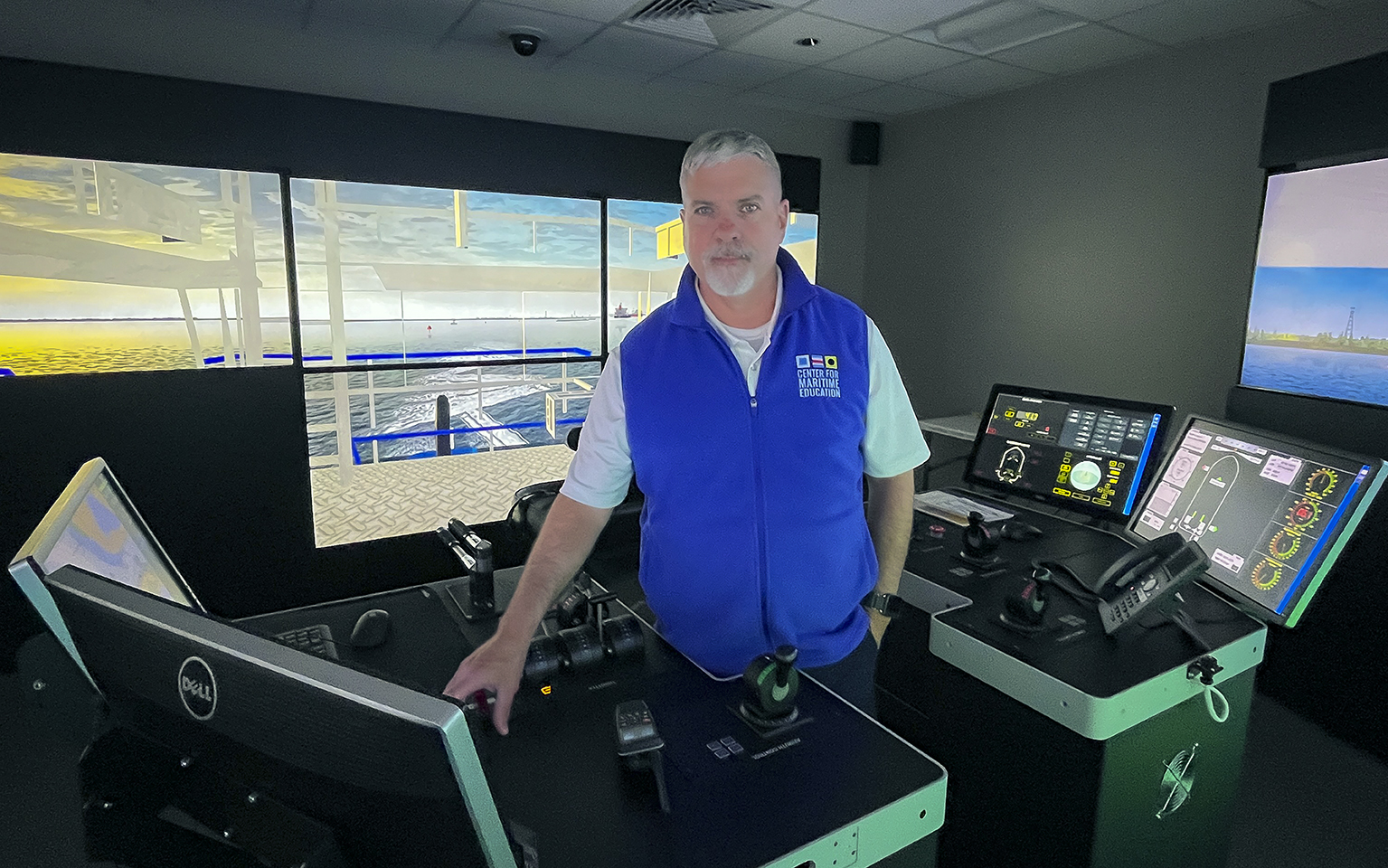
Featured photo caption: Capt. Stephen Polk—Director, Center for Maritime Education, Seamen’s Church Institute—in the simulator classroom in Houston, TX. (Photo courtesy of SCI)