

The Delta Queen Becomes The Darling Of The Inland Rivers
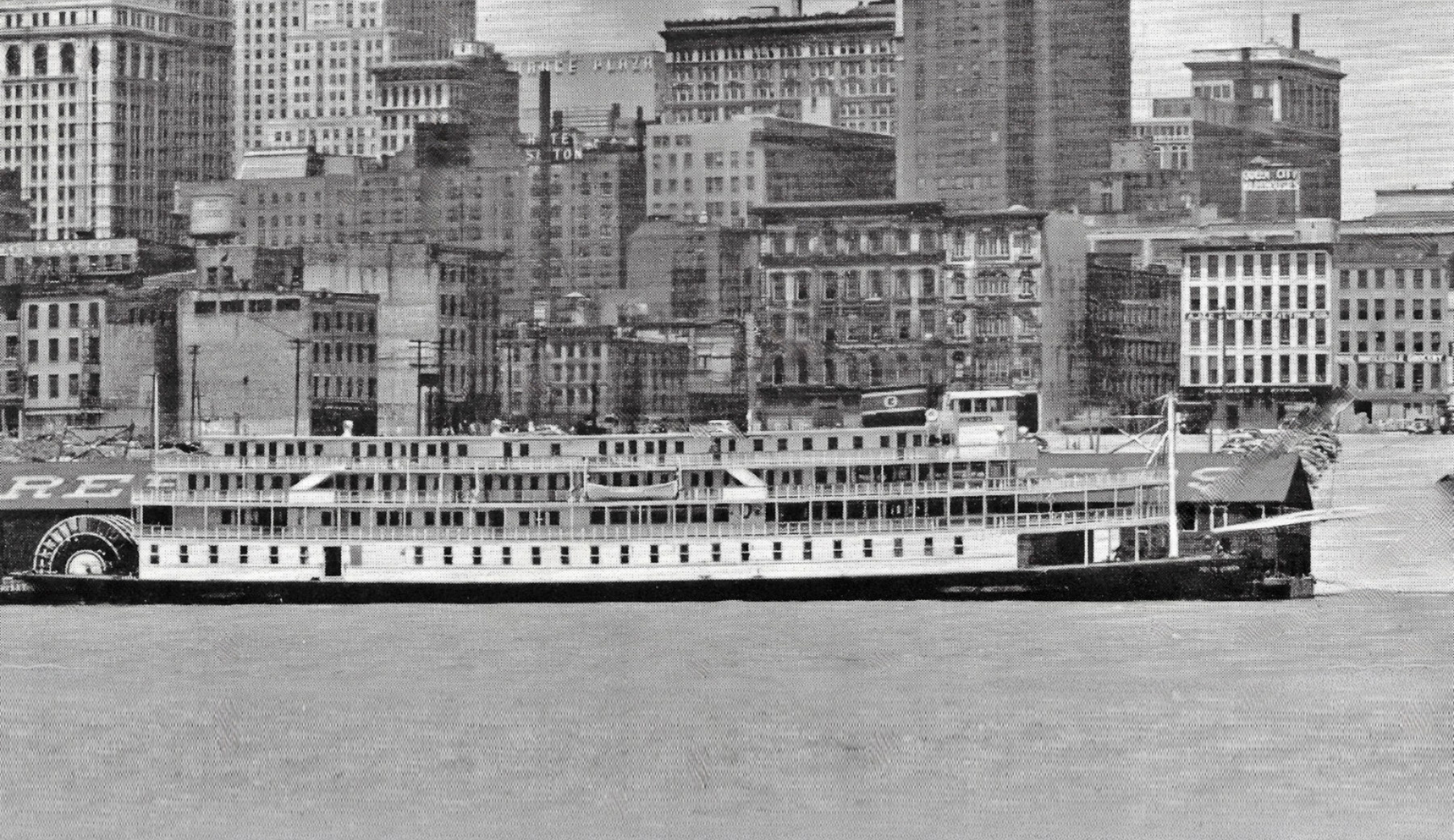
When the Delta Queen departed the Dravo Marine Ways at Neville Island, Pa., on February 28, 1948, after a six-month rebuilding program, the appearance of the boat had been dramatically altered. The navy gray paint was replaced by bright white, the cover over the sternwheel had been removed, the original deck house on the bow had been removed, and promenades had been added to the two decks above. The smokestack had been shortened and streamlined to give the boat a more “modern” look, but the white “G” remained on the sides to signify it was in the fleet of Greene Line Steamers.
Many other modifications had been made to the interior of the boat. Capt. Fred Way, in his book “Saga of the Delta Queen,” says that it “went to Dravo’s very much of a question mark, and she emerged every inch a steamboat.” Way and Capt. Jesse P. Hughes piloted the big boat to Cincinnati from Neville Island, arriving there at 6 a.m. on March 1, 1948. Over the next few months, the cabins and public spaces were furnished and decorated, and Way documents that on June 30, 1948, it departed Cincinnati on a round trip to Cairo, Ill., “thus inaugurating vacation voyages aboard the finest river steamer ever entered in such service.”
Capt. Mary B. Greene, whose husband, Capt. Gordon C. Greene, had founded the company in 1890, virtually lived aboard the Delta Queen and passed away in her stateroom on April 22, 1949. Her son, Capt. Tom R. Greene, died soon after, on July 10, 1950, following his removal from the boat after suffering a heart attack near Evansville, Ind. He was the head of the Greene Line, and it was his dream that had brought the Delta Queen from California to the Western Rivers.
Tom Greene’s wife, Mrs. Letha C. Greene, continued to operate the Delta Queen as it roamed the Mississippi River system and gained a dedicated following. In the late 1950s, the company was not doing well financially, and ads appeared in The Waterways Journal offering the boat for sale. The upshot of this was that Californian Richard Simonton purchased a controlling interest in the Greene Line, with Mrs. Greene remaining as president. The new arrangement allowed the boat to continue operating, and subsequent ad campaigns bolstered the popularity of the vessel. The radio call sign of WA 4141 was familiar throughout the inland rivers.
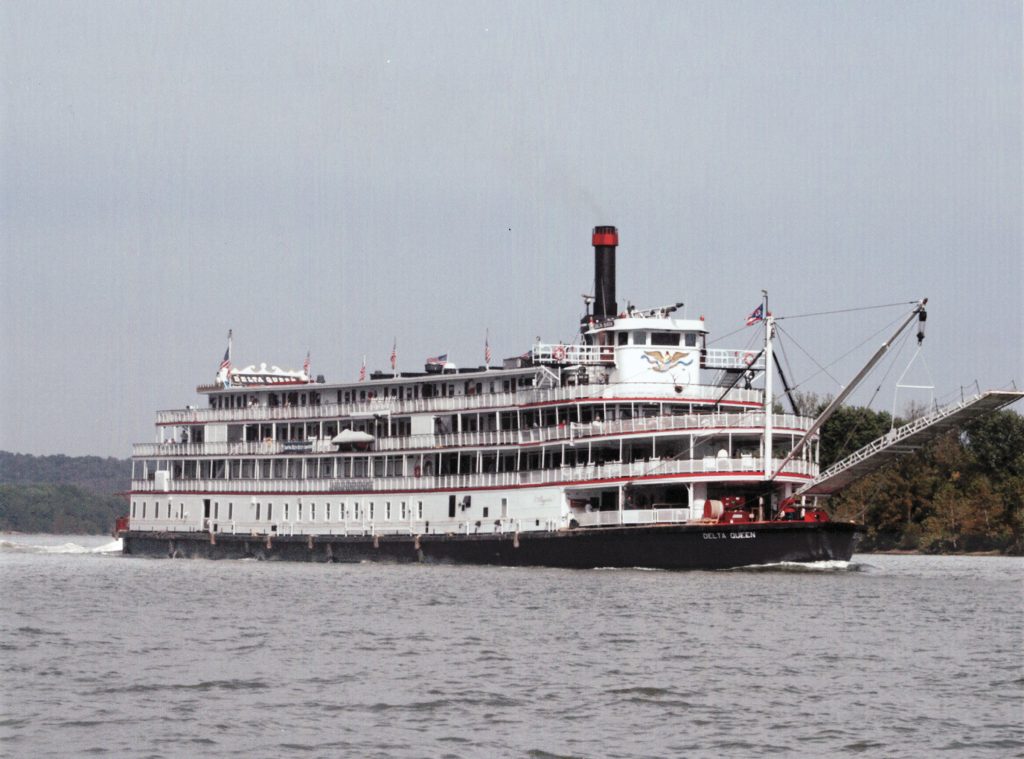
Changes continued to be made to the big boat over the years. The stern splashboard went through several changes of color from green to white to red. The streamlined smokestack did not work well, and it was replaced with a larger, two-stage cylindrical stack. A calliope was placed on the roof and came to be much enjoyed by the throngs that would meet the boat at landings along the way. The bridge wings that were once located behind the pilothouse were moved forward, and side doors were inserted on the structure. The pilot wheel was removed inside the pilothouse and replaced by two steering levers. This necessitated a change in the front windows, resulting in the removal of two in the center, replaced by one larger frame.
After the tramp excursion steamer Avalon quit business after the 1961 season, many crewmembers from that boat found their way to the Delta Queen. These included Capt. Ernest E. Wagner, who would serve as master for many years, becoming the very face of the boat. Capt. Clarke C. “Doc” Hawley was another, and eventually deckhand Don Sanders, who later became mate and master himself. The boat came under the threat of the Safety of Life at Sea Law (SOLAS) that would not allow passenger vessels with wooden cabins to operate.
A successful “Save the Delta Queen” campaign, spearheaded by Betty Blake, finally secured a congressional exemption for the boat in 1970. The Greene Line had been purchased by Overseas National Airways. Ownership changed several times over the years, even to the Coca Cola Company at one point, operating the boat under the Delta Queen Steamboat Company, New Orleans.
Many alterations continued to be made to the boat in efforts to make it as safe as it could possibly be. A new hull was placed around the original hull in about 1991. The stack became a towering skinny pipe that could be lowered for low bridges. The Delta Queen was being operated by Majestic America Line in 2007 when it was announced that the boat would cease running after the 2008 season due to the most recent exemption from SOLAS expiring and Congress seeming unwilling to enact another.
In 2009, the Delta Queen journeyed to Chattanooga, Tenn., under its own steam. There it became a floating hotel and restaurant until closing in December 2014. In 2015, under the ownership of a newly formed Delta Queen Steamboat Company, the boat was towed to Houma, La. On November 27, 2018, Congress did vote to reinstate the exemption from SOLAS for the Delta Queen. The new company has so far been unsuccessful in obtaining funds to restore the historic vessel to operation and in June 2025 offered the boat for sale.
The Delta Queen, at age 99, remains tied up in Houma, La., looking somewhat bedraggled yet very much intact. It is certainly hoped that some new owner will come forth to ensure that the boat is preserved, at least in some form.
Featured photo caption: Capt. Fred Way referred to the Delta Queen’s arrival as “the bride upon her arrival in Cincinnati” in March 1948. (Andrew Lodder photo used for advertising by Greene Line Steamers)