U.S. Waterways: The World’s Envy — And The World Is Catching Up
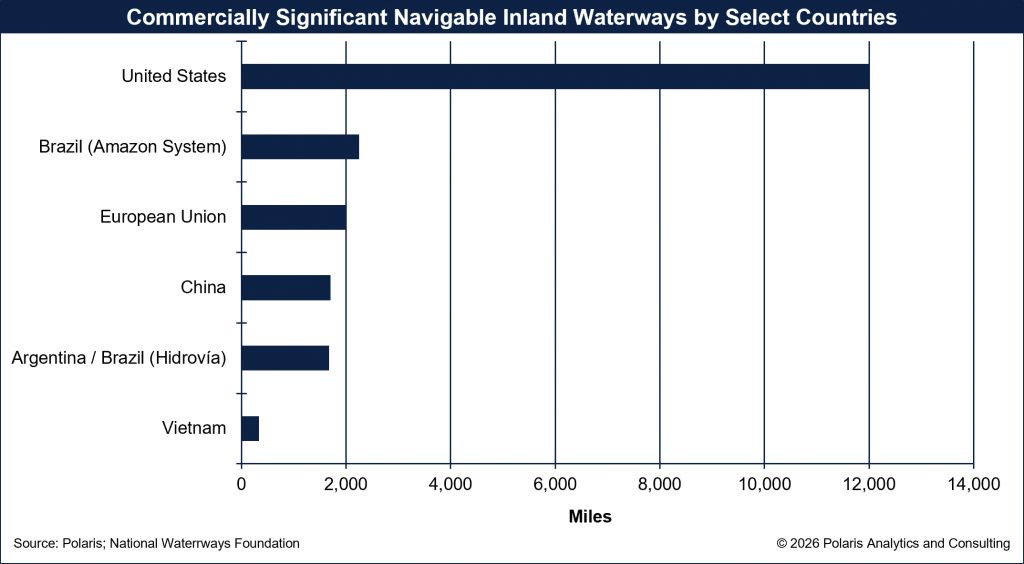
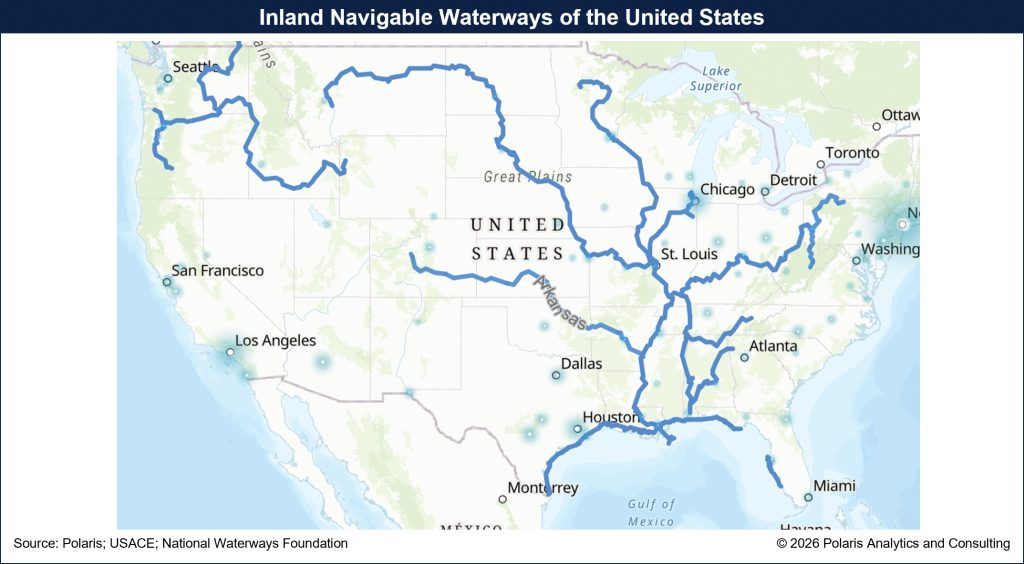
As the United States marks 250 years of American independence, the Mississippi River System remains a testament to visionary leadership and engineering ingenuity. Spanning more than 12,000 miles of commercially navigable inland waterways, with a drainage basin covering parts of 31 states and two Canadian provinces, it supports navigation to 21 states. The broader U.S. inland and intracoastal system encompasses about 25,000 miles and includes roughly 237 lock chambers. It moves approximately 465-630 million tons of cargo annually — valued at over $158 billion — including a large share of U.S. grain exports.
Industry Invested In Waterways
Commercial barge operators contribute through a diesel fuel tax deposited into the Inland Waterways Trust Fund (IWTF), which now covers 25% of construction and major rehabilitation costs under the Water Resources Development Act (WRDA) of 2024 (shifted from the prior 35% share to accelerate project delivery amid a multi-billion-dollar backlog). The remaining 75% comes from federal general revenues, while routine operations and maintenance (including most dredging) remain 100% federally funded.
Many locks, built during the 1930s Great Depression as public works (core Upper Mississippi 9-foot channel project largely completed in about eight years), are aging. Upgrading to modern 1,200-foot locks under initiatives like the Navigation and Ecosystem Sustainability Program (NESP) faces ongoing funding and delivery challenges and delays.
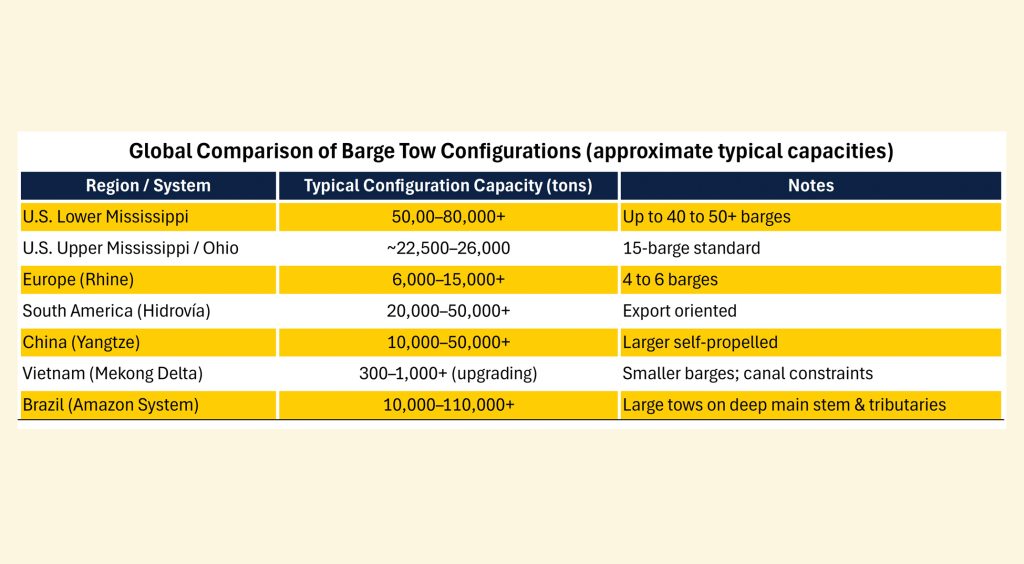
America’s inland waterways pioneered massive-scale operations. Powerful towboats (commonly 6,000 to more than 10,000 horsepower) push integrated tows of 15 barges standard on locking rivers (about 22,500 to 26,000 tons of cargo) and 25 to more than 40 barges (50,000 to more than 80,000 tons) on the open Lower Mississippi. This scale delivers unmatched economies for bulk commodities like grain, coal and chemicals.
Imitation Imagined And Instituted
As the old adage goes, “Imitation is the sincerest form of flattery.” Nations worldwide are paying the U.S. system this compliment through aggressive investments and adaptations of its model. Yet flattery alone will not sustain the U.S. edge — and it cannot rest on past laurels.
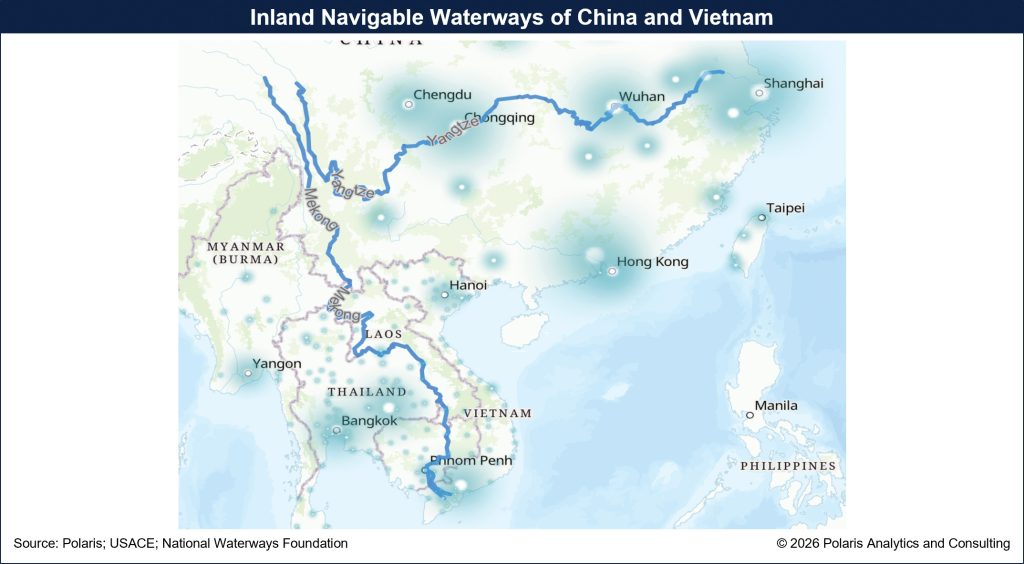
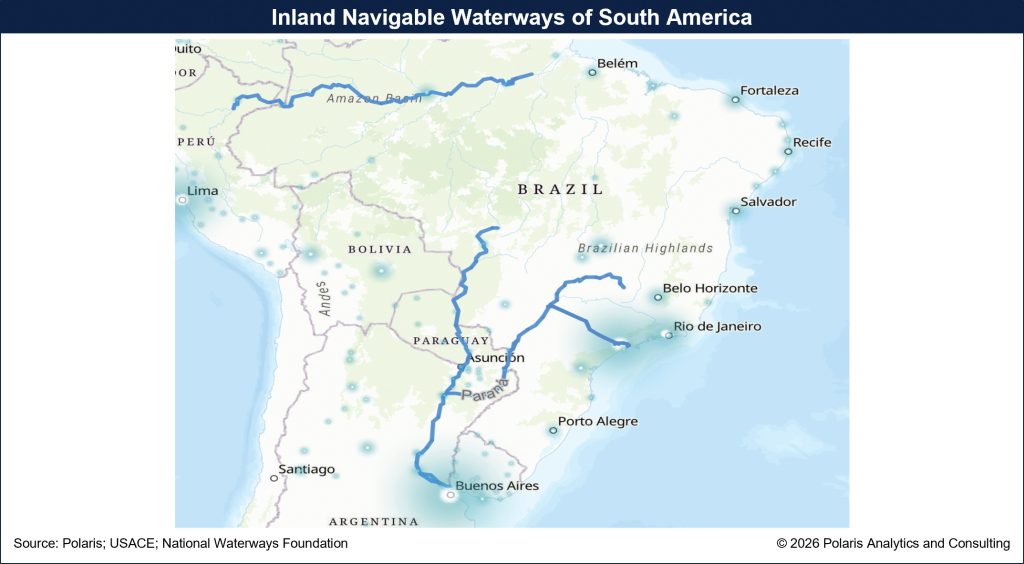
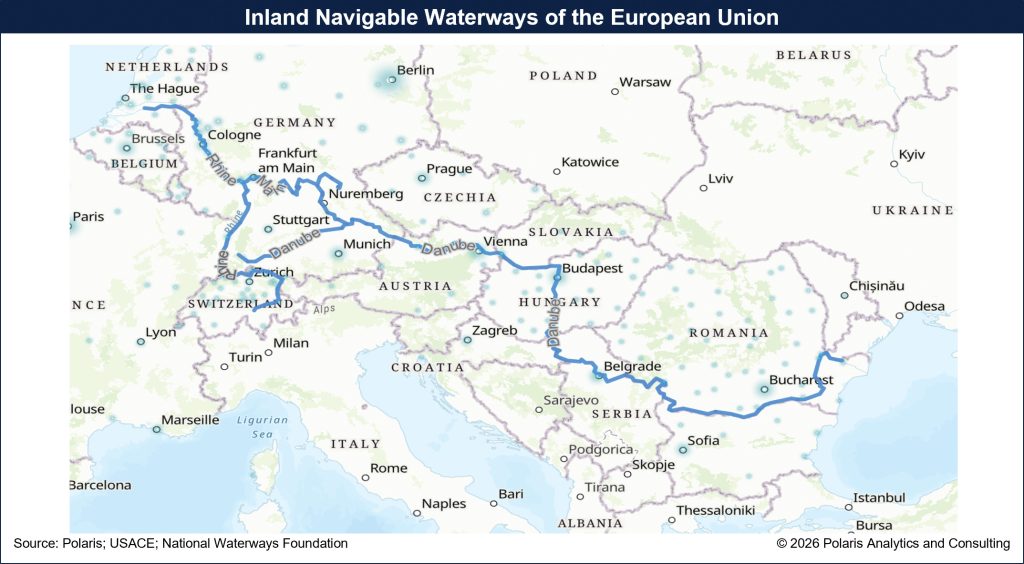
The reach of navigable waterways in select countries is shown in the accompanying figure where Brazil, a prominent competitor to U.S. corn and soybean exports, has more than 2,000 miles of inland waterways on the Amazon River System while sharing nearly 1,700 miles with Argentina on the Paraguay-Paraná Hidrovía. Across Europe, there are about 2,000 miles of navigable waterways.
In South America, the Paraguay-Paraná Hidrovía supports large tows optimized for soy and mineral exports, while Brazil’s vast Amazon River System — including the Madeira and Tapajós tributaries — leverages enormous natural depths for growing bulk traffic with push convoys that can exceed 100,000 tons in some operations. It should be noted that some of the towboats and barges operating on the Hidrovía were exported to Argentina from the U.S. during the early 2000s.
In Europe, the Rhine and Danube systems operate differently, with smaller, more flexible push convoys or self-propelled vessels (typically four to six barges, 6,000 to more than 15,000 tons) suited to narrower channels, frequent locks, bridges and canals. Projects like France’s Seine-Nord Europe Canal (costs approaching €7–8 billion) build on historical ambitions dating to Napoleon to enhance multimodal connectivity.
China’s Pinglu Canal, a roughly $10 billion river-to-sea link, is set to open in 2026, shortening routes for inland cargo.
Vietnam, with its extensive Mekong Delta and Red River networks, is rapidly modernizing smaller self-propelled barges and canals to support rice, seafood and container traffic through government-led investments aided by international partners.
Mexico advances its multi-billion-dollar Interoceanic Corridor of the Isthmus of Tehuantepec as a land-based complement to the Panama Canal.
Even in the Black Sea–Aegean region, the 2025 Black Sea–Aegean Sea Corridor Platform (BACP) coordinates infrastructure improvements among Bulgaria, Greece and Romania.
A comparison of barge tow configurations by select regions and systems is shown in the table. The U.S. and South America move the largest number of barges and volume at a time. Such efficiencies allow for lower per-unit costs by moving cargo to market position. Elsewhere, the economics of scale diminish and, likely, lead to higher per-unit costs as compared to the U.S. and South America, though lower than other surface modes in those countries.
Inland Navigation Cost Advantages
While per-ton costs remain competitive across systems (often 0.5–3 cents per ton-mile, far below truck or rail for bulk), U.S. scale on open rivers provides tremendous efficiency. Yet global competitors invest heavily in infrastructure — public-led in Europe, China, Vietnam and Brazil’s Amazon region — with targeted modernization grants, highlighting the need for sustained U.S. commitment.
Without full funding for lock rehabilitation, new construction and maintenance — paired with streamlined permitting, regulatory reform and attention to environmental processes — delays will continue to mount, costs will rise, and the U.S. competitive advantage in feeding and fueling the world will erode.
History Is The Guide To The Future
History offers a clear warning — and timeless guidance. Prompted by his observations of the Mohawk Valley in the fall of 1783, George Washington wrote: “I could not help taking a more extensive view of the vast inland navigation of these United States and (the) importance of it, and with the goodness of that Providence, which has dealt (its) favors to us with so profuse a hand. Would to God we had the wisdom enough to improve them.”
The apostle Paul knew Ephesus as a prosperous port city until its channels silted in, and priorities shifted (including its religious allegiances), leading to decline. Lack of investment in critical infrastructure invites lost opportunity.
As the U.S. celebrates 250 years of independence, it is appropriate to honor the visionaries who harnessed the waterways. From the Erie Canal — championed by DeWitt Clinton and completed in 1825, slashing freight costs dramatically and binding East to West — to the systematic development of the Mississippi River System, early American leaders understood that reliable inland navigation would drive growth, fuel industry and secure the nation’s future.
Organizations like the Waterways Council, Inc. (WCI) and National Waterways Foundation provide detailed analyses, advocacy and research-backed plans to modernize the system. America’s inland waterways remain the envy of the world. The world is acting decisively. The question is whether the U.S. will match — and exceed — that ambition to sustain our God-given advantages.
Looking over the horizon, there is a need for strategic, sustained investment today for prosperity tomorrow.