

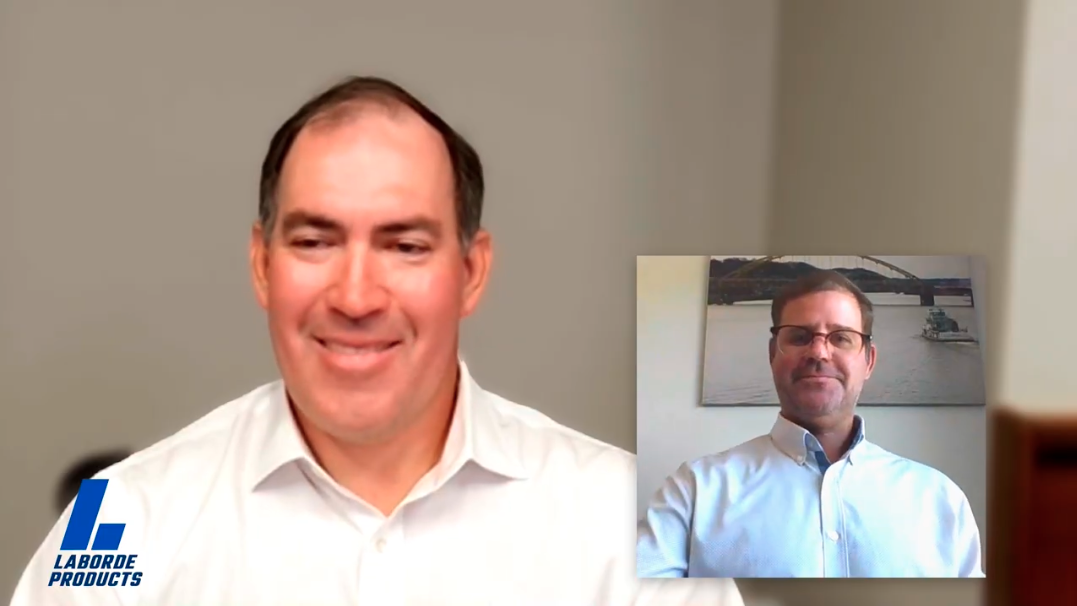
WJ Talk: Brian Laborde On Mechanical Engines, Repowers And Marine Technology
Brian Laborde, president and CEO of Laborde Products, joined Zac Metcalf, associate publisher and editor of The Waterways Journal, to discuss the company’s history, engine technology, service network and outlook for the inland marine market. Laborde joined the family-owned company about 15 years ago after working in the inland towing and liquid barge industry.
Editor’s note: This interview has been edited for length and clarity.
The Waterways Journal: Tell us about your background and Laborde Products.
Brian Laborde: My background is in finance, but my career led me into marine operations. I worked in Houston for an inland towing and liquid barge company that was a Laborde Products customer. That gives me a unique perspective because I was a customer before joining the company.
My father started Laborde Products in 1998 after acquiring a small engine company. His goal was to build an engine company focused on the commercial marine market. I joined about 15 years ago, bringing an operator’s perspective and a desire to create a company that truly partners with the industry.
We represent several engine manufacturers. Mitsubishi, our largest brand, provides rugged, heavy-duty engines well suited to the inland marine industry. We also represent Austria-based STEYR Engines and Sweden-based Scania, whose higher-speed engines are used predominantly in planing-hull applications.
We also work with the Navy on high-speed craft and are involved with autonomous uncrewed surface vessels, or USVs. That is a lesser-known but complementary part of our business.
WJ: How did Laborde’s relationship with Mitsubishi begin?
Laborde: When my father acquired the company, it represented Yanmar recreational engines. He traveled to Japan hoping to bring Yanmar’s commercial engines to the United States, but encountered resistance.
During the same trip, he met with Mitsubishi. Although Mitsubishi knew about his relationship with Yanmar, which is a fierce competitor in Japan, its management supported his goal of introducing another commercial engine to compete with Caterpillar and Cummins in the U.S. market.
WJ: What distinguishes Mitsubishi engines in inland marine applications?
Laborde: Mitsubishi engines are heavy, well built and have considerable displacement relative to their horsepower. Another important distinction is Mitsubishi’s focus on the U.S. marine industry.
As the engine market shifted toward electronics, Mitsubishi asked us what our customers wanted. Our engines were mechanical, with no computers or electronic controls, and our customers wanted them to remain that way. Mitsubishi listened.
We still offer a completely mechanical engine line, including Tier 4 engines without onboard computers. We are now working to combine the advantages of that mechanical design with technology that can support operators in the future.
WJ: How does Laborde participate in the design and construction of new vessels?
Laborde: The process begins when an operator first considers a new vessel. For years, repowers drove our business. Several years ago, however, we reached an inflection point and began being selected more frequently for new construction. That trend has continued, and we now have a strong presence in the inland new-construction market within the horsepower ranges we serve.
The operator is the final decision-maker, but naval architects, shipyards and vessel crews are also involved. We work with all of them. Our goal is to be flexible and easy to work with while helping deliver the best vessel possible.
WJ: What factors determine whether an operator repowers an existing vessel or builds a new one?
Laborde: The primary factor is economics. Many customers historically followed regular construction programs, adding vessels annually while selling older assets.
That has shifted as construction costs have increased. The revenue an operator can earn with a vessel must support the cost of building it. Until the market catches up with the cost of new assets, we expect operators to continue extending the lives of vessels that previously might have been sold. We are seeing more repowers and major rebuilds of older equipment.
WJ: How have Subchapter M and Tier 4 requirements affected your business?
Laborde: Subchapter M has brought more planning and structure to vessel maintenance. Previously, many engine replacements were reactionary: An engine failed, and the operator had to respond immediately.
With vessels entering scheduled inspection cycles, we can sit down with operators and discuss what should happen when each vessel comes in. Should it be repowered? Should the engines be rebuilt? That structure helps customers plan and budget for the work.
WJ: How are you expanding service and parts support?
Laborde: We operate facilities in Covington, La.; Deer Park, Texas; and Paducah, Ky., with technical teams at each location. Our customers, however, operate from Maine to South Florida, throughout the Caribbean and across the eastern inland waterways.
We are strategically positioning parts inventories and expanding our dealer network, which now includes more than 30 dealers. Dealers must maintain trained technicians and parts inventories. The objective is to put support closer to customers because downtime costs money.
We also train customers’ vessel and shoreside personnel. Rather than trying to control every service interaction, we want customers to be as self-sufficient as they choose. If they can complete a straightforward repair, our team will support them so they can return to work quickly.
WJ: How will technology complement your mechanical engines?
Laborde: A mechanical engine avoids many electrical and computer-related problems, but it does not generate the same data as an electronic engine. We are developing a monitoring system that overlays the engine and uses telematics to report its condition.
That information could help operators refine maintenance, identify developing problems and intervene before damage becomes catastrophic. It will also help us identify operating and engine-performance trends that we cannot see today.
Much of the industry’s maintenance guidance is based on averages, but every vessel and operating environment is different. A boat pushing 10 barges has different demands than one pushing 30. We want to use operating data to help customers customize maintenance and extend engine life.
WJ: Can technology from the USV market transfer to inland marine operations?
Laborde: Absolutely. In the USV market, we work with autonomy, cameras, infrared systems and other technology. The inland industry has an opportunity to incorporate many of those tools.
The objective is not necessarily to replace mariners or eliminate jobs. Technology can improve efficiency and give operators better information. What we are learning in the autonomous vessel market should be applicable as artificial intelligence and other tools are integrated into inland marine operations.