

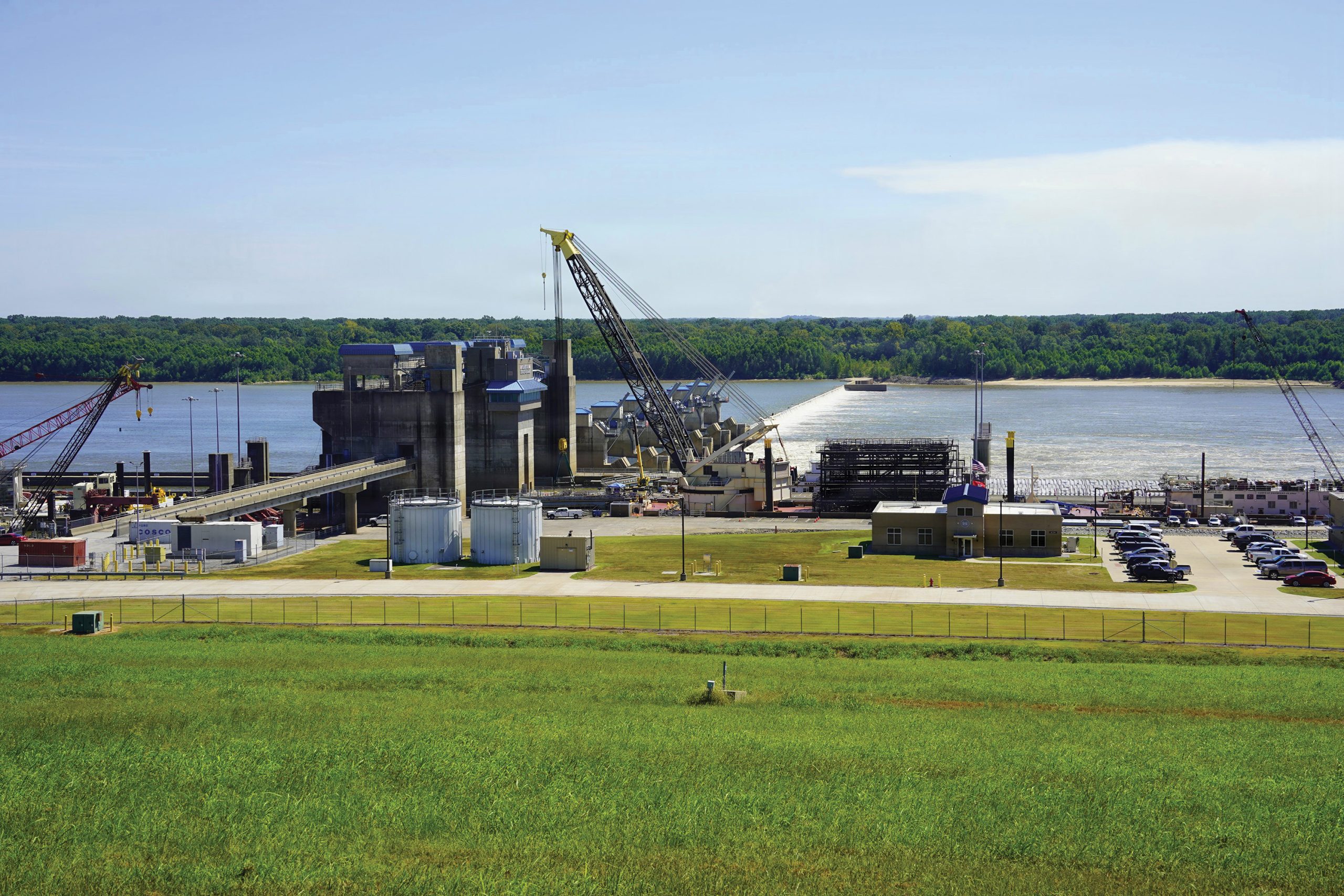
Repairs At Second Olmsted Chamber To Begin
Unscheduled repairs to the land-side lock chamber at Olmsted Locks and Dam have been completed, with scheduled work in the river-side chamber to take place October 5 to November 13.
During a routine preventive maintenance inspection August 11, Olmsted mechanics noted a deficient miter gate anchoring pin in the land-side chamber, said Brad Stout, chief of locks and dams for the Louisville Engineer District. The chamber was closed until repairs could be scheduled.
“The anchorage pin is a critical component in the anchorage system of the miter gate that pins the miter gate to the anchor arms that hold the system to the lock wall,” Stout said. “The Louisville District immediately coordinated with the Regional Rivers Repair Fleet (R3F) to identify available floating plant assets and crews to support the repair while minimizing impacts to other ongoing and upcoming major maintenance projects throughout the region. The repair work required support from the DB Shreve to hold the miter gate as the repair crew disassembled the anchor arms and replaced the anchor pin.”
Repairs began September 9 and involved a gudgeon pin in the lower miter gate. Those repairs were completed September 16, with the lock going back into service September 17.
The upcoming work on the river-side chamber was part of the Fiscal Year 2027 budget package.
“Part of the scope of work for this project will be the same as the land chamber repair work to replace the anchor pins,” Stout said. “Additional work is to change out the hydraulic cylinders that operate one filling valve and one emptying valve as well as a maintenance dewatering to inspect and make structural repairs to the miter gates.”
The riverside chamber was last dewatered in 2017.
“Olmsted Locks and Dam was placed into service in 2018; however, the lock chambers were constructed in the mid-2000s,” Stout said. “The Olmsted lock chambers are routinely submerged during high-water events, which causes additional wear to operational equipment and components once the chambers are placed into service. This, combined with the increase in lockages resulting from extended periods of low water over the previous four to five years, has contributed to the degradation of the miter gate anchorage pins at Olmsted.”
Olmsted Locks and Dam is located at Ohio River Mile 964.4, 17 miles upstream of the Ohio River’s confluence with the Mississippi River. Its location makes it one of the busiest lock and dam facilities on the inland waterways system.
Stout said that routine and preventive maintenance are vital to ensuring that operational impacts are minimized at lock and dam projects because it allows the Corps to ensure that equipment is performing as designed as well as to troubleshoot any issues before they become more significant.
He said the closure of the river-side chamber could impact transit times, depending on river conditions, as the upbound approach to Olmsted can be difficult.
“However, with the land chamber being a 1,200-foot chamber, the navigation industry will not have to double lock,” he said.
Additionally, during the project, industry will be performing self-help to assist with making the upbound approach to minimize any lockage delays.
The wicket dam at the site was lowered at the time Stout spoke with The Waterways Journal, meaning traffic was passing freely. However, a falling river meant the possibility of raising them within days, which would require all navigation traffic to pass through the land-side chamber.
Featured photo caption: The Louisville District and Regional Rivers Repair Fleet completed repairs to the land-side chamber September 16 at Olmsted Locks and Dam but begins work October 5 on the river-side chamber as part of a scheduled dewatering. (Photo by Abby Korfhage/Louisville Engineer District)