

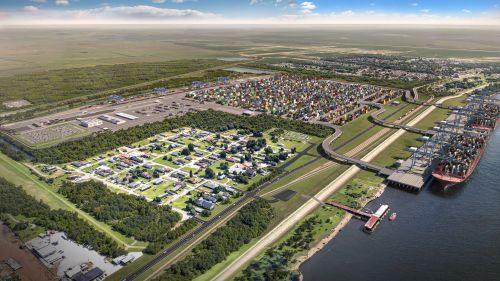
Louisiana Terminal Outlines Next Steps
Port of New Orleans leaders and private partners outlined phases, inland connectivity and future capacity for the Louisiana International Terminal (LIT) during the American Association of Port Authorities (AAPA) annual convention September 29 in New Orleans.
The panel featured Morten Møller Jensen, chief operating officer of the Port of New Orleans and LIT lead; Michael Thomas of Terminal Investment Limited (TiL), who is also chairman of the Port of New Orleans Board of Commissioners; and John Elliott, vice president of corporate operations and engineering at Ports America.
As previously reported in The Waterways Journal, LIT is a greenfield site planned for Violet, La., below the Crescent City Connection, a public-private partnership among the Port of New Orleans, TiL and Ports America. The Corps of Engineers granted the federal construction permit August 17.
Commercial Case And Inland Reach
Jensen, appointed chief operating officer and LIT lead November 17, 2025, asked Thomas about TiL’s commercial case for LIT.
“For TiL, the investment in LIT means an opportunity for the city of New Orleans and for the state of Louisiana to return to prominence,” Thomas said. Growing ship sizes and the in-city terminal behind the bridge constrained New Orleans, he said; moving outside the city ahead of the bridge creates room to expand.
Jensen put Midwest demand near 1.2 million container moves. “We’re estimating that there’s 1.2 million container moves handled in the Midwest, and that (leaves) a big hole for potential cargo that we have an opportunity for,” he said.
New Orleans is the only deepwater U.S. port connecting all six Class I railroads and the Mississippi River system, Jensen said. “What you need when you’re building this ecosystem is velocity and redundancy,” Thomas said, citing barge, road and rail. Louisiana Gov. Jeff Landry committed a project-linked road so trucks bypass neighborhoods and limit impacts on Violet.
“This investment in LIT is an investment in the country, to allow for more potential main ports of call and many more entry points into the country, into the Midwest, into the other parts of the country,” Thomas said.
Phases, Berths And Design Capacity
Elliott called LIT a rare U.S. greenfield build. “This is actually a golden opportunity because this is the first greenfield facility that I’m aware of, probably in the last almost 20 or 30 years,” he said. The aim is productive handling for vessels near 18,000 TEU after Gulf calls around 14,000 TEU.
Pilot simulations in extreme current and 30-knot winds supported larger ships at Violet. “Right now it’s proven no problem even for 16,000 TEU ships,” Elliott said. “This is a facility being built for a 50-plus-year time period.” He said 18,000-TEU ships may need modest adjustments.
Berth length would handle two 16,000-TEU ships at opening, expandable to three berths, Elliott said. Startup would use about six to seven ship-to-shore cranes, rubber-tired gantry (RTG) yard delivery and mixed RTG and top-loader operations. “We don’t envision this facility running out of capacity because we’ve got phase two that we can also build and expand,” he said.
Published estimates of LIT’s eventual throughput span a wide range. Port NOLA’s public materials and prior WJ reporting have cited about 1.2 million containers a year, or roughly 2 million TEU at full build, with first-year throughput of 180,000 to 280,000 containers. A July WJ interview with trade coordinator Michael Hecht put eventual volume at 500,000 to 600,000 TEU a year. Together, those figures place mature capacity from about 500,000 to 2 million TEU, depending on the source. The panel did not restate an annual TEU figure.
Rail, Highway And Container-On-Barge
Elliott said productivity fails without inland links. Expressway access, the St. Bernard corridor and six Class I railroads must advance with the terminal.
Jensen said about 4 percent of New Orleans boxes now move by rail. “We want to grow this significantly beyond the 4 percent, well into the double digits, with the natural growth of the port that we expect,” he said. The port sees rail capacity through 2050 with that growth. Thomas said design aims at “targeted double-digit rail capacity through and around the terminal.”
On container-on-barge, Jensen contrasted Europe’s 600- to 800-TEU Rhine and Danube fleets with few container barges on the Mississippi. Thomas said past U.S. efforts leaned on box subsidies, not upstream infrastructure. “Direct subsidy for a container is not the way to build that container ecosystem,” he said. “What you need is investment by these entities into infrastructure, as opposed to into throughput.”
He cited inland-port models in South Carolina and Georgia. Elliott said a Request for Proposals (RFP) went out about four or five months earlier for an upriver barge terminal to feed New Orleans, and LIT is outfitting expandable barge fendering. “Am I optimistic? I’m optimistic,” Thomas said. “If the investments are made, there is definitely potential.”
Partnership And Next Steps
Asked for the next milestone, Elliott said, “Hopefully shovels in the ground,” coordinating rail, the St. Bernard corridor and interstate links. Thomas said partners must keep the business plan viable. Elliott said the Section 404 permit was the major hurdle, almost a four- or five-year process lengthened by Corps levee rules.
Elliott said Ports America and TiL already share large 50/50 investments, including New York-New Jersey, and operate neighboring facilities. Thomas said TiL has been in New Orleans since 2007.