
Cyber Expert Outlines AI Business Risks, Opportunities, Tips
Dr. Michael Ramage began his remarks to the Paducah Propeller Club November 11 with a prediction.
“AI will change business over the next five years,” he said. “Yes, it will, whether we want it to or not.”
Ramage is the director of the Cyber Education and Research Center at Murray State University in Murray, Ky. The center has been designated as a center of academic excellence in cyber defense.
He said that artificial intelligence has been around longer than most people realize, but it became more commonplace in most people’s lives through the addition of machine learning, which allows AI systems to learn patterns from data, and generative AI, which uses models trained on language that can understand and generate text. An even more recent form of artificial intelligence, agentic AI, can pursue goals, plan tasks, use tools and take actions with a degree of autonomy.
Ramage compared the use of AI today with the beginnings of the internet becoming accessible to the public. When it first started, he said, it wasn’t heavily regulated. Problems that arose, including the need for cybersecurity, came out of the realization of those needs.
“AI today is the worst that it will ever be in the future because it is improving every day,” he said. “If you tried it last year and didn’t like it, try it again because it has improved by leaps and bounds.
Using artificial intelligence for business comes with both opportunities and risks, Ramage said. Opportunities he named include faster analysis, automation of routine work, improved threat detection and new roles and specializations. Risks include more convincing scams, sensitive data exposure, inaccurate, AI-generated outputs and automation without oversight.
“The goal of AI is to please you,” he said, noting that can cause problems, such as when his parents used a search engine with artificial intelligence to find a nearby thrift store for them to explore while on a trip. They went to an address, but there was no store there. The AI had invented one that didn’t exist.
That experience led Ramage to the point that oversight is key, and that people should not accept a fact provided by artificial intelligence without verifying it with additional sources.
When looking at business applications, Ramage said that AI is not just a software trend but instead will change how businesses view operations, skills and competition.
“I don’t think that AI is going to take our jobs,” he said. “I think it is going to change some of our jobs.”
It is already driving efficiency in the tech space, he said, noting that while technology companies are reporting hiring no fewer software developers, each software developer can now do an average of 12 times the amount of work before.
For companies looking to bring in AI, Ramage outlined steps of identifying opportunities, educating employees, starting small, managing risk and preparing for change.
“AI is not perfect, so make sure that you are maintaining oversight,” he said.
He added, “Fear is not a strategic approach. Neither is worshipping it.”
When identifying whether AI is a good fit for a task, it is important for employers to ask a series of questions. For example, if AI provides faster analysis, how is accuracy going to be verified? If it allows more automation, who is going to approve consequential actions? If it provides better visibility of data, is the underlying data reliable? And if it is assisting employee capability, how is confidential data being protected?
Additionally, he said, employers should ask whether it is more expensive to manage AI agents or people.
“AI is not free,” he said. “If you are using an AI agent that is free, you are what they’re getting.”
Key tips he suggested when using AI are:
Verify output to ensure accuracy. Be careful adding sensitive or private information in generative AI prompts. Stay vigilant against social engineering and AI-generated content. Understand bias and AI ethics. Be aware of adversarial attacks and robustness. Adhere to Compliance and regulatory requirements.
The world is driven by waves of innovation, and Ramage said that while advances in electricity, mechanization, automation and transportation were questioned and sometimes feared in their early days, subsequent waves built upon them, but they did not totally replace them.
“There is not ever going to be a world that we exist in without AI,” Ramage said. “Good or bad, it is here.”
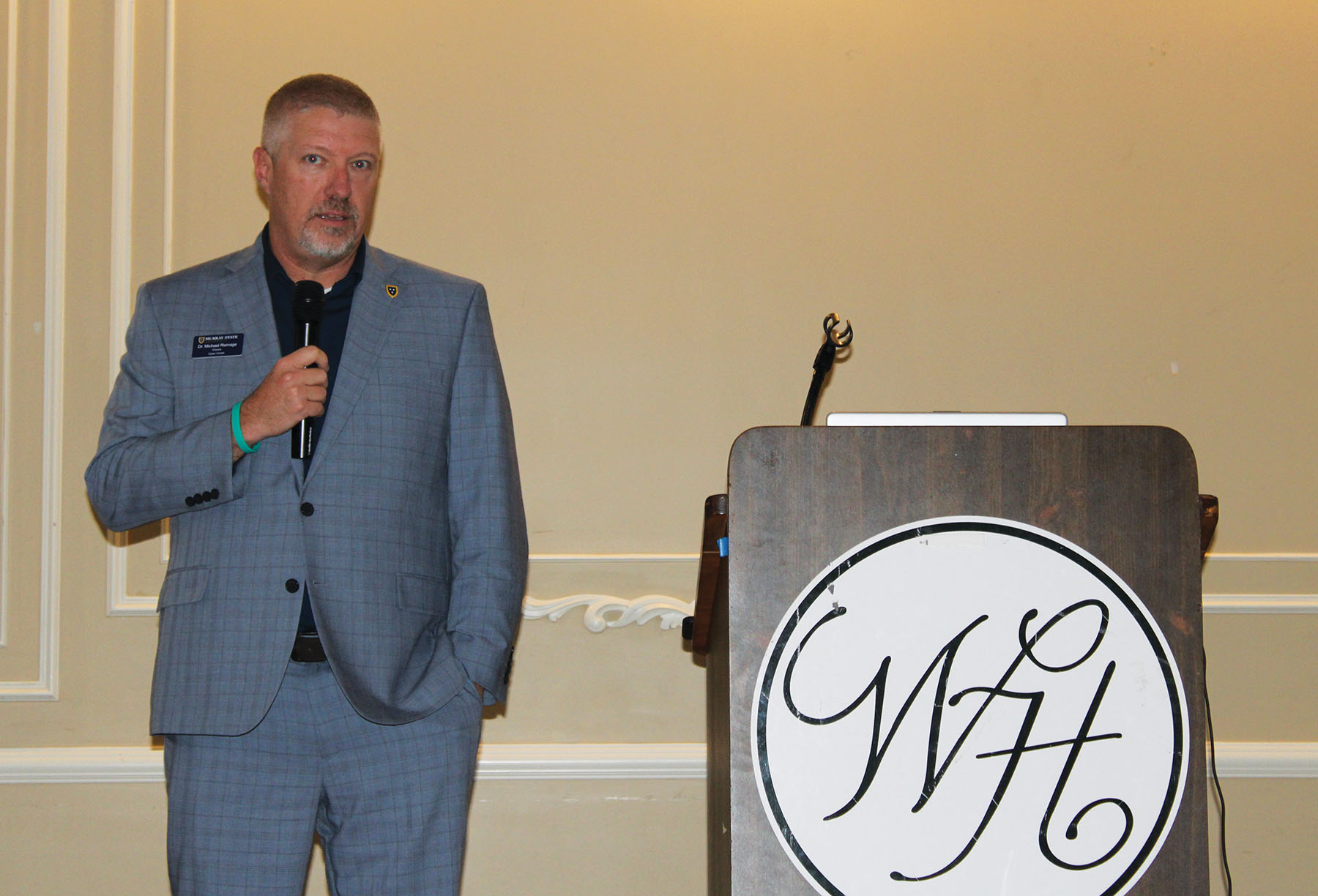
Featured photo caption: Dr. Michael Ramage speaks about “AI and the Future of Work” at November 11’s Paducah Propeller Club meeting. (Photo by Shelley Byrne)