
Regional Roundup: AIWA Highlights Waterway Needs, Benefits
When the Atlantic Intracoastal Waterway Association met for the 27th time for its annual conference November 17-19, it was to renew its mission as “the voice of the waterway.”
The AIWA is a membership organization that advocates for both the commercial and recreational users of the waterway, and one of its major efforts is ensuring that it receives the funding required for dredging and other operational needs to remain an active, viable waterway, Executive Director Brad Pickel said.
The Atlantic Intracoastal Waterway stretches 1,243 miles from Norfolk, Va., near Chesapeake Bay and the Elizabeth River in the north to Key West, Fla., in the south. Along the way, it passes through five different U.S. Army Corps of Engineers districts and two divisions.
For Fiscal Year 2026, the waterway received $42 million in funding. For Fiscal Year 2027, the waterway is in the president’s budget request for $33 million, but, with no budget bills passed by Congress, current funding is through a Continuing Resolution, which is set to expire December 11. That could potentially be extended up to the end of the fiscal year on September 30, 2027.
If appropriations are passed via the Energy and Water Development Appropriations Act, the association hopes that the waterway will receive additional funds through community project funds in the House of Representatives, which are essentially earmarks put in place by members. Pickel said the association has backed earmarks in North Carolina, Georgia and Florida for the waterway.
Funding for dredging in the southern portions of North Carolina is especially important as the region is known for shallow inlets and crossings that need frequent dredging, he said.
Pickel noted that the AIWA’s collective approach of working with Congress and the Corps has led to the reduction of the waterway’s maintenance dredging backlog by more than $60 million within the last decade.
One key mission of the AIWA is to help educate those working in or representing the districts along the waterway to understand its industry and recreational needs. Pickel visits Washington, D.C. each March, and this year he and his team met with 12 different Congressional offices. They then followed up with meetings with six more in May.
“At the end of the day, our job is to step in and explain to them why the waterway needs to be maintained on an annual basis,” Pickel said.
With several new members of Congress taking their seats in January, that could bring as many as 3,500 new congressional staffers to the House of Representatives alone, he said, so that education effort must be even more robust moving into the new year.
“We’ve got a lot of work to do in the next two years to hit the ground running,” he said.
The annual conference is another way to get the word out about the waterway’s yearly successes and challenges, Pickel said. Each year it rotates among cities within the various Corps districts. This year it included presentations from the Corps of Engineers, the U.S. Coast Guard, the National Oceanic and Atmospheric Association (NOAA)’s Office of Coast Survey and the U.S. Maritime Administration, among others.
Special topics included presentations on the Waterway Access Initiative being led by the National Marine Manufacturers Association, changes in contracting for federal dredging projects and emerging technologies and solutions. The conference also served as a kickoff to celebrate the Florida Inland Navigation District’s 100th year of operations.
Since the waterway encompasses natural bodies of water connected by man-made canals, its needs are different in different reaches, Pickel said.
One example of a unique project recently completed is just north of Charleston, S.C., at Breach Inlet. Over the past year and a half, the Corps of Engineers reliquefied dredged materials from a dredged material management area (DMMA) and used it for beach renourishment. Because storage of dredged materials is a constraint in this area, it created capacity for dredging, especially important because this reach contains some of the highest shoaling areas and needs dredged about every three years, Pickel said. Renourishing the beach also adds protection from hurricanes.
“It demonstrated a new approach to utilizing material stored over multiple past dredging events for a present-day coastal resilience,” Pickel said. “To be able to use it in this test case, it offers us another tool in the toolbox.”
With successful projects like the one at Breach Inlet, the Corps learns more about re-using mixed quality material that has been stored over time. It is also evaluating the quality of material in some other DMMAs.
“We hope we can use this approach to increase capacity up and down the waterway where it makes sense,” Pickel said.
He added that while beach renourishment, marsh restoration and the creation of bird islands have all been examples of beneficial reuse of dredged materials along the waterway, the Corps is now finding ways to blend some of these efforts to create unique, site-specific plans to reuse dredged materials while protecting and restoring the natural environment. This is especially important as the Corps aims toward a goal of 70 percent of dredged materials being beneficially reused by 2030, Pickel said.
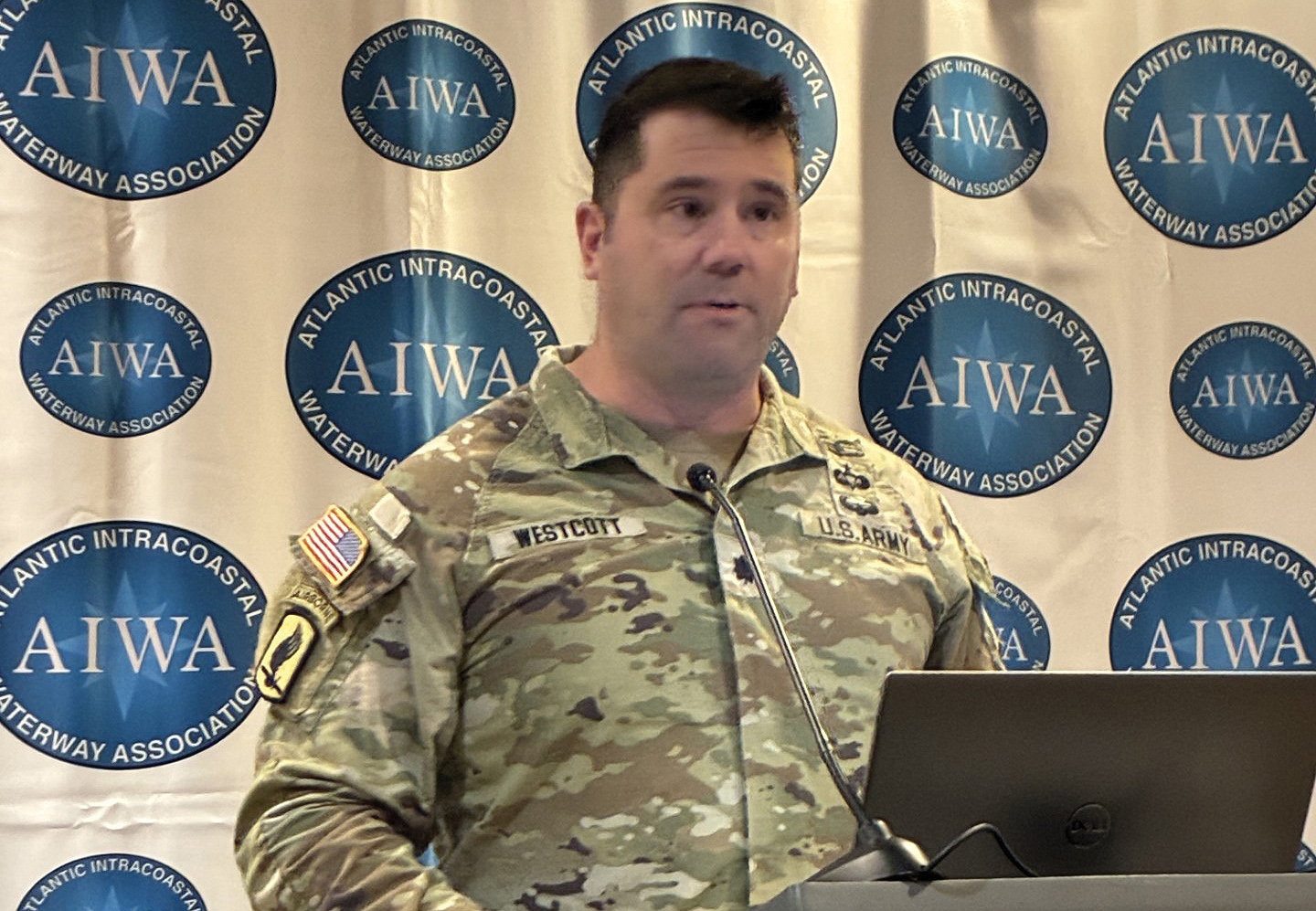
Featured photo caption: Lt. Col. Matthew Westcott, deputy commander of the Jacksonville Engineer District, speaks during the Atlantic Intracoastal Waterway Association’s annual conference November 17-19. (Photos courtesy of the Atlantic Intracoastal Waterway Association)