
Two Big Towboats for Ashland Oil
As a young boy growing up in Catlettsburg, Ky., our house backed up to the earthen floodwall about a half mile from the mouth of the Big Sandy River. In those days (the late 1960s and early 1970s), the line boats of Ashland Oil would unload a complete crude oil tow at Kenova, W.Va., then back down and turn their stern into the mouth of the Big Sandy in order to top around and head back to Owensboro, Ky., to load again.
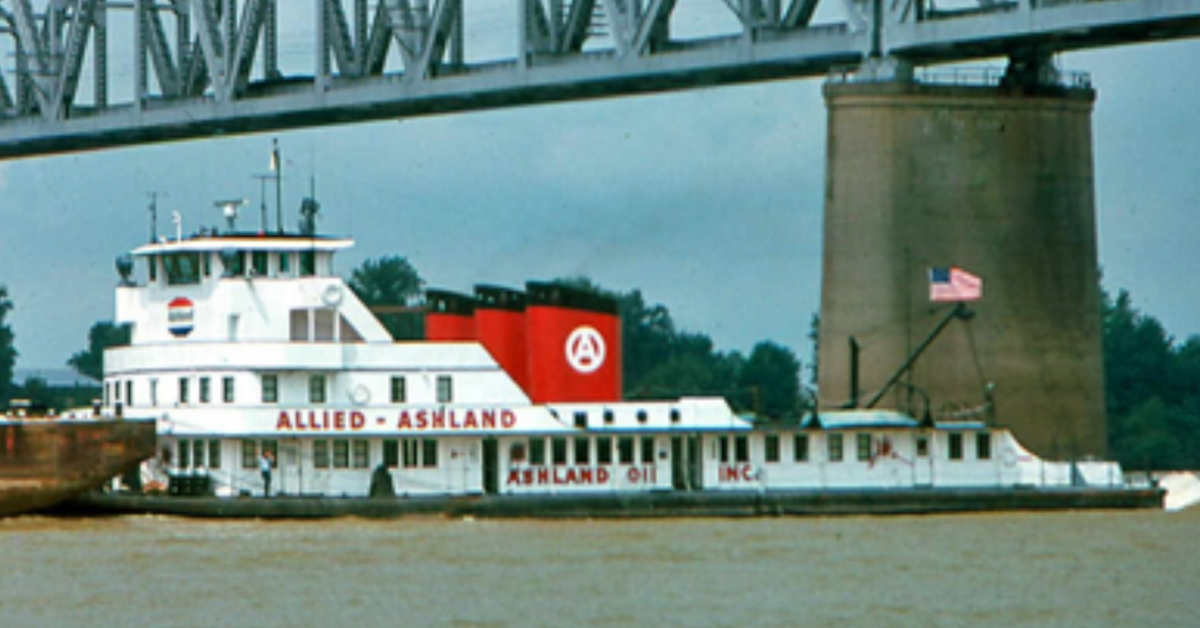
I was in awe of how large they were, especially the triple-screw Aetna-Louisville and Allied-Ashland with their big red stacks and the name in large letters across the stern. At that time, I could not imagine that one day I would stand pilot watches on them.
Early in 1950, it was announced in The Waterways Journal that Ashland Oil & Refining Company (AO&R) was planning to build three 3,200 hp. twin-screw towboats for its fleet. According to the late Robert L. Gray, long-time marine manager at the company, that idea ultimately morphed into building two triple-screw vessels of 4,800 hp. each, which would make them the most powerful vessels on the rivers at the time.
AO&R purchased three surplus twin-screw Navy vessels and dismantled them to use the machinery and equipment for the new boats. Calumet Shipyard and Dry Dock Company of Chicago, which had built four prior boats for AO&R, was selected to build the new towboats, which would measure 150 feet long and 50 feet wide. The 1,600 hp. GM (Cleveland) 16-278A main engines were shipped to Calumet and placed in a building. The engineers and strikers, sent to Chicago for the project, tore down the engines and rebuilt them in preparation for installation in the boats.
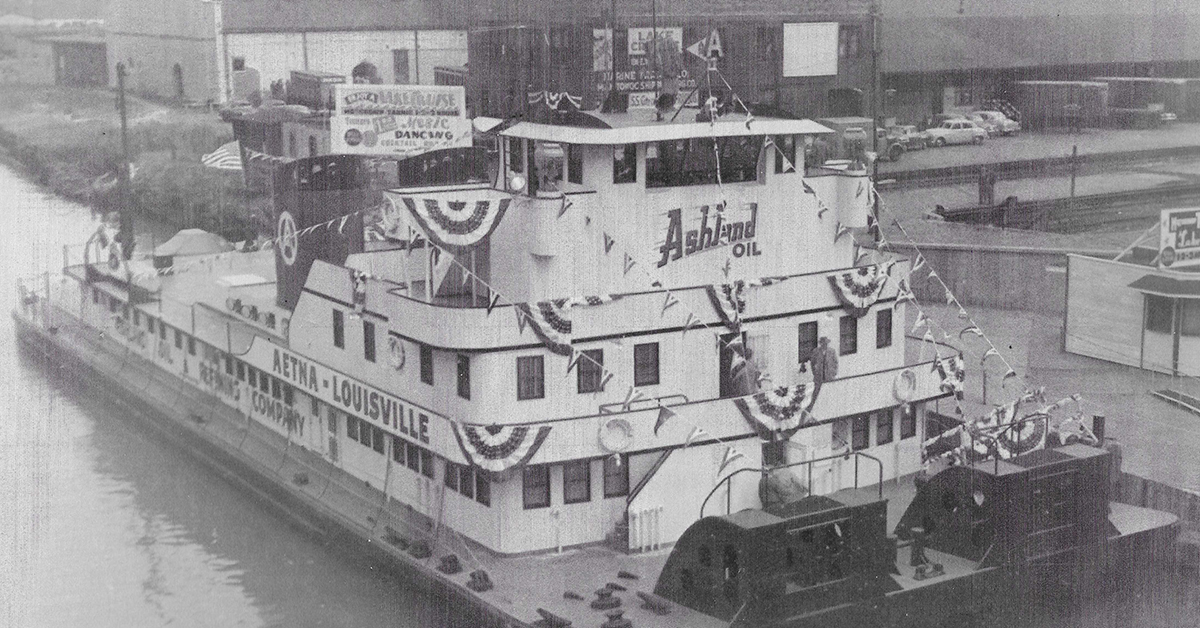
Calumet began construction of the first vessel in November 1950. A small story in the August 11, 1951, issue of the WJ noted that the boat was nearing completion. Following trials, the new boat, Aetna-Louisville, named for both the Aetna Oil Company, a subsidiary of AO&R, and the city of Louisville, Ky., was christened on October 10 of that year. Mrs. Walton Davis, wife of the president of Aetna Oil, was the sponsor of the vessel at a ceremony in Chicago that several hundred people attended. Some 2,000 members of the general public toured the boat following the christening.
The pilothouse and other tall sections of the new boat were lifted off following the ceremonies to allow the boat to be moved down through low bridges. At Lockport, Ill., 31 miles from Chicago, the structures were replaced. The boat later made stops at major cities such as St. Louis, Louisville and Cincinnati to allow those interested to see the powerful towboat. Officially rated at 4,800 hp. at 750 rpm, the three engines were capable of 5,400 hp. at 800 rpm for brief periods, if necessary. The propellers were 96 inches in diameter with 87.5 inches of pitch, turning in kort nozzles.
There were three GM diesels installed that drove dual generators, each providing 100 kw. AC and 20 kw. DC current. The boat had a full lower cabin that housed quarters for the 16 crew members, with a smaller upper cabin that contained three well-appointed guest rooms, each with a private bath (complete with bathtubs). A guest lounge with kitchenette was also within that cabin.
Above this was a full-height storage area surmounted by the pilothouse. Bridge wings extending from each side gave the boat the appearance of an ocean-going ship from a distance. Three tall smokestacks painted a deep red, with the vented tops painted black, rose from a skylight on the second deck roof.
The Aetna-Louisville, paired with a specially designed eight-piece unit of tank barges, was soon seen navigating the Lower Mississippi and Ohio rivers.
A twin named Allied-Ashland (named for the AO&R subsidiary Allied Oil and Ashland Oil) came out in 1952, but unlike the fanfare surrounding the Aetna-Louisville’s debut, it was completed and placed in service without even a christening ceremony. Capt. Robert Smith was the first master of the Aetna-Louisville, followed by Capt. Willard White in the late 1950s. He would leave in 1966 to bring out the new Ashland. Capt. Gene Dent was then in charge the rest of the time the company owned the boat. (AO&R became Ashland Oil Inc. in 1966.) During the Ashland ownership, the Allied had only two regular masters, Capt. Tommy Stevenson at first and, following Stevenson’s retirement in the early 1970s, Capt. Lonnie Ryan.
In 1988, both boats were sold to Parish Towing Inc., Jefferson, La., and renamed simply Aetna and Allied, respectively. In 1989, the Allied was repowered with GM 16-645E6 engines totaling 5,600 hp., leased to Kellum Marine Inc. of Paducah and renamed Christopher D. In 1991, it was leased to Bertucci Construction Company, Jefferson, La., and named James E. Jackson. It was returned to Parish Towing in 1992, and in 1997, both the Jackson and the Aetna were sold to Northstar Navigation Inc., Paducah. The Jackson was renamed Loyd C. Beesecker, and the Aetna was repowered with GM 16-645E6 engines of 5,600 hp. and renamed Grandma Gert.
In 2004, the boats were sold to Versatility Marine Inc, Gonzales, La., and in 2005, both were sold to Transbarge Navigation S.A. and taken to South America. Both received an extensive rebuild with higher pilothouses. The Grandma Gert was renamed Don Eduardo, and the Loyd C. Beesecker was renamed Don Kasbergen.
According to tracking websites, they both appear to be in operation today.
Featured image caption: The mv. Aetna-Louisville christening at Chicago, held on October 10, 1951. (From the author’s collection)