
Berg Propulsion & Thompson Marine: Partnership Built On Trust
For more than a century, Berg Propulsion has been refining the science of marine propulsion from its roots along Sweden’s west coast. For nearly four decades in the southeastern United States, Thompson Marine has been doing much the same—supporting workboat operators and shipyards with increasingly complex propulsion systems designed to perform, endure and evolve. Today, their collaboration stands as a trusted propulsion partnership in the U.S. market.
Thompson Tractor Company traces its history to 1957, when Hall Thompson established the Caterpillar dealership’s headquarters in Birmingham, Ala. By the late 1980s, the company had expanded its marine footprint, acquiring territory across southern Alabama and the Florida Panhandle. What began as engine sales steadily grew into something more comprehensive.
“We recognized early that many workboat shipyards didn’t have in-house engineering support,” said Richard Tremayne, general manager of Thompson Marine. “As propulsion systems became more sophisticated, there was a real need for a partner that could take a vessel from concept on a napkin all the way through commissioning—and then support it for the life of the boat.”
That philosophy shaped Thompson Marine’s evolution. Today, its marine division includes more than 30 professionals spanning marine and mechanical engineering, naval architecture, project management and senior technicians. The team supports everything from system integration and installation to long-term maintenance and aftercare.
A cornerstone of that growth was Thompson Marine’s decades-long relationship with Master Boat Builders, a collaboration Tremayne describes as formative.
“They helped push us to become what we are today,” he said. “What we built to serve them ultimately mirrored what the broader industry needed.”
Berg Propulsion’s story begins even earlier. Founded in 1912 as a small shipyard outside Gothenburg, Sweden, Berg initially built wooden fishing vessels and soon began designing controllable pitch propellers for its own boats. By the 1960s, the company had transitioned entirely into propulsion design and manufacturing.
“That shift defined who we are,” said Jörgen Karlsson, general manager of Berg Propulsion. “We became a propulsion specialist—focused on efficiency, control and system performance.”
Over the decades, Berg expanded globally, establishing operations across Europe, Asia and the Middle East. While the company briefly operated under Caterpillar ownership beginning in 2013, Berg returned to independent ownership in 2020, reopening the door to a refined distribution strategy.
“In the U.S., the distributor model works extremely well with Thompson Marine,” Karlsson said. “They are a trusted partner—very trusted. Our philosophies align, and that matters.”
Thompson Marine became Berg Propulsion’s U.S. distributor in 2023, a role built on years of shared experience dating back to Caterpillar’s propulsion authorization program.
“There’s a tremendous amount of trust involved,” Tremayne said. “They trust us not only to represent their products technically, but to protect their brand. That trust came from a lot of hard work on both sides.”
The partnership extends well beyond sales. Thompson Marine and Berg collaborate early in vessel design, working alongside naval architects and owners to optimize propulsion efficiency from the outset.
“Today, we’re not just supplying propellers,” Karlsson said. “We’re delivering complete propulsion systems—mechanical, electrical and control integration. And that collaboration is strongest when we work together early.”
That approach is increasingly important as hybrid propulsion, battery integration and alternative fuels gain traction. Along the Gulf Coast alone, Berg’s integrated systems are already operating aboard multiple hybrid tugs, with broader adoption underway overseas.
All Berg propulsion equipment is designed and manufactured in Sweden, where the company has invested heavily in advanced Computer Numerical Control (CNC) machinery and AI-driven propeller design tools. Thompson Marine personnel regularly visit the factory, while Berg engineers travel to the U.S. to support customers and align processes.
“You have to see how each other works,” Tremayne said. “That’s how you create a third way—something stronger than either company alone.”
Looking ahead, both companies see opportunity driven by regulation, technology and global experience.
“The U.S. market will face challenges others already have,” Tremayne said. “When that happens, we’ll already have solutions.”
Karlsson agrees.
“The future is promising,” he said. “The world runs on water, and propulsion will continue to evolve. Whatever energy comes next, propulsion will adapt.”
Together, Berg Propulsion and Thompson Marine are proving that the strongest partnerships are built not just on products—but on shared values, deep technical expertise and trust earned over time.
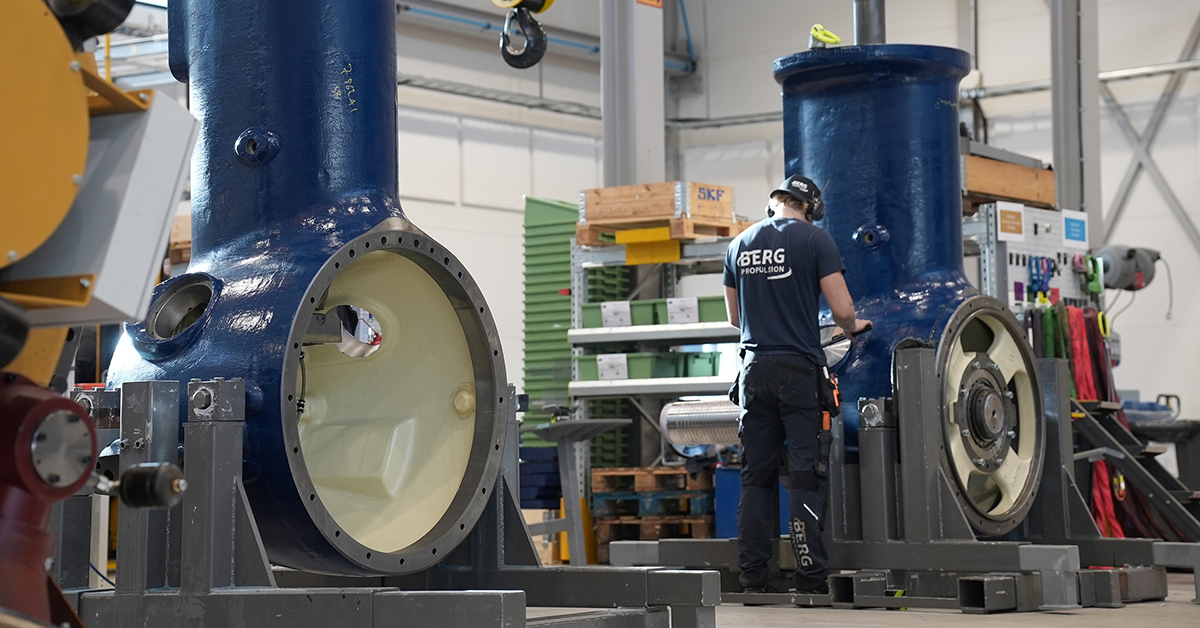
Featured image caption: A technician works on a Berg propulsion unit during assembly of azimuth thruster systems for inland towing vessels and other commercial marine applications. (Photo courtesy of Berg)