Lowering Risk With Fire Suppression Industries
Fire risk remains one of the most serious safety and operational threats aboard commercial vessels, particularly in enginerooms and enclosed spaces. A newer generation of aerosol-based fire suppression technology, now manufactured in the United States, offers an alternative to traditional water- and gas-based systems by suppressing fires rapidly while minimizing damage to equipment on board.
Fire Suppression Industries is a relatively young company, officially formed two years ago after acquiring the assets of Flame Guard. The technology itself, however, has a longer pedigree.
“Aerosol fire suppression has been around for nearly four decades,” said Scott Bieda, a partner with the company. “It was originally developed overseas, primarily for military applications. One of our biggest challenges—and opportunities—is simply raising awareness. A lot of people don’t realize this option exists.”
Bieda explained that only a small number of manufacturers worldwide know how to produce the proprietary aerosol compound that makes the system work. The suppressant is formed from a blend of raw materials that cure into a solid block, which then produces an ultra-fine aerosol mist when activated. Those particles interrupt the chemical reaction of fire by separating heat, fuel and oxygen—without actually removing oxygen from the space.
Coming out of the COVID-era supply chain disruptions, Fire Suppression Industries made a strategic decision to bring production ashore.
“When I came in, the supply chain just wasn’t reliable,” Bieda said. “We decided that if we were going to do this right, we needed to manufacture in the United States.”
Today, the company sources nearly all components domestically and assembles units at its facility in Rolling Meadows, Ill. The aerosol compound itself is produced in-house using raw materials, while other components are sourced from regional suppliers. According to Bieda, the company meets U.S. government standards for domestic manufacturing, with only a small number of minor components sourced internationally.
The maritime sector has proven to be a natural fit. Earlier versions of the product found early adoption in the commercial fishing industry, where crews often operate far from shore, and downtime can be costly.
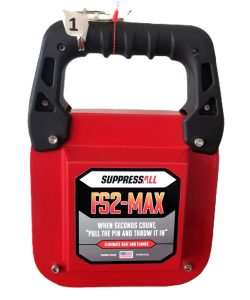
“Fire on a vessel is one of the worst scenarios imaginable,” Bieda said. “What fishermen liked about this system is that it’s Coast Guard-recognized as an auxiliary device, and it’s portable. You can throw it into an engineroom or galley without flooding the space.”
Unlike water-based suppression, aerosol systems do not destroy machinery or electrical components. Once the fire is suppressed and the space ventilated, crews can identify the cause and, in many cases, make repairs and resume operations.
The technology also offers safety advantages over traditional total-flooding systems that displace oxygen. Aerosol does not remove breathable air, but for safety the use of a mask like an N95 is recommended for those who wish to enter a sealed enclosure where aerosol has been deployed.
“It’s non-toxic and non-corrosive,” Bieda said. “It’s recognized by the EPA SNAP program as a replacement for halon. People will still want to exit the space because of smoke and heat, but there’s not that 30-second race against oxygen depletion.”
In addition to handheld units, Fire Suppression Industries recently unveiled a fixed aerosol system designed for permanent installation in engine compartments and galleys. The fixed units can be configured to deploy automatically when a fire is detected, eliminating the need for manual intervention. Bieda said the company has already supplied units for federal vessels under construction.
Distribution is handled primarily through trained partners, including fire service and safety equipment distributors. Training requirements are minimal and straightforward. Units are shipped with the battery disconnected, and activation involves connecting the battery and understanding a simple two-pin deployment process. Once deployed, the device releases aerosol after an eight-second delay and fully suppresses Class A, B or C fires in spaces up to approximately 5,300 cubic feet.
“For towboats, barges and other commercial vessels, this can be a game changer,” Bieda said. “It improves safety, minimizes damage and helps operators get back to work faster. That combination matters in this industry.”