The Mount Vernon’s Unique Drive System
As mentioned in this column before, American Barge Line (ABL), forerunner of present-day ACBL, was formed in the late 1920s when Andrew and Patrick Calhoun pooled resources with W.C. Kelly Barge Line. From the original diesel towboats of modest horsepower, the firm grew by chartering and buying larger steam sternwheel boats. In 1939, the company had two 160-foot by 40-foot steel hulls built by Treadwell Construction Company at Midland, Pa. Jeffersonville Boat & Machine Company, which ABL organized in 1938, completed those vessels at its Jeffersonville, Ind., shipyard.
The two boats were named Progress and Patriot and were powered by Cooper-Bessemer diesels that produced 2,000 hp. In 1940, Jeffboat built the first complete towboat for ABL, a 160-foot by 34.5-foot vessel powered by two National Superior engines of 1,600 hp. That vessel was named National.
Prior to the United States entering World War II, Jeffboat began another craft for ABL. That vessel, with a hull 170 feet by 35 feet, entered service in early 1942 as the 2,000 hp. Jefferson, powered by Cooper-Bessemer engines. After this, the yard turned to the production of vessels for the war effort, including many LSTs, tugs and six DPC towboats.
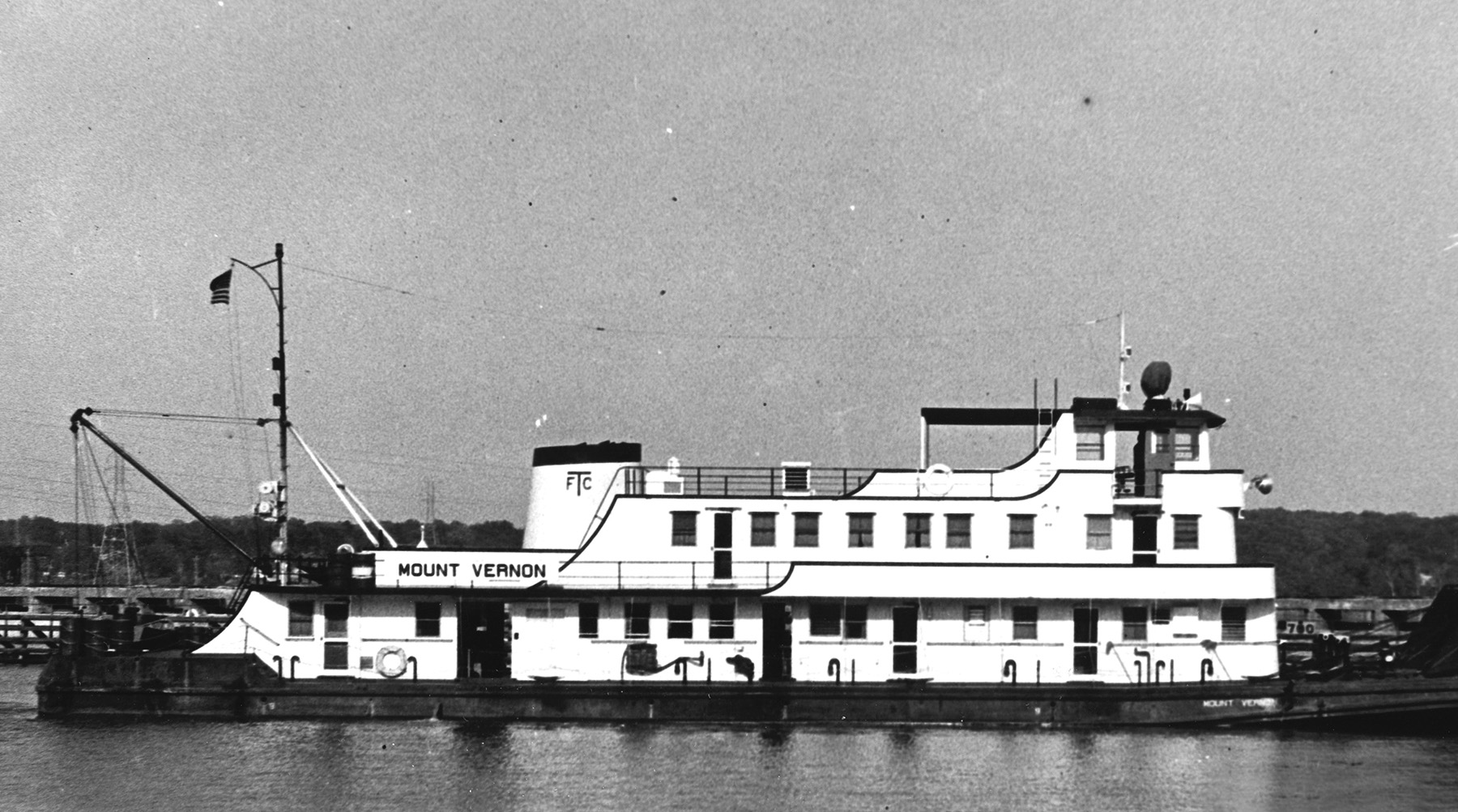
Following the war, Jeffboat built some smaller and modest sized towboats for customers other that ABL. The May 18, 1951, issue of The Waterways Journal carried a feature story on the latest towboat built at Jeff-boat, a triple screw vessel with three Cooper-Bessemer “V” type 8-cylinder model FV8 MGT turbocharged engines, each rated at 720 hp. at 900 rpm for a total of 2,160 hp. The hull was 120 feet by 34 feet, with a model bow. The three propellers were 84 inches in diameter and turned within a single tunnel, rather than individual tunnels for each wheel.
The WJ article highlighted that this new boat was one of the first to have a “Gehres Drive, which consists of a Dynamatic eddy current coupling and a Falk reverse-reduction gear.” This electric drive system evidently was used instead of an air clutch and would “permit the reversing of the propeller at full engine speed without a second’s hesitation, causing the propeller to be reversed from full speed ahead to full speed astern in five to seven seconds.” A 3 kw., 110 volt DC generator mounted on the front of each engine (and driven by V-belts connected to the crankshaft) provided the electric current for the drive.
The new boat was named Mount Vernon, in honor of the town in Ohio where the Cooper-Bessemer Corporation was headquartered.
As with many of the older boats researched, early ownership can sometimes be confusing and convoluted. The 1951 edition of the Inland River Record stated that the boat was jointly owned by Jeffboat and Cooper-Bessemer and operated by ABL. The List of U.S. Merchant Vessels at the time identifies the owner as Jeffersonville Boat & Machine Company.
By 1954, the owner was listed as Cooper-Bessemer Corporation, with the boat chartered to Fleet Towing Company of Carlinville, Ill. At this time the radio call letters assigned to it were WD 4000. In 1954, the boat was taken to Avondale Shipyard in New Orleans and rebuilt with 18 feet added to the bow of the hull, making it 138 feet long. After this rebuilding, the Mount Vernon had a very long head deck at the bow that gave it a distinctive appearance.
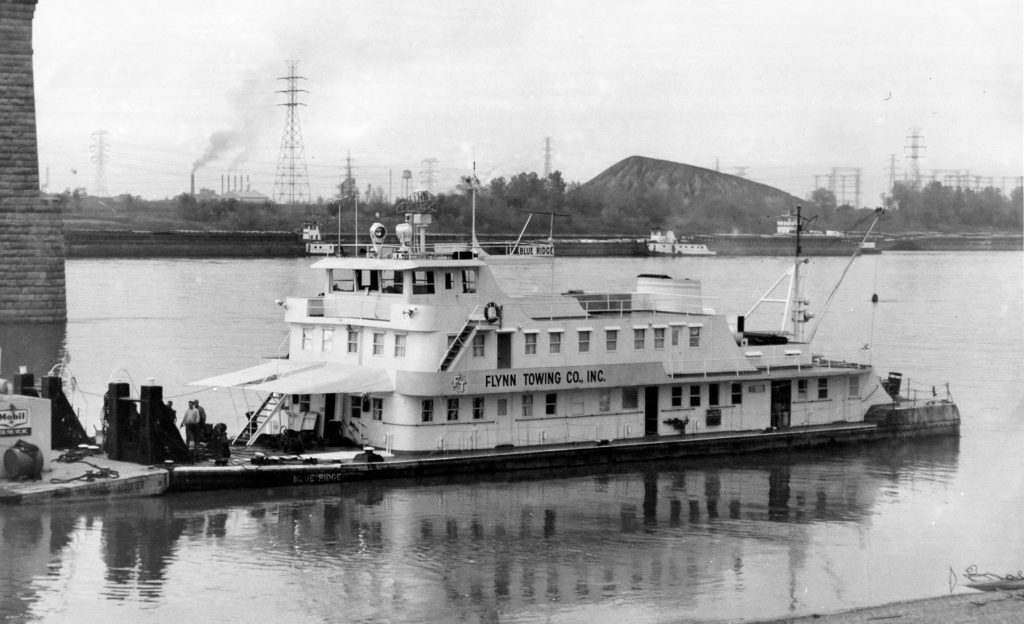
In 1956, the boat was sold to J.S. Gissel & Company of Houston, renamed San Ricardo and repowered with GM 12-567 engines, giving it 2,700 hp. Gissel would utilize the boat all over the inland rivers and Gulf Intracoastal Waterway for the next 11 years before selling it to Flynn Towing Company of St. Louis in 1967. Flynn Towing renamed the vessel Blue Ridge. According to the late Dan Owen, long-time editor of the Inland River Record, Flynn Towing was owned by Gerald Flynn, who named his boats after mountain ranges.
In November 1972, the Blue Ridge was sold to Louisiana Towing Company, Greenville, Miss., and chartered to Aiple Towing Company, Stillwater, Minn. In 1979, it was sold to Twin City Barge & Towing Company, St. Paul, Minn. The 1986 edition of the IRR had the Blue Ridge in the Off The Record section with the notation that it was out of service. For many years after this, it was seen in Lake Ferguson at Greenville in use as a landing boat.
A photo seen on social media in recent months depicts the boat sitting on the bank, completely out of the water. From this photo, it is evident that the 18 feet added in the 1954 rebuild did not impact the original shapely model bow.
————
The Mount Vernon downbound at Keokuk, Iowa, while operated by Fleet Towing Company. (Photo courtesy of the Dan Owen Boat Photo Museum)