
Revisiting The Aetna And Allied
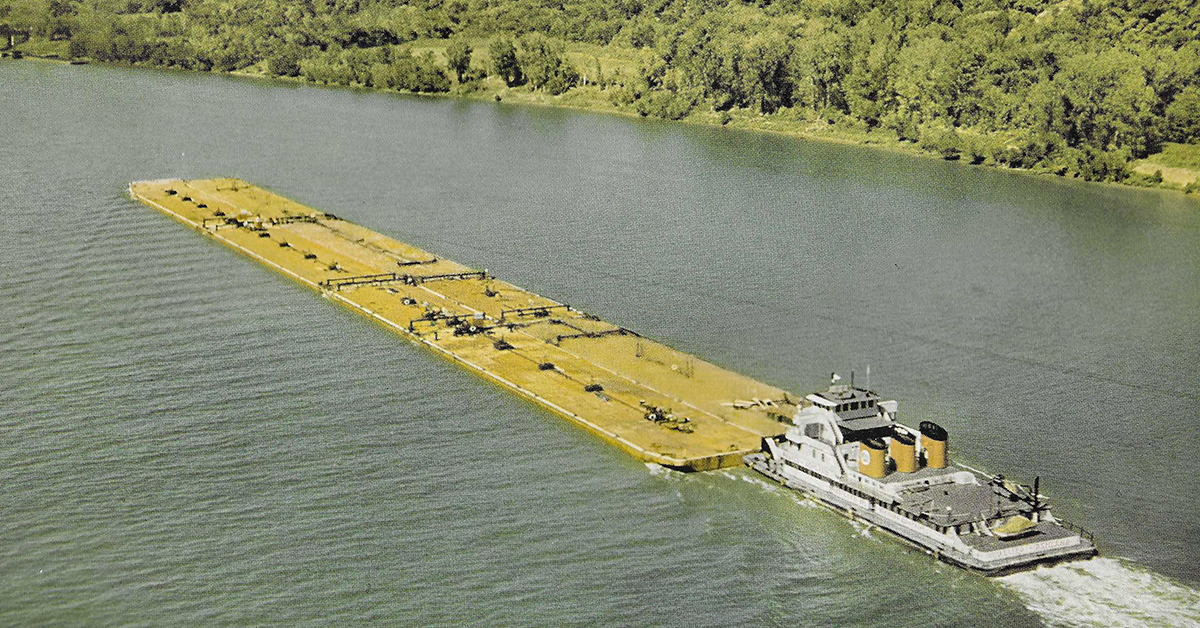
The January 5 Old Boat Column on the Aetna-Louisville and Allied-Ashland really struck a nerve, judging from the response, so this column will take a closer look at them. Built at Calumet in Chicago for Ashland Oil & Refining Company (AOR) in 1951 and 1952, these two triple-screw vessels were the most powerful on the rivers at the time, boasting 4,800 hp. The hulls were 150 feet by 50 feet with a sharply modeled bow. Power was supplied by three 1,600 hp. GM 16-278A engines and Falk gears. Propellers that were 96 inches in diameter with 87.5-inch pitch turned within kort nozzles.
These boats were attractive from any angle. The pilothouses were outfitted with the latest in navigational aids such as a Sperry radar, an RCA radiotelephone and a Bendix depth recorder. AOR pioneered the use of radar with the first installation on the Tri-State in 1946, and the Ashland made the first trip with a depth recorder a few years later. The Aetna’s radio call sign was WD 8428, and the Allied was assigned WE 3121. The pilothouse and interior living spaces were all air conditioned by way of a Chrysler Airtemp system.
The floors of the interior were covered with one-foot square tiles, and the crew and guest lounges, master’s room and pilothouse had special designs in the tile. These included an anchor, pilot wheel, compass points and, in the pilothouse, the Ashland “Flying Octane” logo that the company used for many years.
The three guest rooms on the second deck had bathrooms complete with bathtubs. Two of the baths were done in pastel colors while the third was done in black and white. The wall surrounds were done in matching Pittsburgh Plate Glass “Carrara” tile.
The Aetna-Louisville was christened in Chicago on October 10, 1951, and open houses were held at major cities to allow those in industry, as well as the general public, an opportunity to view the impressive new towboat. When the sister vessel Allied-Ashland entered service in July 1952, however, there was no fanfare. As one long-time AOR employee put it, “They pushed her in the water and put her to work.”
Capt. Robert “Bobby” Smith brought the Aetna out as master. He was hired by AOR in 1944 when the company took over operation of the new DPC steam towboat Midway Islands, and when that boat was turned in after the war, Smith was master of the first Ashland. Prior to all of this, he had been pilot on the sternwheel steam towboat J.C. Rawn when its boilers exploded at Huntington, W.Va., on December 7, 1939. Three crewmembers were killed, and both Capt. Mack Wright, master, and Smith were seriously injured. Smith literally was blown off the boat in the explosion and carried the scars of his injuries for the rest of his life.
The Allied came out in charge of Capt. Tommy Stevenson, who would remain the regular master of that vessel until his retirement in the mid-1970s. Stevenson began his river career on a ferry on the lower Ohio River. Like Smith, he started with AOR when the company was operating the DPC steamers Midway Islands and Wake Island.
As might be expected from the captains of what were then the two most powerful river towboats, a good natured rivalry developed between Smith and Stevenson. Smith liked to rib his rival by referring to him as a “ferry pilot.” Both were very accomplished rivermen and ran their vessels in an extremely disciplined manner.
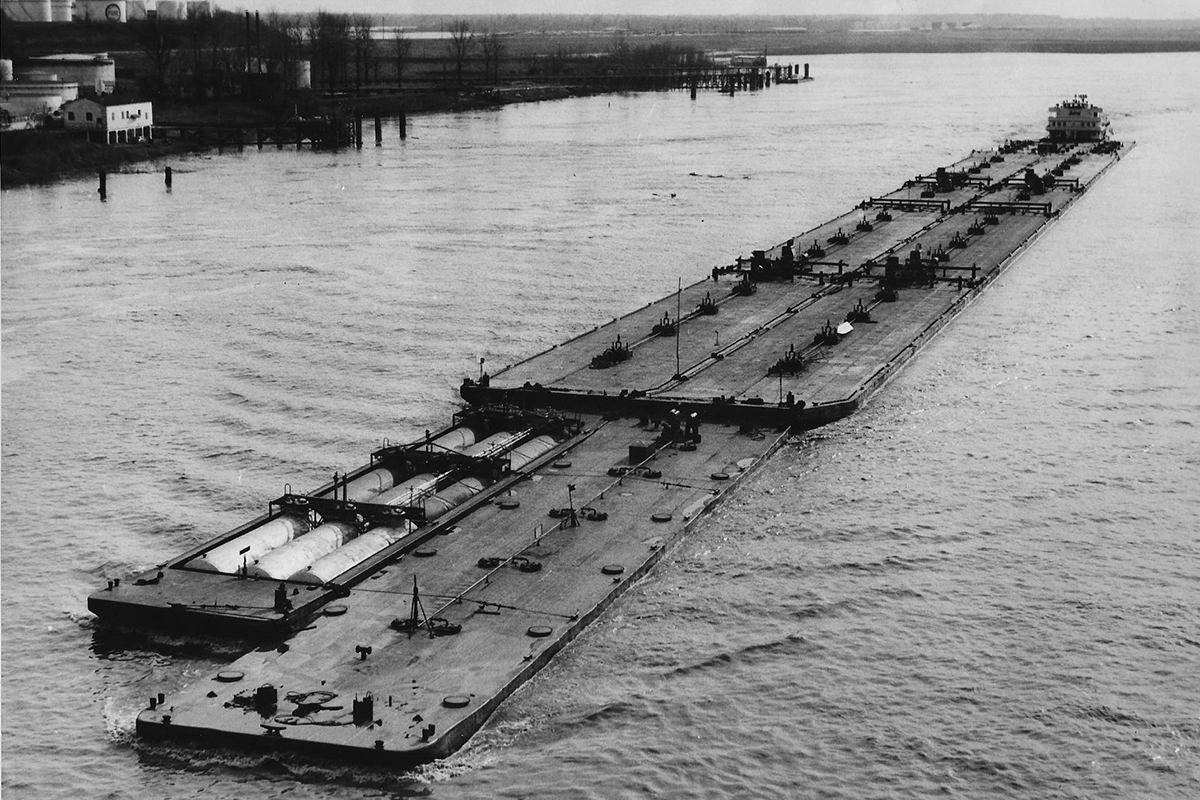
The two big boats immediately began making impressive trips. Ingalls Shipbuilding Corporation built eight-piece unit tows for each vessel to move, but they often handled additional barges. In a press release from June 1952, AOR said that, in its initial six months of service, the Aetna-Louisville had traveled more than 26,000 miles and delivered more than 1.25 million barrels of oil. At that point in time, the AOR boats carried vehicles on the empty barges, and the press release stated that the crew had moved 2,322 cars, trucks and Army vehicles.
In March 1955, the Aetna moved a large, celebrated tow up the Lower Mississippi and Ohio Rivers. The boat left the New Orleans area with 10 loaded barges and added an additional three at Memphis, Tenn. The 30,000-ton tow was 1,605 feet long and contained 8.4 million gallons of petroleum. While this may seem small by the standards of today, it gives an illustration of what these two boats were capable of at a time when sternwheel steamboats were still roaming the rivers.
Featured image caption: The Allied-Ashland wiith an Ingalls-built eight-barge unit tow. (From the author’s collection)