
WJ Talk: USACE Experts Debunk Deepfake Mississippi River Videos and Explain What the Data Really Shows
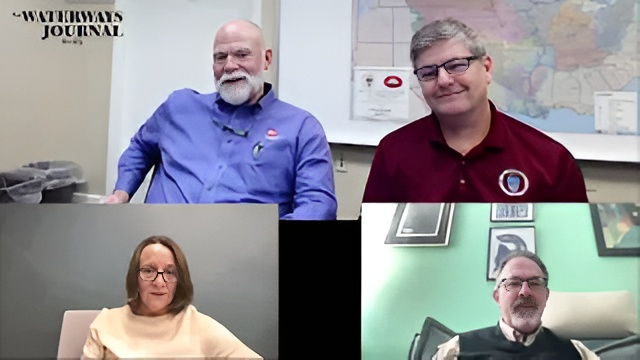
A wave of AI-generated “deepfake” videos about the Mississippi River has been circulating online—videos that claim, among other things, that the river is “losing water,” that agencies are holding “emergency meetings,” and that there are only “three feet of water” at Memphis. In this installment of WJ Talk, Waterways Journal speaks with leaders who work with Mississippi River conditions and data every day, plus a technology expert who helped spot the tells that exposed the videos as fabricated.
WJ Talk is a regular series of conversations sponsored by Waterways Journal, the oldest trade journal covering the barge industry (since 1887). This episode focuses on what the videos got wrong, why they may be spreading, and where the public can go for reliable, transparent river information.
What the deepfake videos claimed—and why it raised alarms
Joey Windham, chief of the Watershed Division with the U.S. Army Corps of Engineers, said he has seen at least three versions of the circulating content, with similar narratives but different visuals and spins. Several claims stood out immediately as misleading or false:
- “We’ve had plenty of rainfall”—presented as proof that low water makes no sense and must be caused by mismanagement or something hidden. Windham emphasized that annual averages are not the full story; when rain falls matters as much as how much falls overall, especially during normal low-water seasons.
- “The river is losing water” between the Ohio River confluence and points downriver (with some versions pointing to areas like Baton Rouge), alleging water is disappearing or not being accounted for.
- “Only three feet of water at Memphis”—a statement Windham described as “horribly untrue,” and one that raised concerns because it can distort public perception of navigation, safety, and commerce.
Patrick Chambers, chief of Operations and Regulatory Affairs at the Corps’ Mississippi Valley Division, said another red flag was the way video producers repurposed unrelated imagery and meetings. Scheduled public meetings were labeled as “emergency meetings,” and unrelated footage—like people behind glass in an office setting—was edited in to imply secrecy and crisis.
How the video was identified as AI-driven
Susan Olson, founder of Action Intel and a longtime technology leader (with an engineering PhD and multiple patents), described how she approached the video the way she would any questionable technical claim: verify the sources and the specifics. The content cited government agencies, “emergency study mode,” and even referenced university experts with credential-sounding titles—yet basic credibility checks didn’t support those identities or claims.
Olson also noticed audio tells that suggested an AI-generated voiceover. More importantly, she emphasized that as generative AI improves, it will become harder to rely on “spotting” obvious tells. Her guidance: don’t assume you can detect manipulation by intuition alone—use verification habits that don’t depend on perfect human perception.
Transparency exists—but misinformation travels faster
One theme the guests returned to repeatedly is that river data is abundant and public—but misinformation is often easier to consume.
Chambers and Windham explained that the Corps and partner agencies publish large volumes of information routinely: river stages, discharges, rainfall data, and more. Windham described an extensive network of gauges and sensors, calibrated and maintained with partners including the U.S. Geological Survey and the National Weather Service. The data is granular and frequently updated—sometimes on a 15-minute cycle—because operators and stakeholders rely on it for real decisions.
Chambers added that, during low-water periods, communication with industry becomes even more frequent. The Corps coordinates closely with navigation interests, surveys conditions, identifies trouble spots, and uses dredges to help keep commerce moving. The agency also posts survey information online to support navigation planning, giving stakeholders the ability to review conditions in known problem reaches.
Olson noted a structural challenge: the number of true experts and authoritative sources on Mississippi River operations and hydrology is relatively small compared with broader internet topics. That can make it easier for sensational, highly clickable misinformation to surface in searches—especially when videos rack up views and engagement signals.
Why low-water questions are easy to exploit
Windham said the recent run of low-water years creates a “message opportunity” for bad actors: when the public senses a pattern but doesn’t understand the drivers, it’s easier for someone to frame the situation as mystery, conspiracy, or hidden incompetence.
He emphasized that long-term records show cycles of wet and dry periods across decades. Looking only at the last 10–20 years can make conditions seem unprecedented, but broader historical data indicates recurring variability. Again, the key point is timing: rainfall patterns that miss critical seasonal windows can lead to lower stages even when a year’s total rainfall looks “fine” in a simplified summary.
What motivates misinformation like this?
Asked why someone would create and spread such videos, the guests suggested practical incentives:
- Clicks and ad revenue driven by sensational claims
- “Influencer” economics where attention itself becomes the product
- Narratives that undermine trust by implying hidden failures or cover-ups, even when public data contradicts the story
Olson pointed out that it’s increasingly plausible for content creators (or automated “agents”) to assemble a dramatic narrative by scraping real headlines, mixing in authentic imagery from credible sources, and then fabricating the “glue” that ties it together—names, credentials, claims, and supposed internal meetings.
Where to find the real information
The guests agreed on the big takeaway: the Mississippi River is heavily measured, collaboratively managed, and closely monitored. Reliable sources exist, and the data is there for anyone who wants to confirm claims rather than relying on viral clips.
Windham described a broad interagency ecosystem of monitoring and publication, while Chambers emphasized the depth of expertise across water management, operations, lock and dam teams, dredging, and surveying—plus ongoing, two-way communication with the navigation industry.
As Olson put it: in the age of AI-generated content, the rule isn’t “trust and verify.” It’s verify.
Watch the full WJ Talk episode above.