
Waterway Commerce Focus Of MVTTC Conference
For most of the world, Mardi Gras week in New Orleans means parades, king cakes, costumes and, in the case of 2026, the one-day reign of this year’s Rex, King of Carnival, Canal Barge Company’s Merritt Lane. But for those connected to the maritime industry, the lead-up to Mardi Gras also brings the Mississippi Valley Trade & Transport Council’s one-day conference, held this year on February 12, the Thursday before Fat Tuesday.
The conference began with a tribute to Capt. Louis M. “Toby” Wattigney Jr., the former president of the New Orleans-Baton Rouge Steamship Pilots Association, who passed away in October.
“Toby Wattigney and I were friends for just about 50 years,” said Sean Duffy, outgoing chairman of the Mississippi Valley Trade & Transport Council (MVTTC) and president of Big River Coalition LLC. “I met Toby as a teenager working as a deckhand tying up ships.”
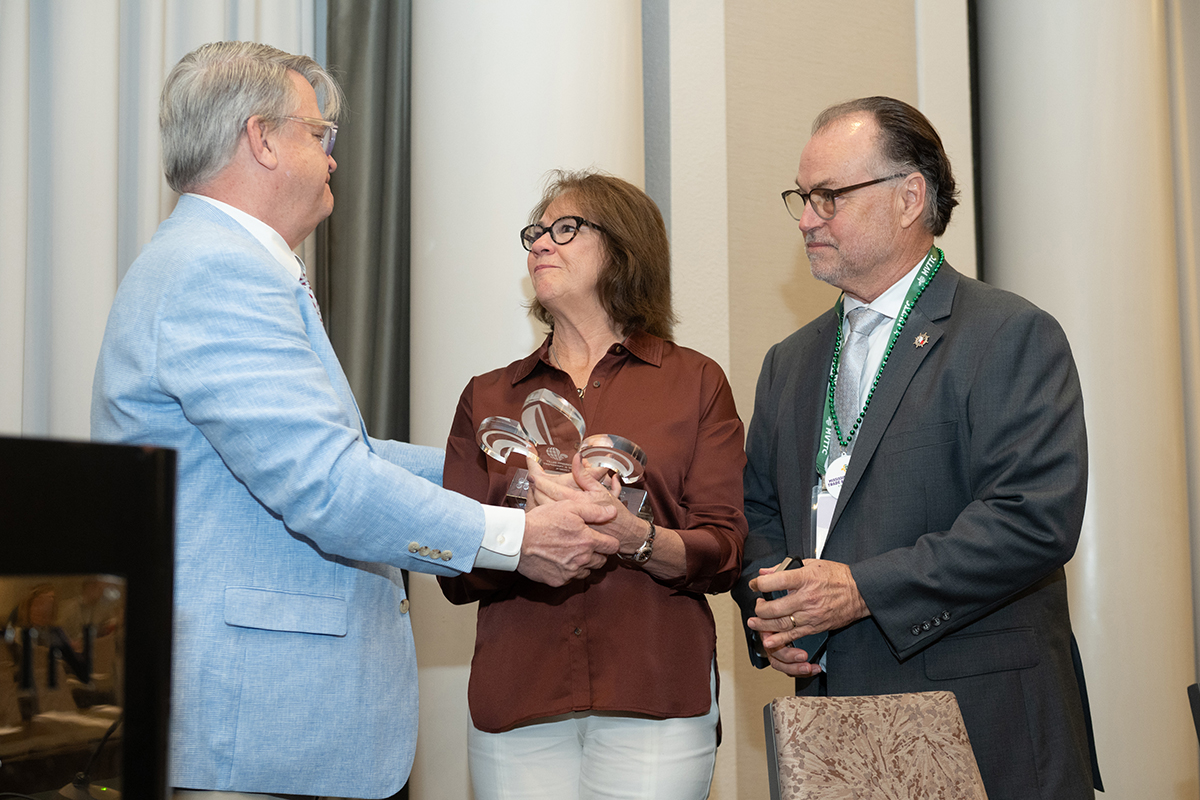
Duffy went on to discuss the wide-ranging impact Wattigney had, not only on him personally, but also on navigation on the Mississippi River Ship Channel as a pilot, association president and advocate for the river. He then invited Capt. Steve Wall, current president of the New Orleans-Baton Rouge Pilots Association, and Wattigney’s wife, Cathy, on stage, where he presented her with an award recognizing Wattigney as an honorary member of the council.
“We issued our first honorary membership last year to Gary LaGrange,” Duffy said of the former president of the Port of New Orleans, “so now we have two real stars in Gary and Toby as the only two honorary members of the Mississippi Valley Trade & Transport Council.”
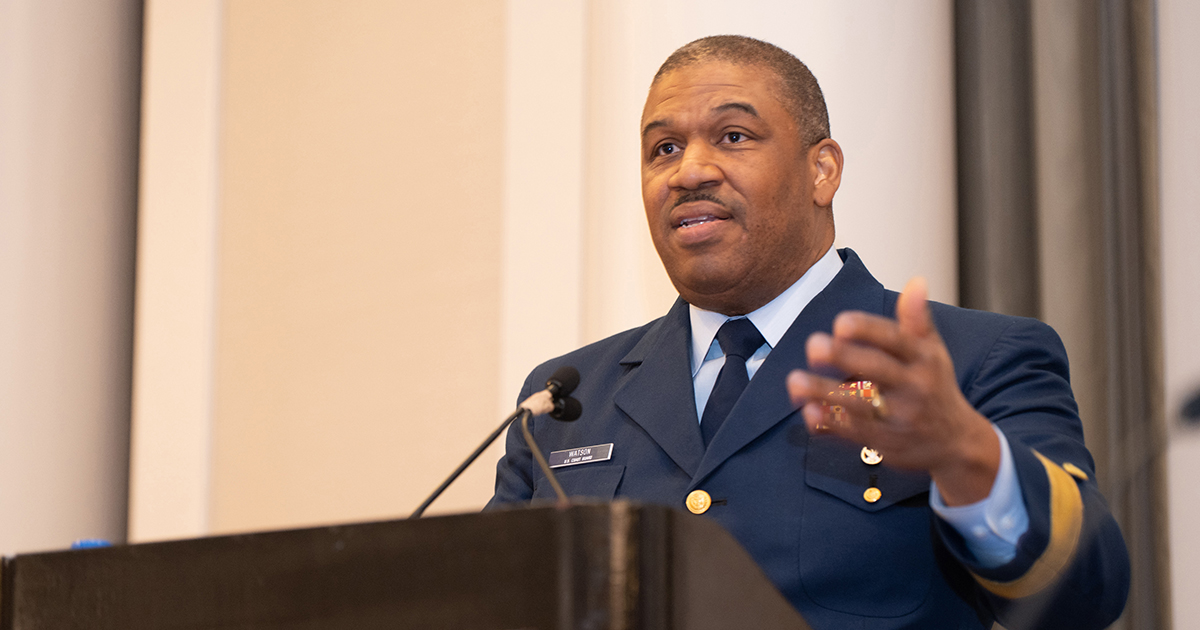
Next, Duffy welcomed Rear Adm. Will Watson, commander of the Coast Guard’s Heartland District, which covers 26 states from the Gulf Coast through the Mississippi River Valley. Addressing the crowd, Watson recognized that he was among friends and colleagues.
“The Coast Guard and the river industry navigate the same waters, face similar challenges and rely on the same critical infrastructure,” he said, “so our success is intertwined.”
That commonality, Watson said, has been on display over the past couple of years during low water conditions on the Mississippi River and its tributaries. Low water means constrained navigation channels, which heightens the importance of communication and collaboration.
“Our Coast Guard river tenders worked hard to maintain channel markings, buoys, chains, sinkers,” he said. “At the same time, we coordinated closely with the Army Corps of Engineers and with many of you, our industry partners, to minimize risk overall.
“Of course, just as we were navigating low river conditions,” Watson continued, “the river reminded us of the alternative, and in early April [2025] we were dealing with high water.”
That rapid shift from low water to high water amplified a truth of waterway management, Watson said.
“Managing our inland waterways and ensuring the free flow of maritime commerce along those waterways is not a seasonal task,” he said. “It’s something that requires continuous collaboration, strategic planning and shared responsibility, day by day by day.”
Watson then touched on the Coast Guard’s Waterways Commerce Cutter program, which will replace the agency’s inland construction and river tenders. The first new construction tender is due out from Birdon in 2027. The $25 billion for the Coast Guard in last year’s so-called One Big Beautiful Bill Act and the agency’s Force Design 2028 initiative stand to shape the Coast Guard for years to come. And yet, the commitment remains the same.
“We will continue to build trust and ensure our partnership with the river industry remains strong and effective,” Watson said.
Communications Keynote
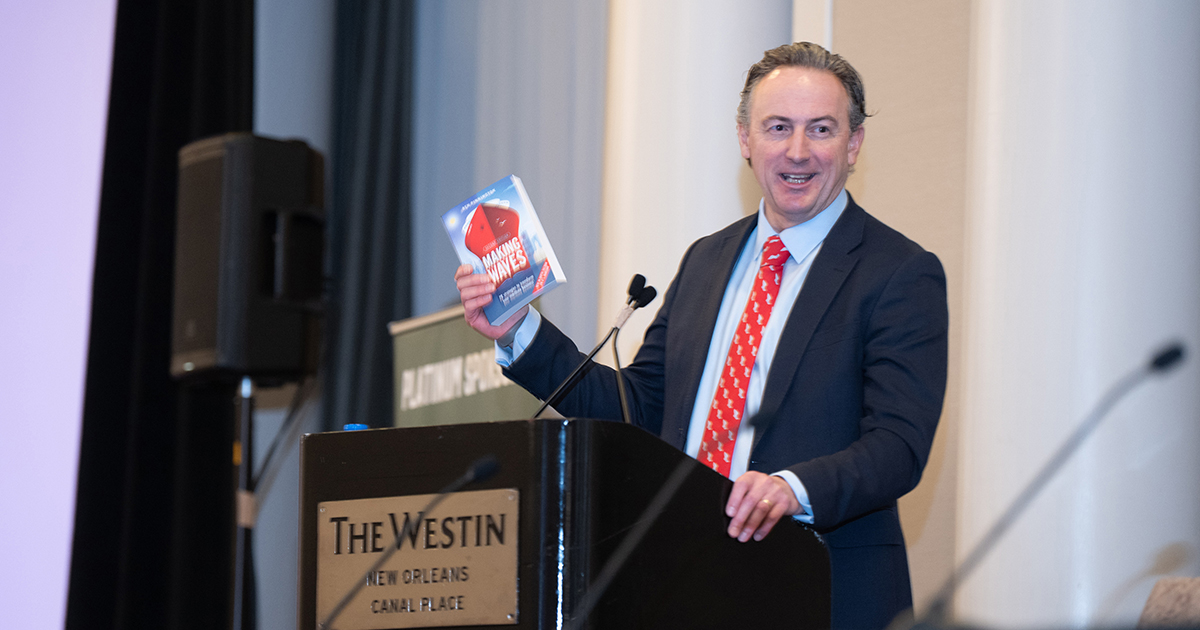
Ben Pinnington, founder of Polaris Media America LLC and author of “Making Waves,” offered the keynote address for the conference. Pinnington, who also serves as board president for the Chicago chapter of the International Propeller Club, drew from his recently published book to talk about the importance of waterway stakeholders to share their story with the wider public. Actively telling that story is critical to the future of the maritime industry, Pinnington said.
“We are in a war for talent, and it’s so much competing with rival businesses,” Pinnington said. “It’s competing with other industries who are much better at promoting themselves, bluntly, than we are.”
Pinnington said it’s time for maritime companies to seize the moment, with the Trump administration releasing its Maritime Action Plan and a renewed focus on the maritime industry, shipbuilding and waterborne transportation in general.
“The challenge, now, is for our sector to harness this higher profile, to showcase our businesses and to really show the mainstream what our industry is about, what it is like to work in our industry and the vast number of jobs that exist,” he said. “It’s not just seafarers. It’s not just shipyard workers. It’s lawyers, accountants and even PR people like me.”
Part of that story is that waterborne transportation is both the most environmentally friendly mode of transportation and the mode with the most available capacity.
“We’ve got to get that message out,” he said. “We’ve got to do our industry justice.”
Pinnington then discussed the importance of public relations, social media and building relationships with local press and trade publications.
Other panelists discussing how to best communicate the needs and worth of the maritime industry included Dawn Lopez, vice president of marketing and public relations for Associated Terminals and Turn Services, Paul Rohde, vice president of the Midwest region for Waterways Council Inc. (WCI), and Duffy.
Lopez shared about a recent interaction day We Work The Waterways (WWW) held at the New Orleans Military and Maritime Academy, where volunteers from the maritime industry spoke with a group of 800 students. Part of their message was that “whatever your interest is, it can get to maritime.” In fact, the WWW website highlights more than 100 different career paths in the maritime world.
Rohde discussed ways WCI encourages and equips industry stakeholders to engage with members of Congress to communicate the benefits of the maritime industry and investment needs on the waterways.
“Democracy is not a spectator sport,” he said. “It’s a contact sport, and it’s a team sport too, but you have to get engaged. Know your legislator. Know your House rep. Know your local and regional lawmakers. Tell them the importance of the maritime industry.”
Part of that storytelling, Rohde said, it to communicate to young people that the maritime industry is a place to build “a career that you can invest yourself in.” Lopez added that it’s also important to make people “feel like they matter” and to invest in the whole person.
“We have to look at, are we treating people not just as an employee—I have the word employee—but as a team member,” Lopez said. “That we’re teaching them about financial literacy. That we’re teaching them about what’s best for their health and future.
State Of The River, Industry And Ports
Henry Peterson, a pilot with the Associated Branch Pilots, also known as the Bar Pilots, moderated a panel focused on channel conditions and challenges facing the Mississippi River Ship Channel. Panelists included Duffy, Rohde, Victor Landry, assistant deputy district engineer for the New Orleans District, and Tim Long, senior manager of marine assurance for Valero.
Peterson highlighted several issues related to the Mississippi River Ship Channel that made headlines over the past year, including the soybean trade between the United States and China, low water on the system and construction of the saltwater sill near Myrtle Grove, La., to stop the upstream movement of sea water in the Mississippi River. Positive headlines included a statewide focus on ports and waterways, particularly the five deepwater ports on the Mississippi River, and the growth of LNG export facilities in the state.
“It’s pretty incredible to see that, after just a few short years [of construction], in October the Mississippi River exported over 22 percent of the LNG produced in the United States through a brand new terminal that’s not ever running at full power,” Peterson said of Venture Global’s Plaquemines LNG facility.
Duffy took the chance to highlight some concerns on the Lower Mississippi River, including the silting in of PIlottown Anchorage and bank destabilization on the east bank of the river below Bohemia.
To that point of focusing on the reliability and maintenance of the Mississippi River, Mark Wright, Louisiana State Representative from the 77th District, who was originally scheduled to be on the panel, sent the following statement: “Shipping follows dollars. If other ports like Mobile and Houston do this work better and faster, Louisiana will lose out. There’s a mentality that says, ‘We have the river, so we’ll always get the business.’ But at some point we’ll lose business if we’re not more strategic about investing in large projects.”
A State of the Industry panel followed, with Ken Eriksen, managing member and strategic advisor for Polaris Analytics and Consulting, serving as moderator. Topics included the status of the Port of New Orleans’ planned container terminal in Violet, La., in St. Bernard Parish, the status of the barge fleet in the United States and the impacts of tariffs on cargo movements.
Eriksen was also part of a panel discussing a recent economic impact study of the five deepwater ports on the Lower Mississippi and a forthcoming unified marketing plan for the ports. The five deepwater ports include the Port of Great Baton Rouge, the Port of South Louisiana, the Port of New Orleans, the St. Bernard Port, Harbor and Terminal District, and the Louisiana Gateway Port. Both initiatives really grew out of the state’s Louisiana Ports and Waterways Investment Commission, which came about early in Louisiana Gov. Jeff Landry’s term.
Afternoon sessions focused on commodity trends and the market for coal and coal coke on the nation’s waterways.
Besides the one-day conference, MVTTC hosted a golf scramble, a Mardi Gras fête dinner party and a parade watch parter the Saturday before Mardi Gras.
For more information about the Mississippi Valley Trade & Transport Council, visit www.mvttc.com.
Featured image caption: Rear Adm. Will Watson, commander of the Coast Guard’s Heartland District, addresses the crowd gathered for this year’s Mississippi Valley Trade & Transport Conference. (Photo by Tracie Morris Schaefer)