

The Dravo 41 And Dravo 42
In the March 23, 2022, issue of The Waterways Journal, we looked at the Pioneer, built by Dravo in 1934 and retrofitted with the first installation of the kort nozzle in the United States in 1937. Within that piece, mention was made of two later near sister boats that this column will take a closer look at.
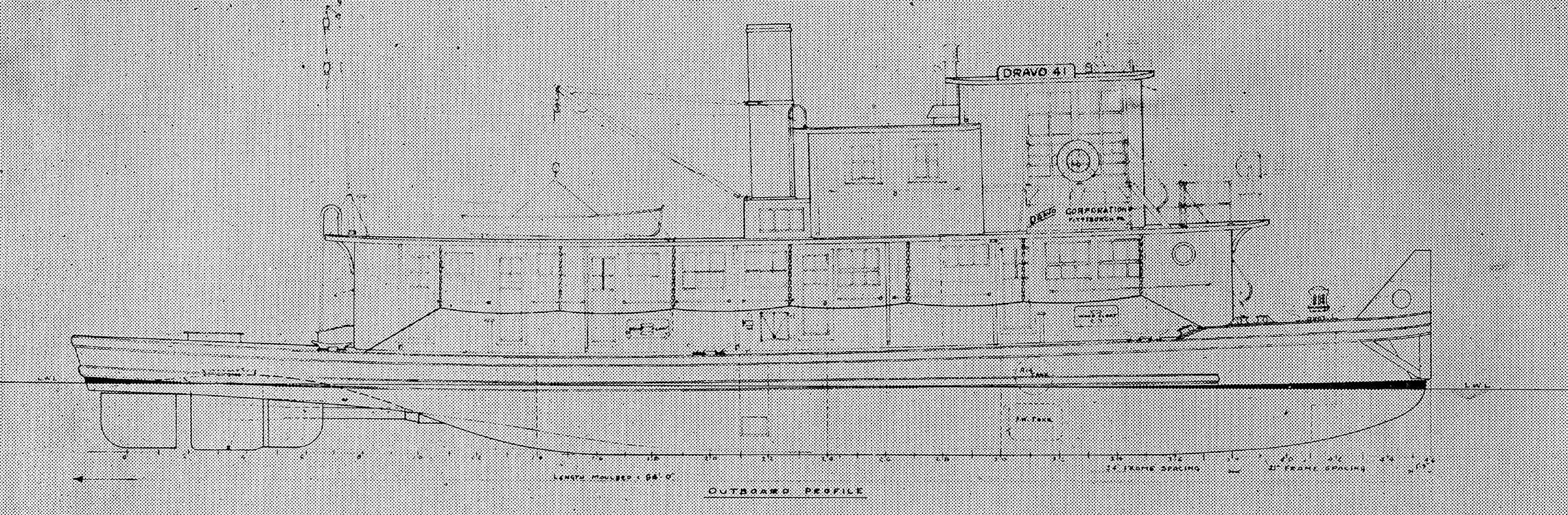
The kort nozzle had proven very successful on the Pioneer immediately. Dravo already had two towboats that were near duplicates to the Pioneer on the drawing board and under construction at the time of the nozzle installation. An article in the November 6, 1937, issue of the WJ detailed the first of these, which had been christened Dravo 41. It had entered service the previous month and had been built without the kort nozzle while the sister vessel Dravo 42 was being built with one so that comparisons could be made between the two otherwise identical vessels.
Both boats were of all steel construction and were 94 by 21 feet with a hull depth of 6 feet, 9 inches and an operating draft of 5 feet. The stern transom was rounded rather than the square shape traditionally found on prop-driven river vessels. The WJ article said that it was equipped with “the Dravo system of skegs and rudders as developed for use in single-screw, shallow-draft towboats.” This involved a “skeg” on each side of the propeller and two steering rudders aft to overcome the “side crawl” of a single-screw boat.
The “fully modeled bow” was touted for not only overcoming resistance while moving through the water, but also for “the ability to throw ice and drift to the side rather than under the boat.” The boat was powered with one Nelseco direct-reversing diesel engine rated at 350 hp. at 280 rpm., direct drive. The full main cabin contained the galley and dining area forward, then the engine room followed by the crew quarters and lounge. A small upper cabin had quarters for the captain and pilot with the slightly elevated pilothouse situated forward of that, pool style.
Trials conducted by Dravo indicated that the Dravo 41 had a backing power equal to the ahead power “and in this respect is superior to sternwheel towboats.” The boat was placed in the Keystone Sand Division of Dravo. The second boat came out in January 1938. Dravo conducted tests involving both vessels to compile comparative performance data utilizing the Dravo dynamometer barge and various size tows.
A photo taken at the time (and included in the March 22, 1922 WJ story) depicts the Dravo 41 and Dravo 42 underway during a “race,” testing the kort nozzle boat against the open wheel vessel. The nozzle-equipped Dravo 42 is obviously ahead, and the collected data would indicate that vessel had some 25% more “push” than the Dravo 41. Dravo literature would later claim that these tests “dealt the final blow to the dying sternwheel boat.” The Dravo 42 would continue to be owned by the Dravo Contracting Company and was frequently “chartered” out to Dravo subsidiary Union Barge Line (UBL).
Both boats would continue in successful careers. The Dravo 41 was sold in 1949 to Valentine & Todd, Blawnox, Pa., and renamed Sara. The firm would run ads that featured the boat in the Inland River Record (IRR) for many years. In 1960, it was transferred to Frank G. Valentine and in 1961 sold to Capt. John M. Hysmith, Charleroi, Pa. He also had the Dravo-built sternwheeler Sewickley. In July 1967, it was sold to Mon River Towing, and again in October 1967 it was sold to Ohio Valley Towing, Glenwillard, Pa. At some point that year it was repowered with a Model 40 Superior engine of 530 hp.
In April 1972, it was sold to Imperial Towing Company, Imperial, Pa. In 1974, it was sold to C&J Towing, Ashland, Ky., and in 1978 to Materials Transfer & Salvage, Belle, W.Va. In 1980, the boat was repowered with a GM 16-V71TI engine of 600 hp., and in 1988 it was repowered with a Cat D343TA of 335 hp. In 1990, it was transferred to ABC Corp., Belle, W.Va.. After being laid up several years, it was ultimately scrapped.
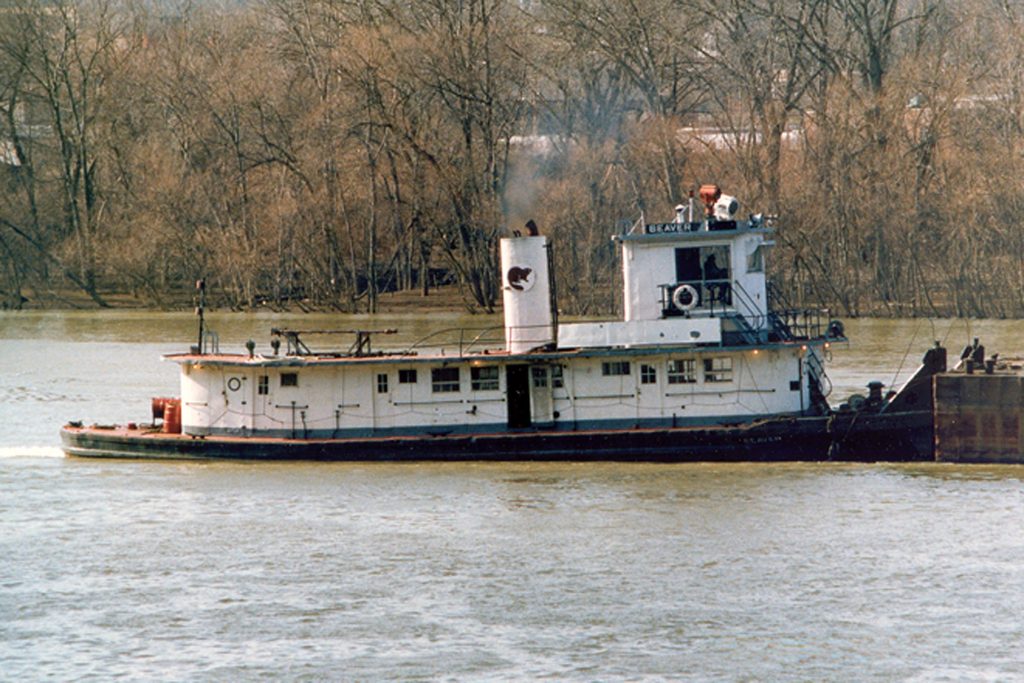
The Dravo 42 was transferred to UBL in 1951 and renamed Beaver. In 1956, it was sold to Capt. Edward F. Smith, Pittsburgh, and sold again that same year to Bulk Towing Company, Point Pleasant, W.Va., one of the companies headed by Capt. Robert H. Bosworth. In 1959, it was repowered with a 450 hp. Fairbanks-Morse engine. During this ownership, the upper cabin behind the pilothouse was removed. That cabin was discovered some years later at Point Pleasant Marine, the former Marietta Manufacturing Company at Point Pleasant, being used as a storage shed. Nelson Jones had it taken to Port Amherst at Charleston, W.Va., where it may still be.
The Bosworth companies were bought by M/G Transport Services in 1968, and, in 1969, the Beaver was sold to Joe S (Neale) Towing Co., Parkersburg. In 1982, it was sold to Grimm’s River Contracting, Coraopolis, Pa. Though never recorded in the IRR, it was repowered soon after this sale. Bud Osbourne, long a marine surveyor in the Pittsburgh area, says that it then had an EMD 8-567 engine of about 700 hp. In 1993, it was listed in the IRR as being owned by Group Wharton, Inc., Glassport, Pa. It was shown in the “off the record” section of the 1998 IRR, noting that the owner could not be located.
Prior to this, the boat had been observed caught out on the bank on the Monongahela River. Osbourne says that it was raised, but later scrapped. It retained the kort nozzle all the years it operated. A lingering question that this writer has is why Dravo never retrofitted the Dravo 41 with a nozzle. It remained an open wheel boat, despite the obvious advantages of the nozzle on the Dravo 42. Both boats did have the twin steering rudders replaced by a single one on the centerline at some point.
Featured photo caption: Outboard profile drawing as shown in the November 6, 1937 WJ. (Photo from the author’s collection)