
A Tragedy Greatly Unnoticed
Mid-to-late April 1865 was full of news. President Abraham Lincoln was assassinated, the hunt for and eventual killing of his assassin, John Wilkes Booth, was ongoing, and the Civil War was ending. Due to war damage, it was difficult to send news by telegraph, and the most reliable method of spreading news was by the newspapers. They had to use their limited space to print the news editors and publishers felt was most important to their readers. It is not too surprising that a horrendous event not directly related to the front-page news would be shuffled aside.
According to Way’s Packet Directory, the steam sidewheel packet Sultana was built in 1862 at the John Litherbury yard in Cincinnati, with a wooden hull that was 260 by 42 feet. It was launched January 3, 1863. The engines were built by Moore & Richardson’s Cincinnati Locomotive Works and had cylinders that were 25 inches in diameter by 8-foot stroke with steam provided by four tubular boilers, the design of which was new at the time. The sidewheels were 34 feet in diameter with 11-foot buckets.
The Sultana was owned by Capt. Pres Lodwick and was intended for the New Orleans trade. Due to the uncertainty of the war events on the Lower Mississippi, it ran the upper Ohio River trade at first. The maiden trip was advertised for Pittsburgh, and the boat departed Cincinnati upbound on February 11, 1863. The trip was cut short when it was found that the tall smokestacks were unable to clear the Wheeling (W.Va.) suspension bridge. For the remainder of February and March, the packet ran between Cincinnati and Wheeling. On March 16, it departed Cincinnati for Nashville, having been pressed into service for the U.S. government.
After this trip, it was back in private service, Cincinnati to Wheeling, until May 4, when it departed the Queen City advertised for Cairo and Memphis. By January 1864, it was running the intended trade St. Louis to New Orleans. In March 1864, the Sultana was sold to a consortium made up of companies and individuals from St. Louis that included Capt. J. Cass Mason, the master and first clerk W.J. Gamboel. Of possible interest to those of the Missouri River, Gamboel lived in Glasgow, Mo., and had been a steamboat agent at Kansas City.
The Sultana ran in sporadic trades St. Louis to New Orleans, at times turning south out of Memphis. It was inspected by steamboat inspectors at St. Louis on April 12, 1865, was pronounced sound and was issued a certificate. On the next southbound trip, it carried the sad new of Lincoln’s death to cities along the way.
The steamer departed New Orleans northbound on April 21, 1865, and stopped at Vicksburg April 23 to load Union soldiers headed home, most having been freed from the horrors of the Confederate prison camps at Andersonville, Ga., and Cahaba, Ala. While at Vicksburg, a leaking boiler was repaired. The night of April 26, it departed Memphis upbound, and a hauntingly simple notation in the Memphis U.S. Customs record reads, “Burned and 1,600 persons perished.”
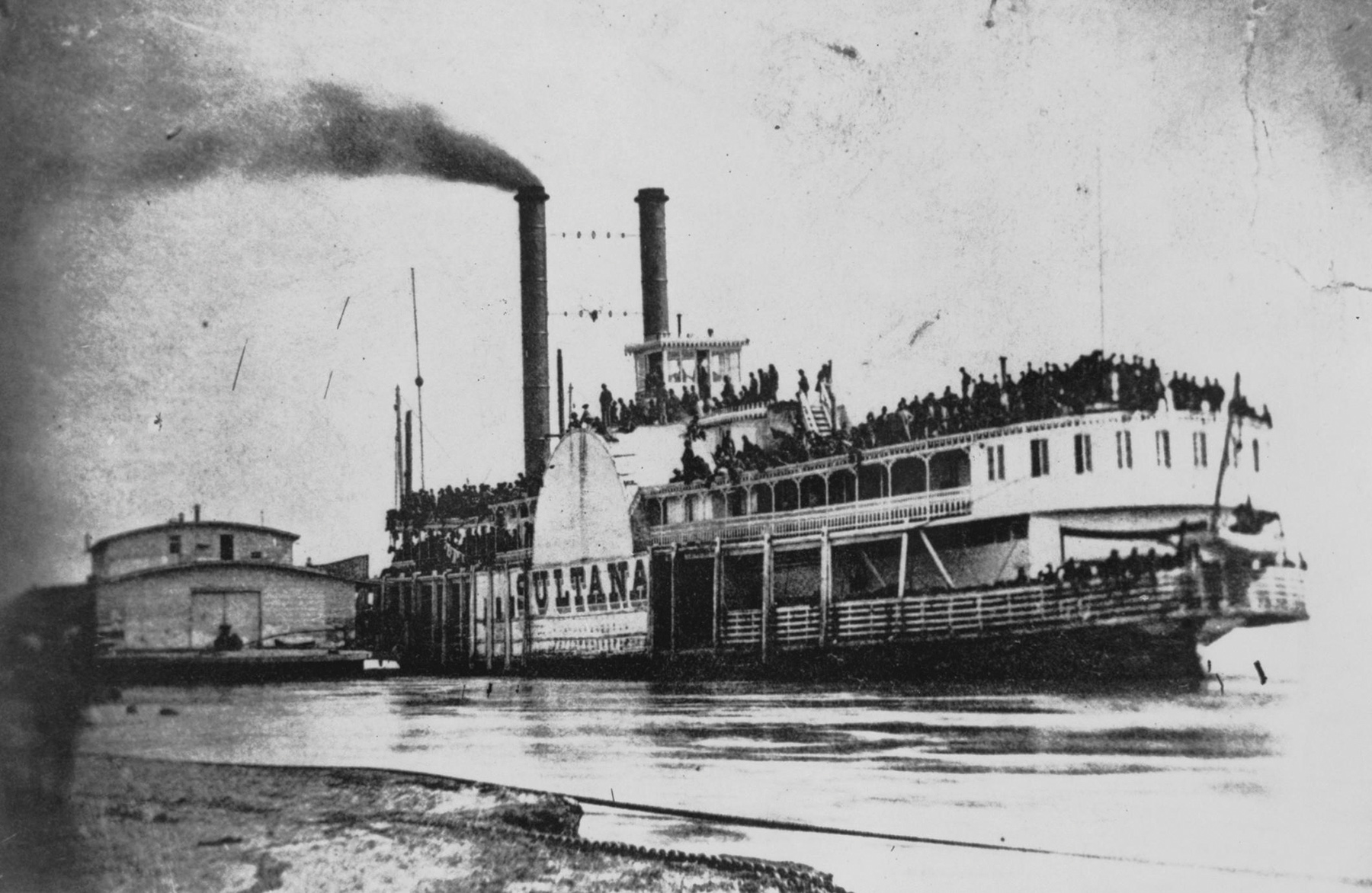
The Sultana was authorized to carry 370 people on a normal basis, but, at Vicksburg, some 2,100 soldiers came aboard, adding to civilian passengers and crew for a total of some 2,500 people aboard the vessel. Though two other steamboats were available to place some of the soldiers on for transport north, officers in charge insisted they all go on the Sultana. The military was paying $5 per enlisted man and $10 per officer on trips north. These revenues and the huge number of men entrusted to the boat later led to suspicion of bribery, greed and kickbacks. In any case, the steamer was grossly overloaded when it left Vicksburg, as shown in a photo taken at Helena.
Jerry O. Potter wrote an in-depth study of the disaster titled “The Sultana Tragedy, America’s Greatest Maritime Disaster,” that delves into the political and military reasons that resulted in so many people being placed aboard the vessel. It describes how passengers later said the Sultana would roll heavily from side to side due to the weight of the people crammed onto the upper decks. After a stop at Memphis to put off cargo, the boat departed at 11 p.m. April 26, the same day that John Wilkes Booth was killed, and moved up a short distance to take on coal.
After coaling, the Sultana got back underway upbound at 1 a.m. on April 27. At 2 a.m., just a few miles above Memphis, at the upper end of what is noted on modern navigation charts as Hopefield Chute, some of the boilers exploded in a massive blast. The resulting fire soon engulfed the wooden vessel. Since there was no truly accurate count of the soldiers loaded aboard, it was difficult to number those lost. The Customs Department at Memphis ultimately placed the death total at 1,547.
Capt. Mason and chief clerk Gamboel (this is the name according to Way’s, while Potter shows “Gambrel”) were lost, and second engineer Samuel Clemens, who had been on watch, died soon after due to his injuries. The steamboat inspectors first revoked the license of chief engineer Nathan Wintriger, but he appealed and did have it reinstated. The inspectors ultimately concluded that the boilers were low on water and judged Clemens to blame. The Army investigation found one officer, Capt. Frederic Speed, guilty of neglect of duty in allowing the mass of soldiers to be placed on the Sultana, but the judge advocate general and secretary of war refused to accept the verdict, so Speed was exonerated.
Because of the other riveting national news, the Sultana disaster was virtually ignored by newspapers and a general public numb to massive loss of life during the war. A Sultana Survivors Association was formed and had regular meetings for many years. In 1982, author Potter led a group that found what is thought to be the wreckage of the boat 32 feet beneath an Arkansas soybean field. Charred deck planks and timbers were found at the site, which is now two miles from the present river channel. Out of respect for the great loss of life, it was decided to leave the wreck undisturbed. The Sultana Disaster Museum was opened in Marion, Ark., near the wreck site in 2015, the 150th anniversary of the tragedy.
Featured photo caption: Famous (and only known) photo of the crowded steamer Sultana at Helena, Ark. April 26, 1865. Library of Congress. (Photo by Helena photographer T.W. Bankes)