

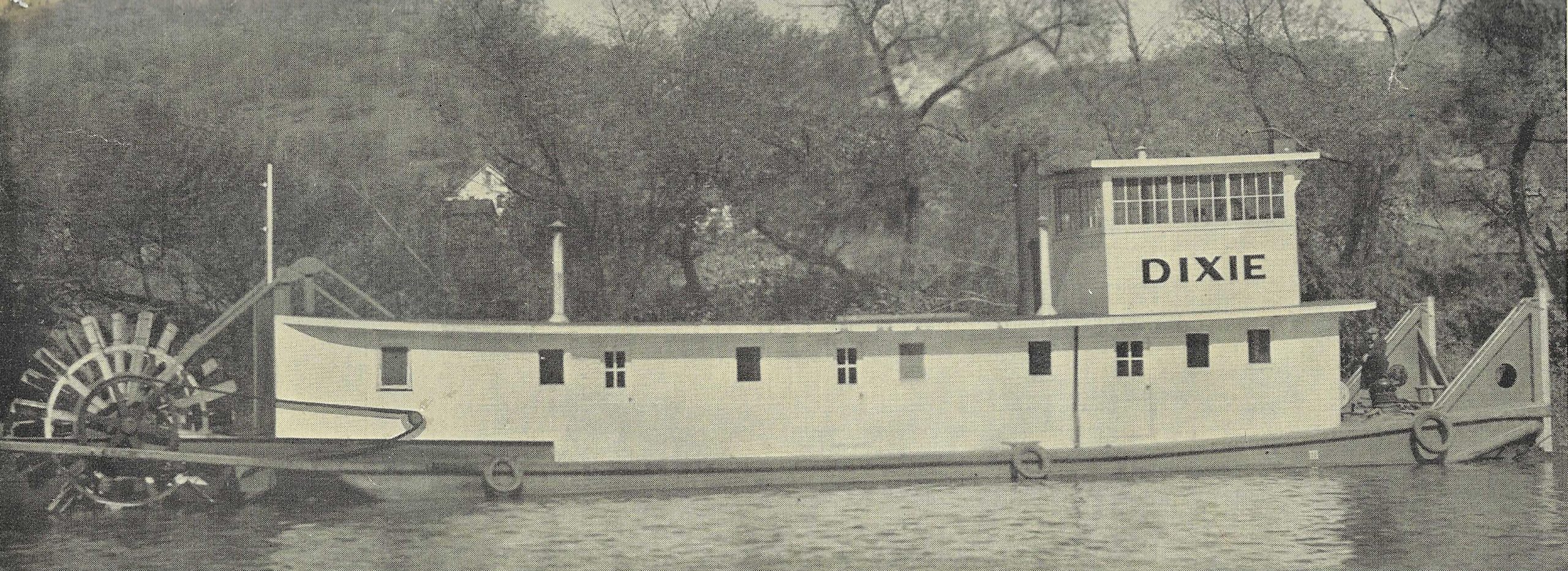
The Dixie Was The Last Sternwheel Towboat Built By Nashville Bridge
As with prior years, with the approach of the Inland Marine Expo (IMX) to be held at Nashville May 27-29, 2026, the Old Boat column will feature boats built by the Nashville Bridge Company (NABRICO) for the next couple of weeks.
NABRICO has been mentioned many times in this column since it became one of the premier inland shipyards over the years. In 1902, Arthur J. Dyer bought out his partner’s interests in the H.T. Sinnot Company and formed the Nashville Bridge and Construction Company. Following another reorganization in 1903 or 1904, it became known as the Nashville Bridge Company (NABRICO). It was headquartered in downtown Nashville, and, as the name implied, it was focused on the building of bridges.
In 1915, the firm constructed a small floating derrick hull for the U.S. Engineers, and this would mark a shift in the company toward marine construction. In 1923, NABRICO built the sternwheel towboat Harvey (The Waterways Journal February 12, 2021) for T.L. Herbert & Son. This 240 hp. boat was recognized as being the first fully diesel boat built for the inland rivers. In 1925 and 1926, NABRICO delivered the twin prop diesel boats Kosmortar and Kings Landing to the Kosmos Portland Cement Company (WJ May 22, 2023). The company would continue building sternwheel towboats while also perfecting its design of tunnel stern propeller craft.
In 1937, the same year that Dravo was building the revolutionary towboats Dravo 41 and Dravo 42 featured in the last column, NABRICO turned out a more traditional sternwheel towboat. This vessel was named Dixie and was owned by Capt. Frank W. Paden of Sardis, Ohio, on the Upper Ohio River. This boat would seem to be the last sternwheeler built by NABRICO.
J. Mack Gamble, long the author of the Upper Ohio News column in the WJ, wrote a story detailing the new craft in the November 6, 1937, issue, saying, “The Dixie, truly modern in both design and equipment, embodies many of Capt. Paden’s own ideas evolved during the time when he operated the diesel towboat Criterion in the Pittsburgh district, as well as the high quality workmanship and experience of the ace Cumberland River boat builders.”
The hull of the Dixie was all-welded steel and measured 76.5 by 18.8 feet, excluding the sternwheel. Gamble reported, “A unique feature of the hull design is that the stern bottom rake plating is brought up to the elevation of the wheel beams, a decided departure from the conventional transom.” The “staggered” sternwheel was of square dimensions, 12.5 by 12.5 feet, and was in two sections, each turned by a separate sprocket chain.
The boat was powered by a 160 hp. four-cylinder Fairbanks-Morse Model 35E-10 engine capable of turning 400 rpm. with a DC generator, turned by a 900 rpm. five hp. Stover diesel. The article in the WJ said that “the deck fittings are exceptionally heavy throughout. High towing knees of special design are adequate for handling empty barges.” The full lower cabin housed the engineroom and crew quarters consisting of two staterooms and a combined galley and dining room.
The pilothouse was described as a large “11 by 12 feet, is 30 inches above the roof and affords excellent vision for the pilot.” The pilot wheel was furnished by the Keck-Gonnerman Company of Mount Vernon, Ind. A single smokestack rose from behind the pilothouse. The engine control in the pilothouse was furnished by Fairbanks-Morse.
Since its inception in 1945, the Inland River Record (IRR) had listed the Dixie as having been owned by Paden, then sold to Standard Sand and Gravel Company, Wheeling, W.Va., with no noted date of sale, but the List of U.S. Merchant Vessels gives an interesting line of ownership. While Frank Paden is shown as the original owner in 1937, from 1939 to 1944 the owner is shown as W.H. Klieves. From 1945 to 1954, Charles S. Dickson is the owner, and, in 1955, it is Margaret A. Dickson, executrix of Charles S. Dickson estate. In 1948, the Dixie had been repowered with a 210 hp. F-M engine.
From 1958 through 1964, it was listed as owned by Margaret A. Dickson, and, in 1965, it was finally shown as owned by Standard Sand and Gravel (SSG). Since it was in the SSG fleet all those years and marked as such, it can be assumed that it was under bareboat charter to SSG. In 1966, it was sold to W.L. Johnson Towing Company, Shippingport, Pa., and, in 1971, to Sidney E. Johnson, Beaver Falls, Pa. In 1975, it was sold to Primo and Jan DiCarlo, East Liverpool, Ohio.
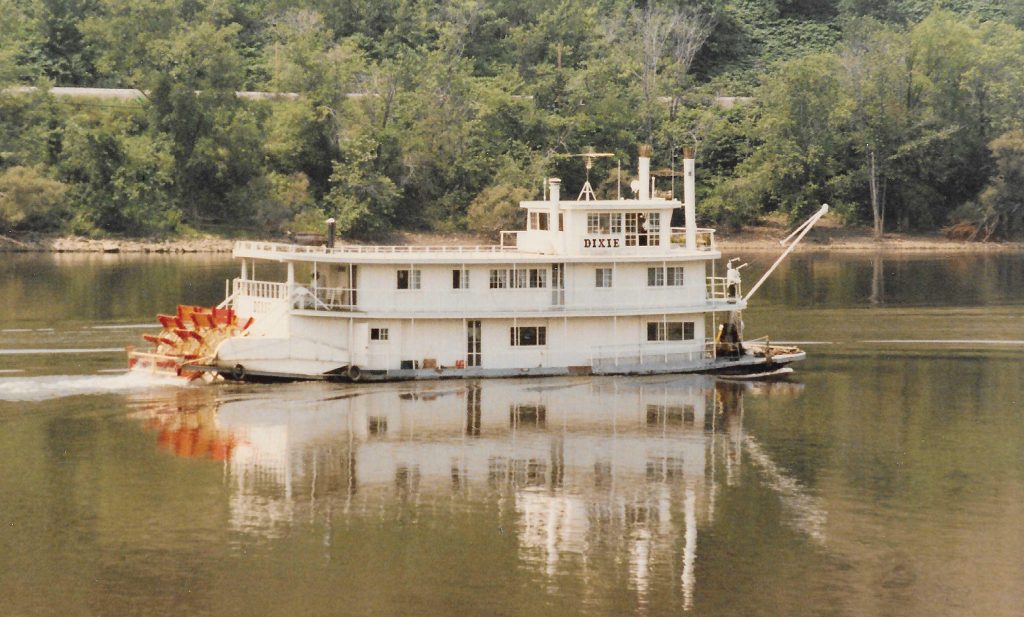
The DiCarlos were swept up in the pleasure sternwheeler craze of that time and planned to convert the towboat into a houseboat. In 1982, the boat was completely rebuilt by Capt. John Beatty at Warsaw, Ky. With new overall dimensions of 125 by 19.6 feet, it sported two full cabins surmounted by a pilothouse with twin stacks forward of that. It was also repowered with a GM 6-71 engine of 165 hp.
The boat sank at its moorings at Chester, W.Va., in 1985, but was raised. In 1998, it was sold to R.C. Heckert, Parkersburg, W.Va. It last appeared in the Off The Record section of the IRR with the notation “burned Aug. 5, 2003, at Parkersburg, W.Va.” It seems that the boat was rebuilt following this, and photos show it as again being a single deck with pilothouse, but no information has been furnished to the IRR.
Featured photo caption: The new Dixie shown in a Fairbanks-Morse ad on front cover of the November 6, 1937 WJ. (Photo from the author’s collection)