
Dredging Sector Adds Additional Capacity
Dredging continues to expand and modernize in the United States and throughout the world. In the United States, the government manages the nation’s navigable waterways as a valuable and economical method of transporting goods. Congress regularly authorizes and funds the expansion and maintenance of the ports and waterways. This guaranteed market for dredging services has led to private industry making huge investments in dredges, along with auxiliary vessels, crew, other workers and equipment required to operate them.
The U.S. Army Corps of Engineers, which historically performed most of the maintenance dredging, began divesting its dredge fleet in the 1970s, and today it maintains a minimum fleet for security, emergency and defense purposes. This guarantees sufficient annual work for a market-driven private industry to safely make large capital investments in new equipment.
The United States saw the addition of three major vessels in the past year: two trailing suction hopper dredges and one self-propelled rock fall vessel. A new government hopper dredge is under construction for delivery in late 2027.
Largest Dredge
Manson Construction Company’s new trailing suction hopper dredge Frederick Paup left Seatrium AmFELS shipyard in Brownsville, Texas, on January 28 and sailed to newly deepened Mobile Bay for a maintenance dredging job. Named for the company’s chairman of the board, the Frederick Paup is a 15,150-cubic-yard, 25,000-hp. dredge designed by Manson engineers in conjunction with the Hockema Group of Seattle. The dredge has dimensions of 420 feet by 81 feet with 31 feet of depth to the main deck. Discharge is through five pairs of bottom dump doors or by pumpout via a bow coupling. Propulsion and maneuvering are by three azimuthing stern drives and two bow thrusters. Two hull-mounted 34-inch dredge pumps run two hull-mounted dragarms. There is accommodation for 29 crewmembers. The Frederick Paup is the largest-capacity hopper dredge in the United States and also the largest possible dredge, as size is limited by the nature of harbors and channels in which it must maneuver.
GLDD Projects
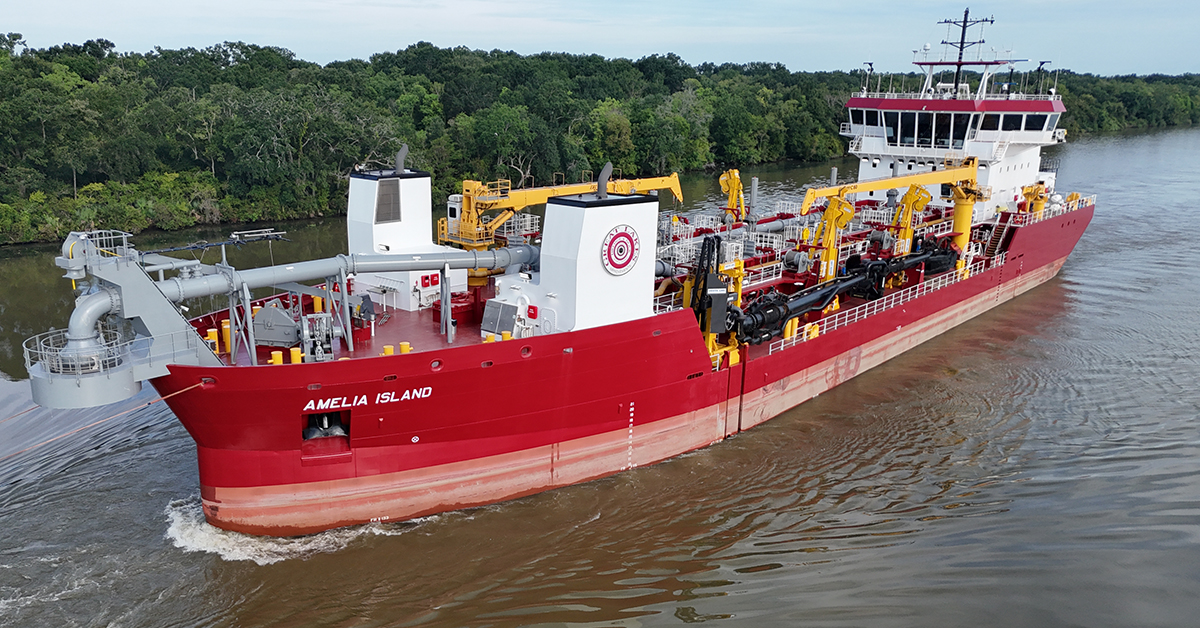
Great Lakes Dredge & Dock Company (GLDD) took delivery of the 6,330-cubic-yard hopper dredge Amelia Island from Conrad Shipyard in Morgan City, La., in August 2025. The dredge, sister ship of the company’s Galveston Island, measures 346 feet by 69 feet by 23 feet in depth, with 16,500 total installed horsepower. Two 800 mm (31.5-inch) dragarms are capable of dredging to 100 feet depth. The Amelia Island is designed for shallow projects on all U.S. coasts, ports and channels and is equipped with bottom doors and direct pump-ashore capability. After the naming ceremony in Galveston, the Amelia Island sailed to the Galveston seawall to perform maintenance dredging and beneficial use placement of beach quality sand on the west end of the seawall. In late April, it was at work in Myrtle Beach on the Grand Strand beach renourishment project. The Amelia Island brings GLDD’s hopper fleet to six vessels.
GLDD’s rock fall vessel, Acadia, built at Philly Shipyard, is undergoing sea trials this spring. The 461- by 112-foot vessel is designed for subsea rock installation to protect offshore wind turbine foundations and cables. It has a capacity of 20 metric tons of rock and a 7-meter operational draught. Equipped with two 2,500 kw propulsion thrusters, two 1,200 kW retractable thrusters and two 900 kW tunnel thrusters, it is capable of operating in challenging, deep-water and open-ocean conditions. Total investment by GLDD was $246 million for the vessel.
Its first contracts are with Equinore’s Empire Wind 1 windfarm, 15-30 miles south of Long Island in the New York Bight on the Outer Continental shelf, and Ørsted’s Sunrise Wind farm, 30 miles east of Montauk Point, Long Island on the Outer Continental Shelf, 18 miles south of Martha’s Vineyard, Mass. The U.S. Department of the Interior issued a stop-work order on these and three other East Coast ongoing projects on December 22, which was lifted by a federal judge on February 2, allowing the projects to proceed after incurring hundreds of millions of dollars in costs for idle equipment and labor.
William Hansen, GLDD vice president of marketing for Great Lakes, said of the Empire and Sunrise projects, “Work on these two projects will be started and completed this year. There have been some challenges to these projects, but they are still proceeding. After that, we have won work for the vessel in the UK, where the Acadia will work while we maintain the American flag in hopes of returning to work in the U.S. at some point.”
Saltchuck Acquisition Of GLDD
On February 11, Saltchuk Resources Inc, a privately owned family of diversified freight transportation, marine service and energy distribution companies headquartered in Seattle, announced that it would acquire Great Lakes Dredge & Dock Company, a move unanimously approved by both boards of directors and by GLDD shareholders. Great Lakes will operate as a standalone business within Saltchuk, and its common stock will no longer be listed on the Nasdaq.
“This is a great fit for both us and Saltchuk, and we are excited about the future opportunities,” Hansen told The Waterways Journal.
New Corps Dredge
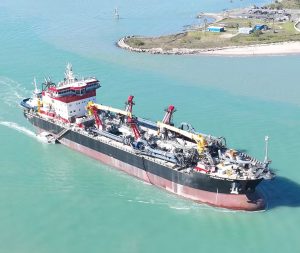
The U.S. Army Corps of Engineers began construction on the 6,000-cubic-yard trailing suction hopper Dredge Donnelly in April 2025 to replace the 3,148-cubic-yard Dredge McFarland, which has been in service for 57 years. The Donnelly will be delivered in late 2027 and will homeport at the Philadelphia Engineer District at Fort Mifflin on the Delaware River.
The vessel will measure 320 by 72 feet with a hull depth of 28 inches and is classed as a medium class hopper dredge. Two 25.6-inch diameter trailing suction pipes will dredge to a maximum depth of 65 feet at a 45-degree angle, powered by Royal IHC pumps. It is equipped with bottom dump doors and pump-out capability. The dredge is being built at Eastern Shipbuilding Group’s Allanton and Port St. Joe, Fla., facilities in close coordination with the Corps of Engineers Marine Design Center and Royal IHC, the designer of record. A Corps news release has reported that modular construction is progressing steadily, with unit builds and fabrication and assembly of key components continuing concurrently.
The dredge is named after the late Ray Donnelly, who retired as chief of resource management of the Philadelphia Engineer District in 2020. Upon retirement, he received the de Fleury Medal (Bronze Order) in recognition of his 44-year career in both the U.S. Navy and the Corps. He conducted the analysis of the four Corps-owned hopper dredges and the impacts of recapitalization on the national Civil Works program. Donnelly also worked in financial management of the Dredge McFarland.
Mobile Ship Channel Reaches Authorized Depth
Continuing the push by U.S. coastal ports to accommodate post-Panamax ships, the Alabama Port Authority announced that the Mobile Ship Channel had reached its authorized 50-foot depth on October 13. The Corps managed the Mobile Harbor Modernization Project to widen and deepen the channel in seven phases from 45 to 50 feet, which improved access to the port’s lower harbor terminals, including the McDuffie Coal Terminal, APM Terminals Mobile and the Pinto Island Steel Terminal.
The Alabama Port Authority and APM Terminals Mobile have announced plans for a new 1,300-foot container berth, a $131-million, 24-month construction project.
The Port of Corpus Christi Ship Channel Improvement Project was officially completed and celebrated in June 2025, deepening the channel to 54 feet Mean Lower Low Water (MLLW) and widening it to 530 feet. This $625 million project allows for larger vessels and two-way traffic, enhancing energy exports. More than 40 million cubic yards of dredged material were beneficially used, including 5 million cubic yards for marsh restoration in Corpus Christi and Nueces bays. The work also created sacrificial erosion protection and a new breakwater.
Port Houston Ship Channel Expansion
By late 2025, Port Houston had completed its portion of the Houston Ship Channel Expansion – Project 11 dredging, widening the channel from 530 to 700 feet from Bolivar Roads to Morgan. The Corps is managing the remaining segments of the project, including the upper turning basin and Barbours Cut. The project is on schedule to be completed by 2029.
Sabine-Neches Project Ahead Of Schedule
The Sabine-Neches waterway project to deepen the 77 miles of channel to 48 feet from the existing 40 feet is underway and expected to be completed eight years ahead of schedule due to increased federal funding assigned to the project. The project will provide deep-draft access to an area dense with industry. The channel begins in the Gulf, 18 miles from the Port of Sabine Pass, and inland from Sabine to Port Arthur, Beaumont and Orange. On April 14, the Sabine-Neches Navigation District (SNND) awarded a $239 million dredging contract to Callan Marine Ltd., to remove 20 million cubic yards of material, providing 44 feet of draft from Taylor Bayou to the ports of Port Arthur and Beaumont, with completion required by April 15, 2028.
Anchorage Cargo Terminal
Finally, the Don Young Port of Alaska in Anchorage has begun an $807 million cargo terminal project to replace deteriorating infrastructure with a seismically resilient 870-foot by 120-foot steel pile-supported concrete wharf structure and two steel-pile supported concrete deck access trestles. Manson Construction Company has retrofitted its DB Wotan for the project, including: replacing the 200 foot boom tip with a new 220-foot configured tip to increase speed and capacity for piledriving operations; constructing a larger crane house, expanding the original structure by 4 feet in height and 10 feet in width; installing two new Tier 3 main generators; and upgrading the boom and gantry catwalk for easier maintenance access.
Notable navigation contracts awarded in the past year include a $19.5 million New Orleans District contract to Pine Bluff Sand and Gravel Company for stone placement at Neptune Pass; a $9 million Buffalo District contract to DMYLES Inc. for Cleveland Harbor dredging; and a Memphis Engineer District $43.9 million design-build contract for the first automated mat-casting facility on the Lower Mississippi — the largest contract in that district’s history.
Beneficial Use Target
The Corps has set a national goal of beneficially using 70% of dredged material by 2030, causing project planning to include maximum beneficial use. In his GIWW Legislative Report this year, Texas Department of Transportation Maritime Director Geir-Eilif Kalhagen reported that his office is “partnering with stakeholders to develop a beneficial use master plan to identify sites where we can create or restore marshes, build bird islands and more.”
The Atlantic Intracoastal Waterway continues to provide protected navigation for barge and recreational traffic in the 1,100 miles from Norfolk, Va., to Key West, Fla. The annual appropriation includes funding for dredging numerous inlets, crossings, hard infrastructure and for emergencies. Stakeholders and advocates take an active part in ensuring that federal funding is authorized and provided for the waterway.
GIWW Contracts
The Gulf Intracoastal Waterway provides a 12-foot-deep, 150-foot-wide channel behind barrier islands for commercial barges and recreational boaters from Apalachee Bay, Fla., to Brownsville, Texas. The Texas segment is 379 miles long and requires approximately 8 million cubic yards of maintenance dredging annually. As of March, two maintenance dredging contracts are active, with four more in design.
Responding to a need for small, portable dredging equipment in remote areas, Wing Marine has developed a system that uses a specialized fluidizer wing device to create a controlled, low-altitude wave of sediment along the bottom, rather than dispersing it throughout the water column. The system combines the patented wing sediment-mobilization device with high-capacity pumping, all packaged into a modular dredge that can be transported by truck and assembled on site.
Featured photo caption: The Amelia Island, the second in a set of hopper dredges built by Conrad Shipyard for GLDD. (Photo courtesy of GLDD)