

The John J. Kelly Began As A Steamboat
One of the growing companies operating on the inland rivers today is Hines Furlong Line, which traces its history back some five generations to Capt. Richard T. Williams, who had a sawmill boat in the 1870s and later was a principal in the Bowling Green and Evansville Packet Company, operating steam packets from Evansville, Ind., on the Ohio River to points on the Green and Barren rivers in Kentucky.
James R. Hines, the grandson of Capt. Williams, began a company about 1940 that was based at Bowling Green, Ky., and engaged in towing barges on the Green, Barren and Nolin rivers. In the beginning, the James R. Hines Company utilized the Queen of Dycusburg, a small steam sternwheel packet converted to towing, the New Hanover, a diesel sternwheel packet repurposed as a towboat and the steam sternwheel towboat Betty Turner.
Much of the cargo moved by barge at this point consisted of rock asphalt, a bituminous sandstone that was naturally impregnated with asphalt. This dry rock was mined extensively throughout the region, shipped by barge and railroad to places where it was crushed and pulverized into a paving material for roads. The Kentucky Rock Asphalt Company built a company town along the Nolin River that was incorporated in 1918 as Kyrock, Ky. The company had eight quarries near the town and a large loading tipple on the river.
In addition to this, the Hines company also began moving gasoline by barge. As business continued to increase, another towboat was needed. An ad in The Waterways Journal in January 1943, showing a diesel sternwheel towboat for sale, may have prompted the acquisition of that vessel for the growing concern.
In 1915, a small steam sternwheel towboat was built at Dubuque, Iowa, for Beder Wood, Jr. Named Beder Wood, it had a steel hull that was 80 by 22.5 feet. The engines were built by Gillett & Eaton, Lake City, Minn., and were 10 inches in diameter with a 5-foot stroke powered by two boilers. Photos show the boat having a single cabin with a pilothouse situated forward above that. Tall smokestacks rose on each side of the pilothouse.
One close-up picture of it tied in a fleet must have been taken years later as it depicts a tired-looking craft with a wooden cabin. An odd-looking whistle of three barrels was mounted on the port side of the pilothouse, the two outboard ones angled out. The Beder Wood was apparently repossessed in 1937 as the List of Merchant Vessels of the United States (List) shows ownership under the Moline Mortgage Loan Company. Way’s Steam Towboat Directory indicates that the bank “sold” the Wood to “C.F. Adams and others in September 1937,” who towed coal from St. Louis to Davenport, Iowa.
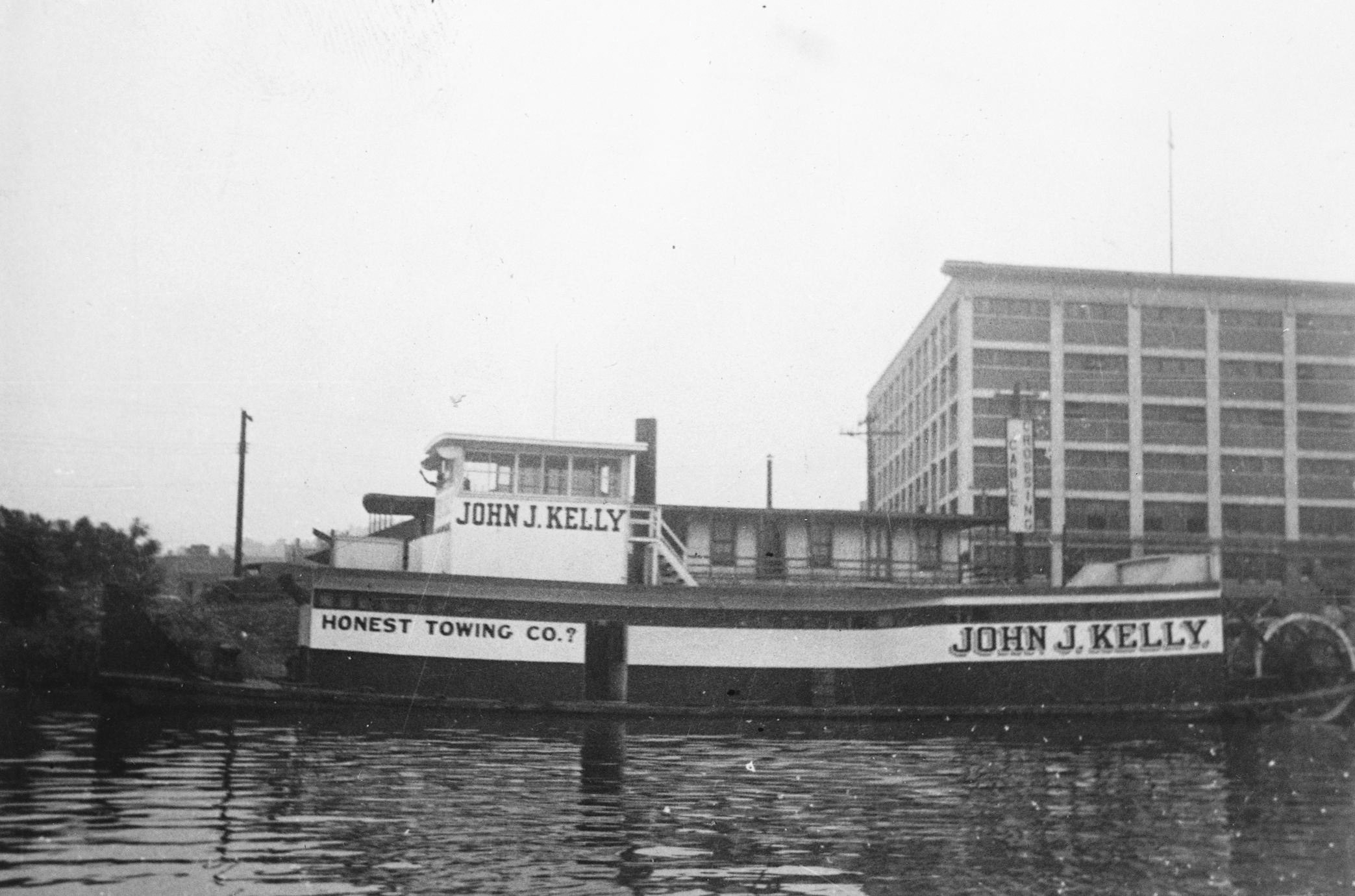
The sale may have been a charter arrangement as the List shows the Moline financial institution as owner until 1942. Boat broker John F. Klein of Pittsburgh purchased the vessel and promptly resold it to Earl Webster, who rebuilt and converted the boat to diesel power, renaming it John J. Kelly. Photos taken at Pittsburgh just after this show the boat with a company name of Honest Towing Company on the forward bulkhead while another shows it with Webster Towing Company.
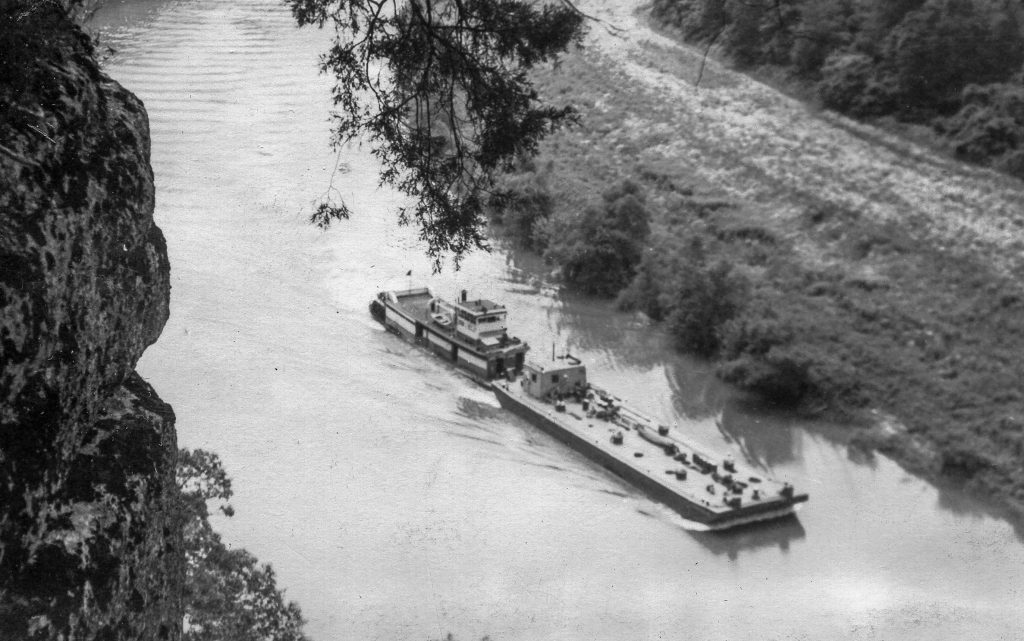
An ad in the January 9, 1943, issue of the WJ contains a stern quarter photo of a pristine vessel offered for sale by Webster. The copy in the ad says, “Diesel boat, steel hull, 22 (feet) by 90 (feet), 320 hp. Fairbanks engine, 10 compartments, fuel tanks separate in hull, three balance rudders. Air steer gear, double chain on each side. Everything New, Handling Done in Pilothouse.” According to the initial editions of the Inland River Record, the Kelly was sold to the James R. Hines Company in May 1943, making it the most powerful boat in that fleet at the time and the first with a steel hull.
After the rebuilding by Webster, it appears to have a new, larger pilothouse with a single stack rising behind it. Photos of the boat under Hines ownership show it always looking well kept. It became a familiar sight along the Green, Barren, Kentucky and middle Ohio Rivers, often towing gasoline and other oil products. At some point, a small cabin was added behind the elevated pilothouse.
The John J. Kelly continued in service for Hines until August 29, 1958, when it caught fire and burned near Rising Sun, Ind., on the Ohio River. Barry Griffith, related to the Hines family and whose father worked for the firm, was then about 13 years old and says he remembers everyone running out of the company offices at Bowling Green, Ky., to head to the scene of the fire.
Other than the steel hull and some metal framing, there was not much left of the Kelly. The wooden superstructure had completely burned away. Griffith says that the hull was moved first to Jeffboat at Jeffersonville, Ind., and was then sold to a company at the mouth of the Green River for use as a landing boat.
Featured photo caption: The John J. Kelly at Pittsburgh after the 1943 rebuilding. (Photo from the author’s collection)