

A 103-Year-Old Showboat May Have A Home At Last
The stern line rumor mill was flying last week with talk that the Showboat Majestic may finally have a home to go to.
Showboats were once a common sight on the inland rivers of America. Beginning early in the 19th century, somewhat crude craft began appearing that were floated downstream, stopping at towns and providing entertainment to isolated settlements. Most often this was in the form of plays that would range from simple dramas to something from Shakespeare.
Just prior to the Civil War the “floating theaters” became a more elegant craft, somewhat like the packets of the day, and were moved by steam sternwheel towboats, allowing them to go both up and downstream. Music and dancing were often featured in the productions aboard, as well as museum exhibits. This all lent to an air of excitement when one of these showboats would arrive at municipalities both large and small.
The hostilities of the Civil War brought an end to the traveling entertainment centers, at least temporarily. Even with the war over, the unrest of the Reconstruction era kept most from venturing along the rivers. By the late 1870s, they began to reappear. The popularity of the showboat was so infectious that many wound up being built, some so opulent that they rivaled theaters built in towns.
The early 20th century saw the showboats still a favorite means of amusement and diversion from a somewhat hard life for small communities dependent on the river system for travel and supply. With names like New Sensation, Sunny South, Cotton Blossom and Goldenrod, these vessels were advertised for a time before their arrival, often with elaborate posters that had the populace eagerly anticipating their arrival. The shows presented changed to melodrama and vaudeville.
Capt. Thomas Jefferson Reynolds was a long-time showboat owner. His first such vessel had been the Illinois, which was described by his son Tom Reynolds Jr. in the June 1968 S&D Reflector as a multi-use craft that was “a junkboat, dishboat and showboat all combined.” The Reynolds family lived aboard, and, when the Illinois burned in 1916, Capt. Reynolds’ young son Norman died of injuries suffered in the blaze.
In 1917, Capt. Reynolds, with his father and brother, built the showboat America, which was moved about by a small boat named Ida Mae. In 1923, they built a new showboat at Pittsburgh. It was 135 feet long and of completely wooden construction. The theater was on the main deck, and a full second deck contained living quarters. A pilothouse was situated on the roof. This new craft was christened Majestic, and, to tow it, a new sternwheel gasboat named Attaboy was built at the same time.
Capt. T.J. Reynolds operated the Attaboy, which had a wood hull of 75 by 16 feet and was powered with a one-cylinder Fairbanks-Morse gas engine of 40 hp. He had cables rigged to the pilothouse on the Majestic so that the flotilla could be steered and controlled from there. A calliope was on the roof of the Attaboy, with a small boiler providing steam. The Majestic roamed all over the Ohio and tributaries in the warm weather months, including small streams like the Green, Kentucky, Muskingum and Cumberland rivers. It would winter in the mouth of the Kanawha River.
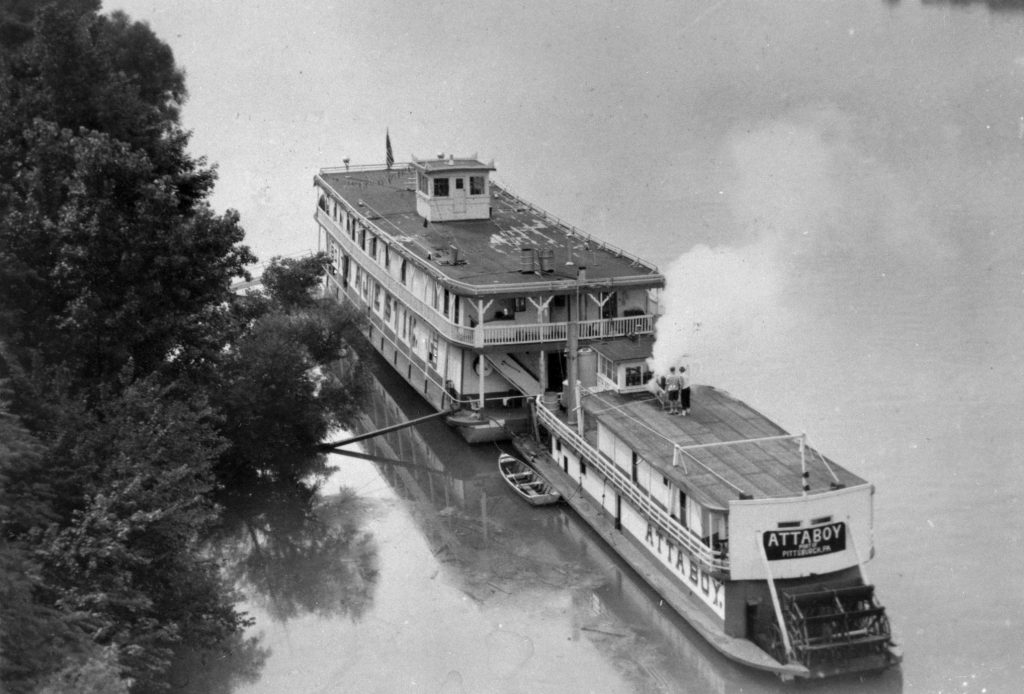
Capt. John Reynolds, who was widely known by many contemporary rivermen, was born aboard the Majestic in 1933 and lived his first 16 years aboard the showboat. In 1949, the Attaboy was repowered with a Caterpillar diesel engine of 135 hp. In the late 1940s and 1950s, Capt. Reynolds partnered with Hiram College, Kent State University and Indiana University, where the schools would have their students present summer theater aboard while Reynolds operated the vessels from town to town as before.
In August 1959, the Majestic and Attaboy were sold to Indiana University for a reported $30,000, with Reynolds still caring for the running of the Attaboy. While in winter quarters in the mouth of the Kanawha on December 15, 1959, Capt. Reynolds had gone from his home at Point Pleasant, W.Va., over to where the vessels were tied at Henderson, W.Va., to check on them. He somehow fell into the river and, tragically, drowned.
Indiana University renamed the Attaboy I.U. and continued to run the vessels. The I.U. received a new steel hull in 1965 and, about the same time, the wooden hull of the Majestic was encased by one of steel. The Majestic was the last roving showboat when, in 1967, both vessels were moored at the Cincinnati public landing as a municipal venture. According to the late Capt. Bill Judd, the I.U. was dismantled at Tucker Marine, Cincinnati in 1970. A steel cabin was placed on the hull, and it then served as a transient boat landing moored below the Majestic.
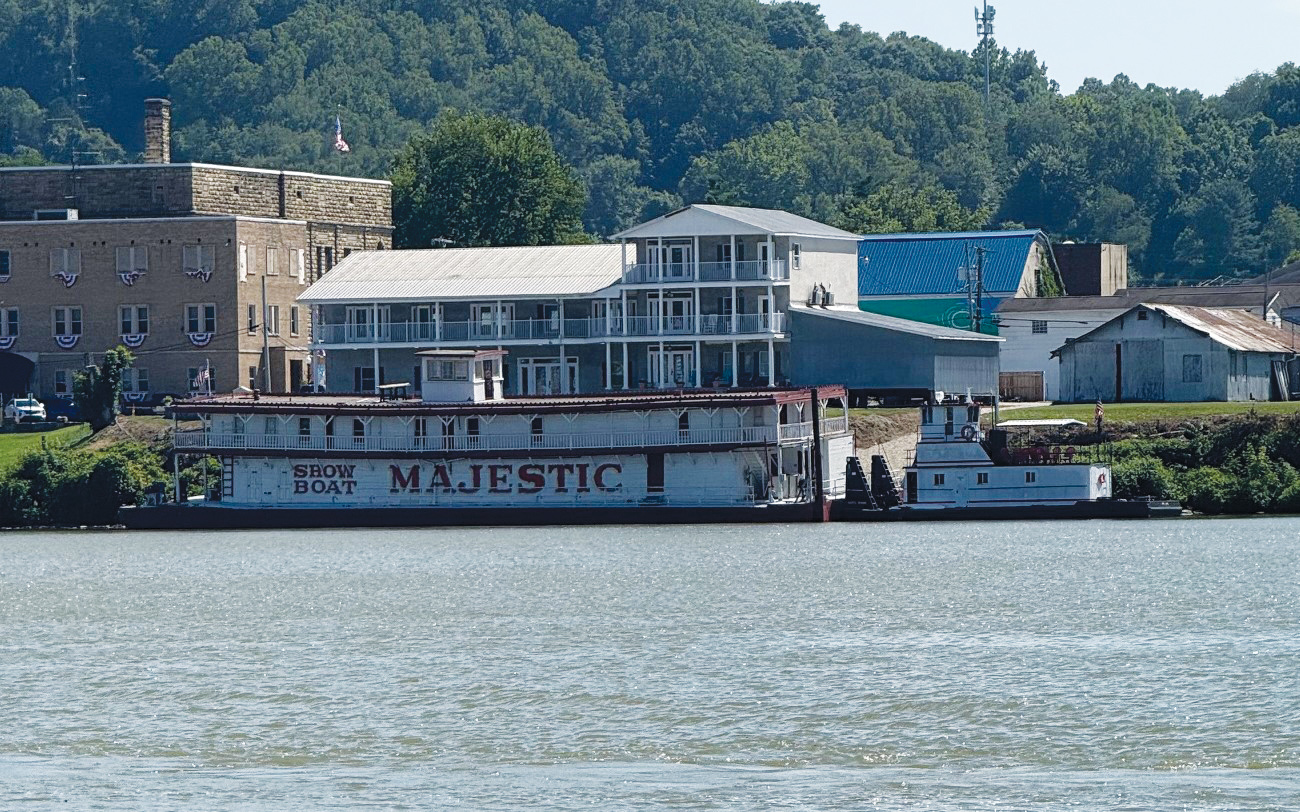
In 2019, the Majestic was sold at public auction to a private owner. Since that time, it has been moored at several locations, seeming never to find a true place to rest. It was first moved to Manchester, Ohio, then New Richmond and Portsmouth, Ohio, and is now at Greenup, Ky. The recent rumors say it is now to go to Aurora, Ind., to become a “live entertainment venue.” Perhaps this historic showboat will finally find a place to rest its weary bones.
Featured photo caption: The Majestic tied at Greenup, Ky., June 30, 2026. (Photo from the author’s collection)