
GICA Session Stresses Waterway Reliability
Aging infrastructure, federal funding, hurricane readiness and a new effort to manage the Gulf Intracoastal Waterway more cohesively dominated discussion at the Gulf Intracoastal Canal Association’s 2026 annual seminar.
GICA leaders said the association spent much of the past year responding to operational disruptions across the waterway, including high water at the Brazos River Floodgates, lock delays and repairs at Calcasieu, bridge problems in Louisiana and tropical weather impacts.
GICA distributed more than 560 bulletins during the year, with more than 167,000 recipient accesses, while advocating for improvements to some of the waterway’s most consequential infrastructure.
That work increasingly centers on a central premise repeated throughout the seminar: the GIWW functions as one transportation system, regardless of district or state boundaries.
Corps Launches GIWW Task Force
The U.S. Army Corps of Engineers’ New Orleans, Galveston and Mobile districts are formalizing that idea through a GIWW Task Force designed to improve coordination and develop a 10-year capital investment plan for the waterway.
The initiative grew from the Corps’ Building Infrastructure Not Paperwork effort and is intended to produce a more unified approach to maintenance, closures, dredging, infrastructure priorities and communication with industry.
The New Orleans District commander described the objective as “operationalizing the GIWW.”
“You don’t want one set of rules in Galveston District, a different set of rules in New Orleans and a different set of rules in Mobile,” he said.
Initially, the effort is straightforward: representatives of the three districts and other stakeholders are meeting regularly to coordinate priorities and share information. Longer term, the Corps wants the task force to help identify risks across the entire system and rank work accordingly rather than having each district address needs largely within its own boundaries.
That could mean weighing a lock problem in Louisiana against a floodgate problem in Texas or a shoaling issue elsewhere and developing a common message about which investment carries the greatest systemwide consequence.
A Corps snapshot illustrated the scale of what is at stake. At one point during an ordinary weekday, officials counted 965 vessels operating on the GIWW.
The Galveston District also reported progress on its maintenance dredging program. Work from High Island to Matagorda was nearing completion, while two contracts had recently been awarded for southern reaches extending from Matagorda Bay toward Port Isabel. That work is expected to continue into spring 2027.
Corps officials said improved cross-district coordination could also allow dredging assets and maintenance dollars to be deployed more efficiently. One potential tool is expanded use of crowdsourced bathymetry to identify developing shoaling more quickly.
IHNC Moves Closer To Design
The century-old Inner Harbor Navigation Canal Lock remains one of GICA’s highest infrastructure priorities.
The lock was authorized for replacement in 1956, but it has remained in service through decades of planning, litigation and delay. Corps officials told seminar attendees that the replacement project is now farther along than at any previous point.
The public comment period is scheduled to close August 25. Following completion of the federal decision process, the Corps expects to move into approximately three years of design.
The New Orleans District commander emphasized the consequence of failure at IHNC. The structure is the only lock connecting the Mississippi River with that portion of the GIWW. A closure would force traffic onto an alternate route estimated at roughly 17 days.
The commander said the lock would remain operating during the planned replacement construction.
Funding Mechanism Remains Major Risk
Waterways Council, Inc. Executive Director Tracy Zea offered a broader assessment of the inland waterways construction program and warned that the industry’s challenge is not simply identifying projects or even having money available in the Inland Waterways Trust Fund.
Getting that money appropriated to specific projects remains the obstacle.
Zea said only three inland waterways megaprojects have been completed during the past 28 years: Olmsted Locks and Dam, the LaGrange Lock and Dam major rehabilitation and the Lower Monongahela River project.
“That’s not acceptable if we want to have a modern, efficient system that can be reliable and competitive into the future,” Zea said.
He pointed to Kentucky Lock as a cautionary example. The project has been under construction for decades and has experienced significant cost growth. Zea said WCI supports having projects much farther along in design before construction begins, allowing the Corps and industry to better understand costs and risks before large contracts are awarded.
WCI’s current priorities include Montgomery Lock and Dam on the Ohio River and Lock and Dam 25 on the Upper Mississippi River. The House fiscal year 2027 Energy and Water Development appropriations bill included $167 million for Montgomery and $250 million for Lock and Dam 25.
Zea noted that those were among the largest congressional earmarks in the appropriations process — a fact that illustrates the problem the inland waterways program faces.
Major projects increasingly require individual appropriations of hundreds of millions of dollars over consecutive years. Persuading lawmakers to repeatedly request earmarks of that size, Zea said, is difficult politically even when the projects are authorized and the trust fund has sufficient resources.
“The good news,” he said, pointing to the trust fund balance, “is we have plenty of money to pay for these.”
The problem is moving those funds through Congress to the Corps.
That issue becomes particularly important if Congress operates under a full-year continuing resolution instead of passing regular appropriations legislation. Under a CR, project-specific congressional earmarks can disappear into broader Corps funding accounts, leaving the eventual distribution of those funds largely to the administration.
WCI fears that could redirect money away from new inland navigation construction and toward other Corps priorities, disrupting schedules for Montgomery, Lock and Dam 25 and projects waiting behind them.
For the Gulf, that queue includes Port Allen Lock.
Under the Corps’ current program outlook discussed by Zea, substantial construction funding for Port Allen may not arrive until fiscal year 2033 because Kentucky Lock and Lock and Dam 25 consume significant funding in earlier years. Zea said supplemental appropriations or other funding mechanisms could provide an opportunity to advance work sooner.
He noted that the Gulf Coast has historically received relatively little from the fuel-tax-supported construction program despite the volume of traffic moving through the region.
Brazos Is Immediate Concern
If IHNC represents a major long-term replacement need, operators described the Brazos River Floodgates as an immediate operational problem.
Towing representatives discussed recurring contacts with the structures, difficult currents, limited clearances and conditions that can vary significantly with water levels. Several companies have changed internal operating procedures, requiring risk assessments, additional communication or more experienced personnel before transiting during difficult conditions.
Operators also pushed for construction activity to occur at night when possible, leaving daylight hours for vessel transits.
“Don’t depend on a single source of information,” one operator said, describing guidance given to towboat crews. “Talk to the boat that just went ahead of you, and find out what it’s like.”
Industry representatives again urged removal of the West Gate and continued movement toward the broader Brazos replacement project.
One exchange summarized the concern. Asked how long an alternate route would take if Brazos suffered a catastrophic failure, an industry representative answered simply: “There is no go-around.”
Cruise Line Expands To GIWW
A new type of GIWW user also addressed the seminar.
American Cruise Lines, one of GICA’s newest members, outlined its expansion onto the Gulf Coast and its need to operate alongside commercial towing traffic.
The company completed three development cruises in March between New Orleans and Pensacola. The seven-night round-trip cruises originated in New Orleans and were sold out, according to the company.
American Cruise Lines plans additional Gulf cruises in November and December, followed by further expansion in 2027.
The company operates shallow-draft passenger vessels designed for river and coastal service, typically carrying fewer than 200 guests. Its fleet has grown from nine vessels in 2018 to an expected 27, while the number of communities served is projected to increase from 85 in 2018 to 162 next year.
The company emphasized that its presence on the GIWW makes communication with towboat operators, the Coast Guard and Corps particularly important.
“We know we’re not alone on the water,” the American Cruise Lines representative said.
Its vessels are designed with high maneuverability, multiple propulsion systems and bow thrusters, allowing them to hold position or yield to large tows in confined waterways. The company said it sees membership in organizations such as GICA as part of being both a waterway user and an advocate for the infrastructure it relies upon.
Flood Protection And Hurricane Readiness
Navigation reliability around New Orleans also is increasingly intertwined with post-Katrina flood protection infrastructure.
Jesse Noel, regional director of the Southeast Louisiana Flood Protection Authority-West, said the West Bank system protects approximately 250,000 residents and $41 billion in infrastructure.
The Westclosure Complex and Harvey Canal sector gate directly affect GIWW navigation during major weather events. At Westclosure, a projected surge of 4 feet or greater can trigger preparations for closure.
“We don’t get any second chances in flood protection,” Noel said. “Every inch of it has to work.”
The authority’s goal is to provide at least 24 hours for evacuation of the regulated navigation area before a closure, although rapidly developing storms can shorten that window.
Lt. Cmdr. Jake Gamble, waterways chief at Coast Guard Sector New Orleans, said recent storm operations demonstrated both the value of coordination and the need to make decisions quickly as tropical systems develop.
One lesson was the importance of suspending bridge curfews when necessary to give commercial vessels maximum time to clear regulated navigation areas.
Coast Guard Heartland District Commander Rear Adm. Will Watson likewise emphasized readiness and the relationship between the marine transportation system and national interests.
“Economic security is national security,” Watson said.
Watson highlighted continued Coast Guard investment in the Inland Waterways Cutter program, aids-to-navigation technology and cybersecurity while emphasizing continued coordination with industry and the Corps.
Workforce And Mariner Wellness
Workforce development and mariner health were addressed in separate sessions at the seminar, with speakers focusing on both attracting new mariners to the industry and retaining those already working aboard vessels.
Representatives of the Seamen’s Church Institute discussed findings from its U.S. Inland Mariner Wellness Assessment, developed with the Yale School of Medicine and published in January.
The report identified a range of health and wellness concerns among inland mariners, including fatigue, chronic sleep disruption, elevated blood pressure and metabolic risks, anxiety, depression, substance use and a reluctance to seek mental health care.
SCI representatives said many of those issues are compounded by the nature of vessel work, including extended time away from home, isolation, relationship difficulties and limited access to counseling and other resources while aboard.
The organization encouraged vessel operators to strengthen what the report describes as a “culture of care,” in which mariners are more comfortable seeking assistance and companies recognize the connection between physical and mental health, safety, job satisfaction and retention.
SCI chaplains said calls from mariners frequently involve family and relationship problems, financial pressure, sleep deprivation and isolation — many of the same stressors identified in the Yale study. Speakers also pointed to nutrition, exercise opportunities and crew cohesion as areas companies can address aboard vessels.
In a separate session, officials with the Louisiana Maritime Academy at Nicholls State University outlined progress toward establishing what would become the nation’s seventh state maritime academy.
The academy is initially developing a marine transportation degree program leading toward an unlimited third-mate license. While the degree itself has been approved by the Louisiana Board of Regents, much of the maritime curriculum must also receive Coast Guard approval.
Academy officials said they are continuing that curriculum development process while preparing for additional discussions with the Maritime Administration. MarAd recently invited academy representatives to Washington to provide more information on the need for another state maritime academy and the role the Louisiana program would fill.
Sea service will be another major component of the program. Cadets pursuing an unlimited license will need 360 days of sea service, requiring partnerships with vessel operators willing to provide berths and opportunities to complete required assessments.
Academy officials said they have received verbal support from numerous maritime companies and are beginning the process of seeking more specific commitments for cadet placements. The program also intends to expose cadets to the towing industry and, where possible, provide opportunities to work toward towing-related endorsements and assessments.
Longer term, the academy plans to develop an unlimited engineering program, although officials said the immediate priority is securing approval and resources for the deck program.
A new facility is also planned at Nicholls State, with simulators and other maritime training equipment included in the broader development plan. Academy officials said Louisiana and university leaders are developing a fundraising strategy with industry, while federal support has also begun to emerge. The most recent federal appropriation included $1 million for aspiring state maritime academies.
For now, academy officials said the focus is on completing the Coast Guard approval process, establishing the sea-service partnerships and assembling the resources needed to begin the approved program.
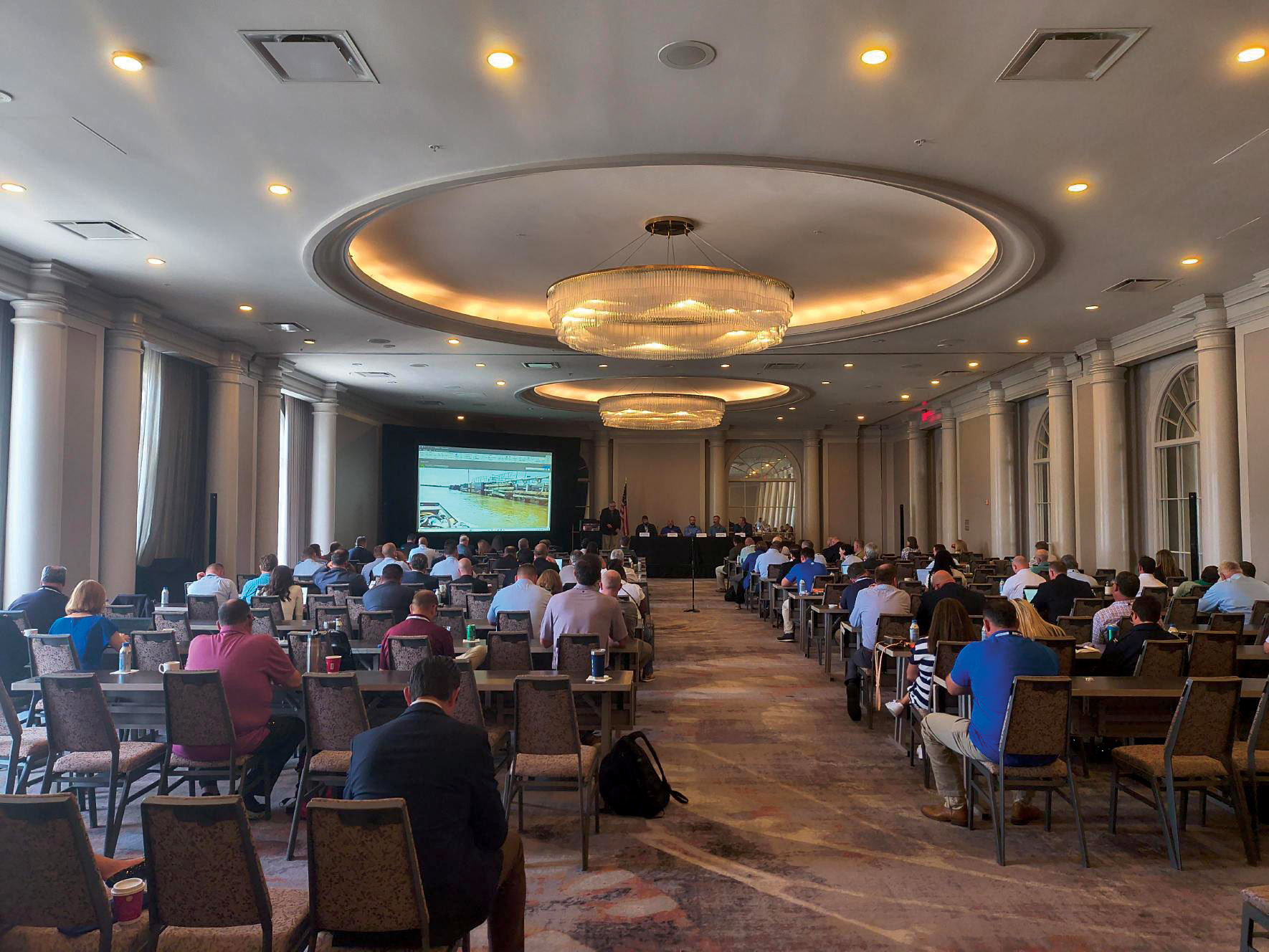
Featured photo caption: Attendees listen during the Operators’ Panel at the Gulf Intracoastal Canal Association’s 2026 annual seminar, where operators discussed navigation challenges and infrastructure concerns along the GIWW. (Photos by Zac Metcalf)