
Missouri River Regional Roundup: Port KC Revitalization Addresses Industrial, Recreational Needs
Port KC has undergone a major transformation, with $12 million in improvements over the last 18 months to its bulk terminal alone.
The project is part of the port’s multi-pronged effort to revitalize the Kansas City riverfront. Since 2015, it has acquired or redeveloped roughly 800 acres and invested $1.65 billion, including industrial, residential and recreational spaces connected by hiking and biking trails and highlighting historic railroad bridges and public art installations.
“We really are turning our focus on not just letting people see the river but explore the shoreline,” President and CEO Jon Stephens said.
The development has been aided, in part, by $37 million in dedicated state funds in the 2024 Missouri budget, which built on a $9.88 million federal Port Infrastructure Development Program (PIDP) grant from 2020. A $2.5 million Federal Railroad Administration grant funded design and safety studies concerning providing multimodal access and rail crossings near the riverfront.
Bulk Port Revitalization
For 40 years up until 2015, Kansas City didn’t have a functioning riverport terminal, Stephens said. Then a study meant to help determine the limitations on movement of goods along the river determined the need for investments in ports on the lower Missouri River.
Port KC was founded as an independent public agency, a federal tax-exempt nonprofit group that promotes shared business interests. Its seven-member board reports to the mayor of Kansas City, Mo.
Getting the bulk port up and running again was one of the initial priorities, Stephens said.
“We took a risk and started investing in the infrastructure, bringing the port terminal back online and acquiring the land,” he said.
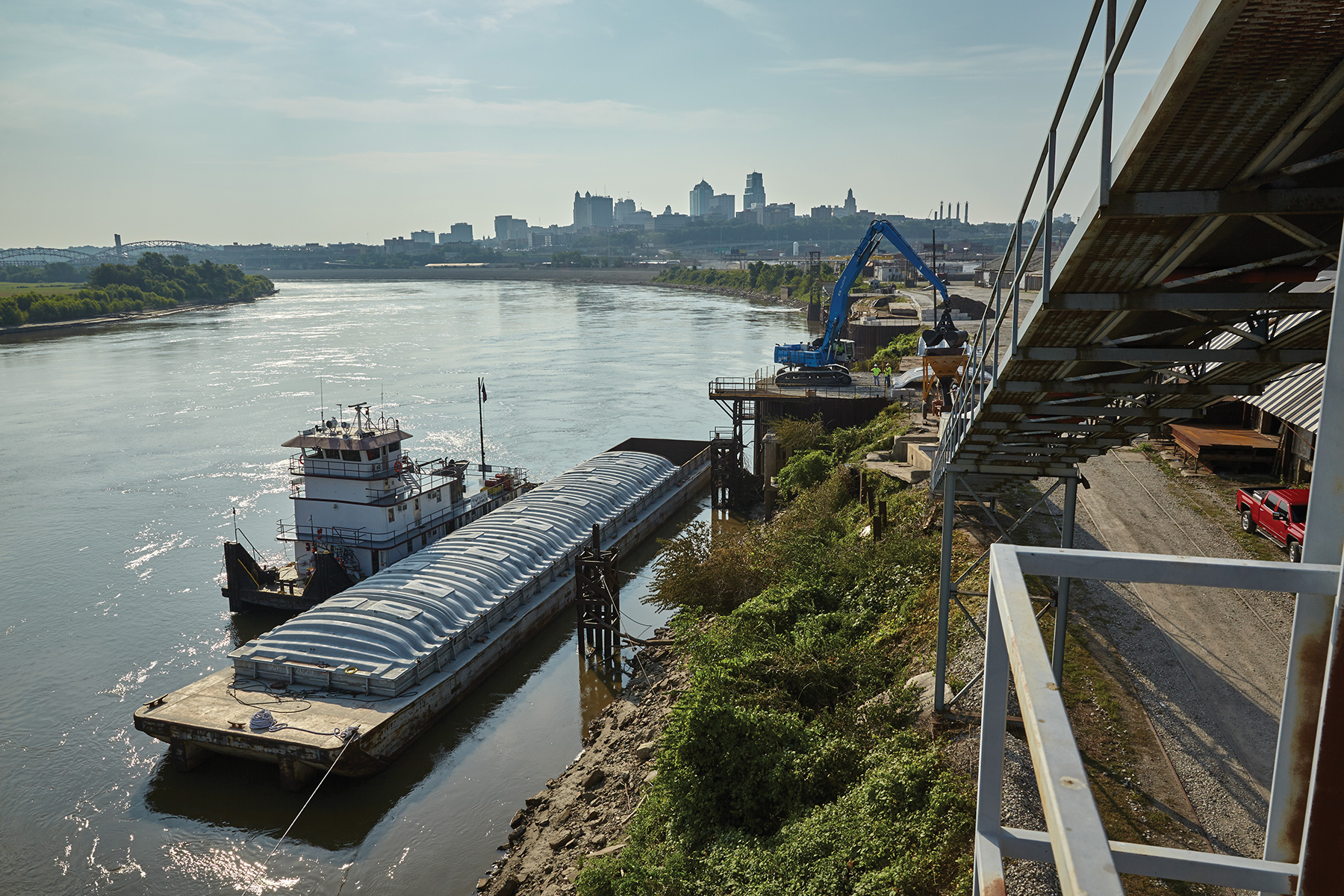
The former Woodsweather Terminal at Missouri River Mile 367.1 was rebranded as the Governor Michael L. Parson Port Terminal. Upgrades included replacing a failing railroad trestle originally built in 1932 with heavy-duty open cell sheet piles to create a multimodal dock handling bulk goods, including fertilizer, scrap metal, road salt and project cargo. A 7,000-ton fertilizer dome also increased covered fertilizer storage, and ground storage was expanded via the addition of laydown areas for cargo that isn’t weather-sensitive. Conveyors were added, along with a new winch system. A dedicated rail spur links the terminal to the Union Pacific rail line, allowing easier transloading.
The improvements have more than doubled the barge capacity, Stephens said.
“We’ve made it a bulk goods port,” he said. “We saw the potential more than most. Now, I think we’re seeing the fruits of that labor. There is more and more interest.”
The port is working closely with the 19 member ports that comprise the Missouri Ports Association, he said, and product moving through the port is being routed north to Blencoe, Iowa, or St. Joseph, Mo., into the mid-Missouri region or sometimes on to St. Louis.
“Missouri is a river state, and I think sometimes we forget that,” he said. “It’s especially important for agricultural needs.”
Future Intermodal Facility
To the east, at Mile 357.5, Port KC is developing its Missouri River Terminal, transforming a 415-acre former steel mill site near the confluence of the Blue River with the Missouri River.
“That is a future intermodal facility on the east side of Kansas City,” Stephens said. “We are under construction now for a $30 million bridge connector, and we are in the design to start converting that to a multi-phase facility that will be the home to a newly announced federal program called the Critical Materials Crossroads.”
A grant from the National Science Foundation, in cooperation with the state university system, is developing the refinement and manufacturing of components and materials related, primarily, to the battery industry, he said.
“This will be the home for it, so we are going to take what was already going to be a premier inland port development and making this a critical materials inland port development,” Stephens said.
Berkley Riverfront Development
The success of the two primary waterway transportation initiatives has paved the way for other projects, he added. One of those is the Berkley Riverfront Development at Mile 365.2, a $1.5 billion investment that includes the redevelopment of 55 acres. The development is already home to CPKC Stadium, the first stadium purpose-built exclusively for a professional women’s sports team. It serves as the home for the Kansas City Current of the National Women’s Soccer League.
Port KC also just opened a streetcar route extension to the riverfront and a riverfront pavilion. Plans call for what will become the nation’s largest mural installation, a 1.1-mile-long mural to be built along the levee wall.
Additionally, the port recently took control of another 220 acres, including the only boat ramp on the Missouri River (Mile 363.1) in the city of Kansas City, Mo. It is preserving the boat ramp and adding mountain biking and other trails, complete with landscaping involving native plantings.
“Barges are hugely important on the Misouri River, but we also want to make it a river of recreation, that people want to walk along and jog along,” Stephens said.
The goal, he said, is to bring as many people back to the river as possible, and Port KC is already seeing results, with 200,000 visitors to the Berkley Riverfront Development in 2024 and more than 500,000 in 2025. So far in 2026, it is on pace to attract more than 1.6 million visitors, Stephens said.
Some of the changes have been unexpected hits. For example, in an effort to restore as much of the shoreline as possible, Port KC has eliminated using any herbicides in core riverfront development and has switched to using a herd of goats to keep the brush trimmed back.
“It’s hilarious,” Stephens said. “They have become absolute celebrities.”
Kansas City’s hosting of Argentina’s national soccer team for the recently concluded World Cup tournament coincided with the birth of a new baby goat, so officials named the goat Messi after the legendary Argentina player Lionel Messi. The baby goat Messi was dressed in an Argentina team jersey, which brought more positive attention to the development during the 2026 tournament.
The last 18 months have also brought about the addition of a couple of more miles of trails along the river, enhanced landscaping and additional seating.
Moving Forward
These projects are not independent of one another. While the Berkley Riverfront Development begins where Main Street meets the river, at the point where Kansas City had its historic beginnings, it is connected immediately to the west by the Parson Port Terminal, with a hiking and biking trail in between. Just to the east of the Berkley Riverfront Development are more trails, connecting to the Missouri River Terminal facility.
“This will be a really amazing economic development and recreational space with both ends connected with functioning port terminals,” Stephens said.
He sees even more room for growth in the future, connecting Kansas City back with its river roots.
Featured photo caption: For 40 years up until 2015, Kansas City didn’t have a functioning riverport terminal. That changed with the creation of the Gov. Michael L. Parson Port Terminal, which now operates as a bulk terminal. An intermodal facility, Missouri River Terminal, is also under construction.