
Missouri River Towing Builds Reliable Service On The Missouri
Missouri River Towing has grown from a small extension of Hermann Sand & Gravel’s dredging business into a four-vessel towing operation serving customers throughout the Missouri River corridor.
Hermann Sand & Gravel began operations in 1978. It began handling limited towing work with smaller vessels and hired barges around 2009 or 2010, President Steve Engemann said.
The company leased the mv. Mary Lynn in 2011 and added a second towboat in 2014. Missouri River Towing was established in 2016 to distinguish and promote the river transportation side of the business. It now operates four line-haul vessels on the Missouri River and is considering adding a fifth in 2027, provided it can finalize the contracts needed to support the additional equipment.
“We keep three (boats) pretty much running up and down the river, and then we keep one in the Kansas City area to service some docks,” Engemann said, adding that those docks and terminals include locations in Kansas City, St. Joseph and Waverly, Mo.
The fleet transports a diverse mix of commodities, with cement accounting for the largest share. Other cargoes include fertilizer, grain, aggregates, steel, wire rod coils and occasional oversized loads. The company also has begun moving aggregates over longer distances, including rock destined for locations on the upper river.
In addition to its towing operations, Hermann Sand & Gravel loads about 30 barges of clay annually at its Hermann, Mo., facility using a conveyor system. The company also owns property in Jefferson City that could support future activity.
Engemann said improved service frequency is making the Missouri River a more practical transportation option for customers. Missouri River Towing now has vessels arriving in Kansas City and St. Louis approximately once a week, with service to Blencoe, Iowa, about every 10 days.
Customers can plan shipments with greater confidence when they know another vessel will arrive within a predictable window, he said.
“If we don’t get it this trip, we’ll get it next trip, and it’s still going to be in a pretty timely manner,” Engemann said. “I think the frequency is helping customers feel more comfortable with using the river as a transportation option.”
That reliability is encouraging investment in docks and terminals, although Engemann noted that new projects require considerable lead time. It can take several years from the time a company decides to improve a terminal until the resulting cargo begins moving.
“Everybody has growth on their mind,” he said.
Navigation conditions have also benefited from the U.S. Army Corps of Engineers’ work to repair Missouri River training structures. Engemann said the channel is probably in its best condition in about 20 years. Under normal river conditions, Missouri River Towing can maintain a 9-foot draft and operate around the clock.
Low-water conditions remain a challenge, however. Drought in Montana, North Dakota and other parts of the upper basin has reduced water storage in the Missouri River Mainstem Reservoir System. Lower storage levels mean minimum releases and a navigation season expected to be about 15 days shorter this year.
The shortened season will likely cost Missouri River Towing several trips and could affect customers trying to move products before the winter shutdown. The second half of November is typically one of the company’s busiest periods.
“We’re usually always pushed to the very end because there’s so much demand,” Engemann said. “It’s definitely going to be challenging, but we’re trying to educate everyone that we’re going to have a short season and need to get ahead of it if we can.”
The timing is particularly important for grain. If crops have not reached elevators in time for loading, the loss of navigation days cannot easily be recovered.
Minimum-release conditions can also reduce available drafts to about 8 or 8.3 feet. Engemann said the loss of carrying capacity can make the economics of some shipments more difficult, particularly for grain, where transportation costs may already be near the threshold of feasibility.
“I feel like grain, especially, would have a lot more loadings if I could get consistent 9-foot drafts,” he said.
Despite those challenges, Engemann sees significant room for growth. The river, its docks and its existing transportation network can accommodate considerably more traffic, he said.
“Navigation is the key to water for the lower states,” he said. “We need the support of all the lower basin states to keep navigation a viable transportation route.”
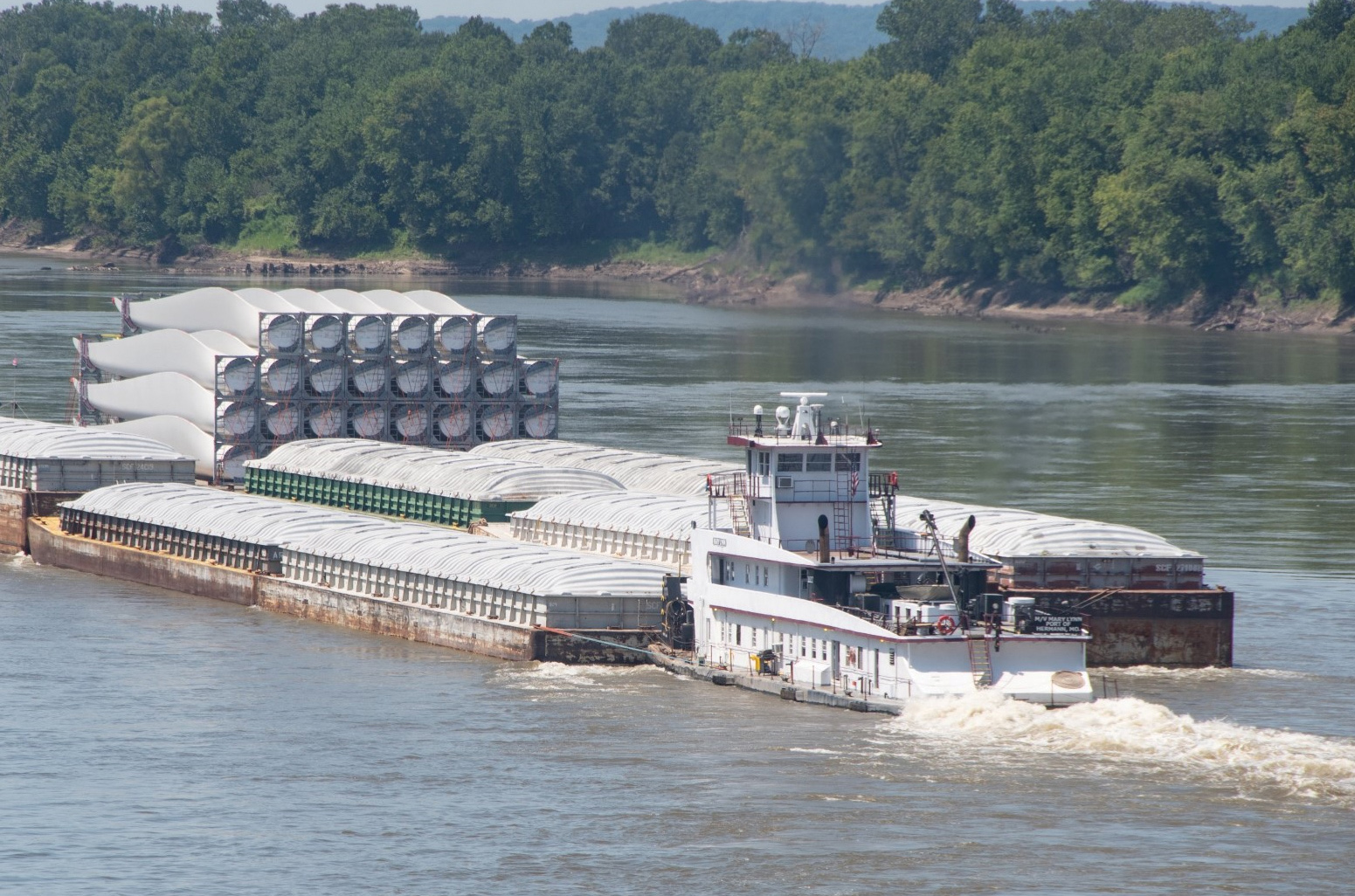
Featured photo caption: An MRT towboat with barges and heavy cargo in tow moves on the Missouri River. The company operates four line-haul vessels and is considering adding a fifth in 2027. (Photo courtesy of Missouri River Towing)