

Horizons: Connecting With The UK Via The Mississippi River
On September 25, at the Port of Memphis office, Randy Richardson, executive director of the Memphis and Shelby County Port Commission and vice president of port and industrial properties at EDGE, and Deb Calhoun, senior vice president of Waterways Council, Inc., sat down with Tim Cade, counsellor for transportation at the British Embassy in Washington, and Ashley Ibett, the United Kingdom’s director general for aviation, maritime and security. Polaris Analytics and Consulting joined them for the United Kingdom 4-R Memphis Forum. The assignment was not a courtesy briefing. It was to put a UK maritime official on the river that is a slice of the special relationship between the U.S. and UK.
That is why the story has to be told in person. Diplomats see ports as dots on a map. Memphis is where four modes sit in one city, and a 36-barge tow becomes an export unit. From river mile 725 to 740, there are 68 waterfront facilities; about 90 percent of the industries sit on Presidents Island. There are no locks or dams from Memphis to the Gulf, and the harbor is ice-free. Richardson put the port at sixth among U.S. inland ports, with $8.7 billion in annual economic impact, 13,267 combined direct and indirect jobs, $954 million in wage impact and $104.7 million in local taxes. After showing his slides, he walked Cade and Ibett through the harbor. Polaris rode along.
Calhoun’s River 101 is the system a visiting official needs before a fleeting harbor makes sense. The inland waterways run about 12,000 miles through 28 states, with 219 lock chambers at 176 sites, she said. They move on the order of 500 million tons a year, valued at more than $150 billion. About 65 percent of U.S. grain exports ride this river. National Waterways Foundation comparisons still do the work a guest remembers: one 15-barge locking tow equals 216 railcars or 1,050 trucks. A barge moves a ton of cargo about 675 miles on a gallon of fuel, against 472 for rail and 151 for truck. WCI’s job in that room is to make the next lock chamber — and the Inland Waterways Trust Fund that helps pay for it — as concrete as a pellet cargo bound for a UK power station.
At The Horizon: New Orleans Is The UK’s Dry-Flowable Door
The United Kingdom is not a niche farm market. U.S. goods exports to the UK were $97.4 billion in 2025, the fourth-largest U.S. goods export market, and a $33 billion surplus — the second-largest bilateral goods surplus the United States runs. Agricultural exports were about $2.24 billion; the UK ranks 15th among U.S. farm markets. Forest products, which the USDA-Foreign Agriculture Service top 10 table does not show, added $1.69 billion.
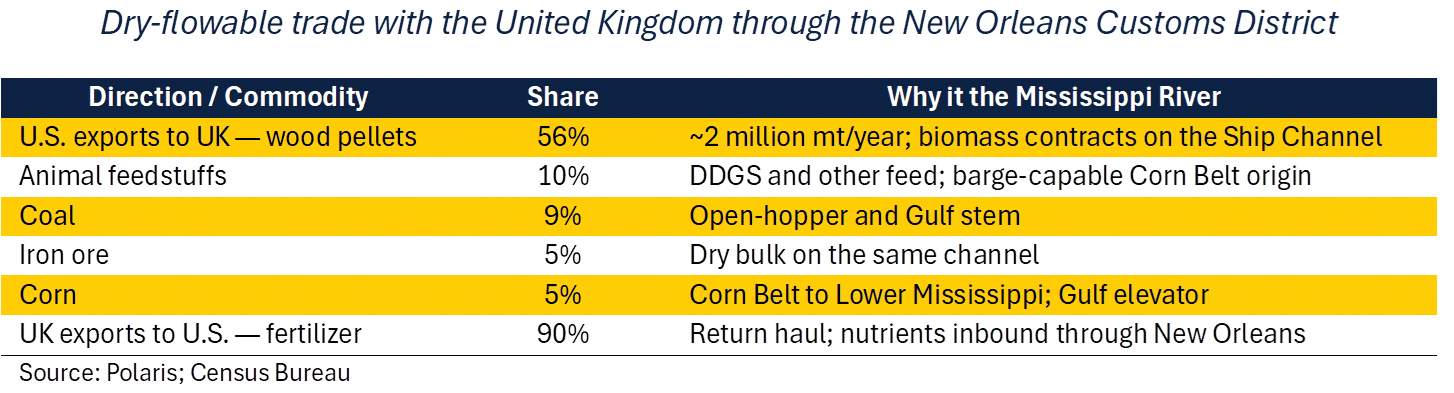
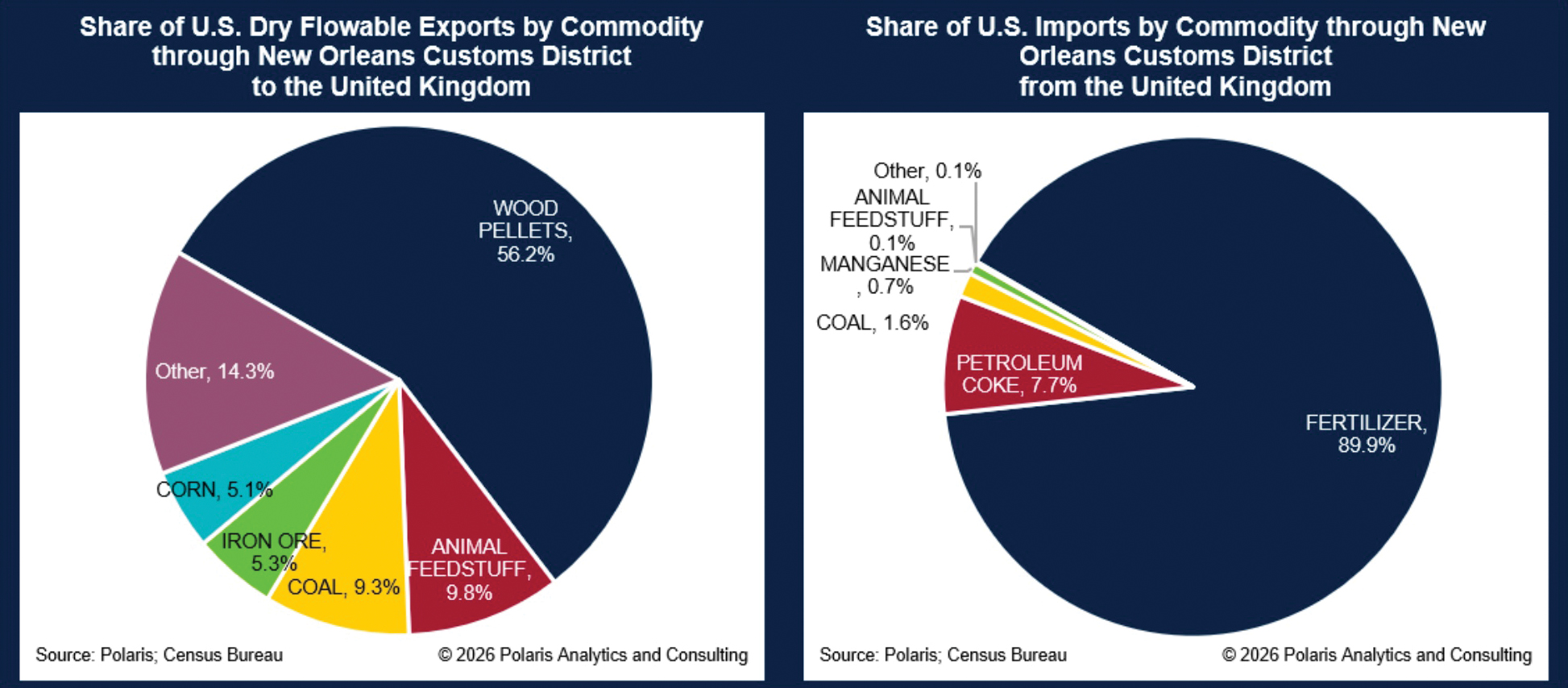
Volume through the New Orleans Customs District tells a different story than the value table. New Orleans is the key U.S. customs district for dry-flowable commodities. On the UK stem, wood pellets are 56 percent of those dry-flowable exports — about 2 million metric tons a year. Animal feedstuffs, coal, iron ore and corn follow. The return haul is not a mystery either: fertilizer is about 90 percent of UK-origin dry flowables coming back through New Orleans. Field to barge through the Memphis pinch points, then the Mississippi River Ship Channel, then a UK berth. That is the physical chain.
On The Horizon: Reliability Is The UK Buyer’s Hidden Basis
The Mississippi River Ship Channel runs from Baton Rouge past New Orleans through Southwest Pass into the Gulf. Polaris’s study for the Big River Coalition, funded by the Louisiana Department of Transportation and Development, put average annual trade value through the New Orleans Customs District at $226.5 billion — $620.4 million a day — and about 20 percent of U.S. waterborne cargo. An unplanned 12-hour closure can take $3.8 million in output. A two-week closure can take $194.8 million in sales across water transportation, port operations and grain storage. Lose a foot of draft on a typical dry-bulk ship, and ocean freight rises $0.92 to $1.05 per metric ton. A lock outage, a low-water draft cut or a late commerce file does not stay in Memphis. It shows up in a UK feed mill’s basis and in a biomass contract written against this channel.
The May 2025 U.S.–UK Economic Prosperity Deal sits on top of that water. USDA has framed roughly $5 billion in new agricultural export opportunity. A tariff line does not move a ton. A lock, a fleeting harbor and a Gulf elevator do. That is also why House passage of WRDA 2026 belongs in a UK briefing. On September 16, the House passed H.R. 9497 by 415–9. The Senate companion, S. 4949, is committee-cleared; conference is next. WRDA is the lock, dam and channel vehicle for the Memphis–Vicksburg pinch points on the way to the Ship Channel.
Over The Horizon: The 4-Rs Must Stay Physical
What was asked of the UK visitors to take from Memphis was not a slogan. It was the 4-Rs-plus-one of this supply chain: reliable, because the network is established and integrated; resilient, because there are multiple options from farm to market; resourceful, because the throughput is high and efficient; redundant, because the system is built to plug and participate; and regenerative, grow back and give back.
Take the meeting when it is offered. Walk the island. Put a director general on the tow. The Mississippi River is how the hinterland meets the Atlantic. The United Kingdom is one buyer on that stem. The relationship stays physical only if the channel, the lock and the story stay in working order.