
Waterways Symposium Focuses On New Congress, Project Delivery
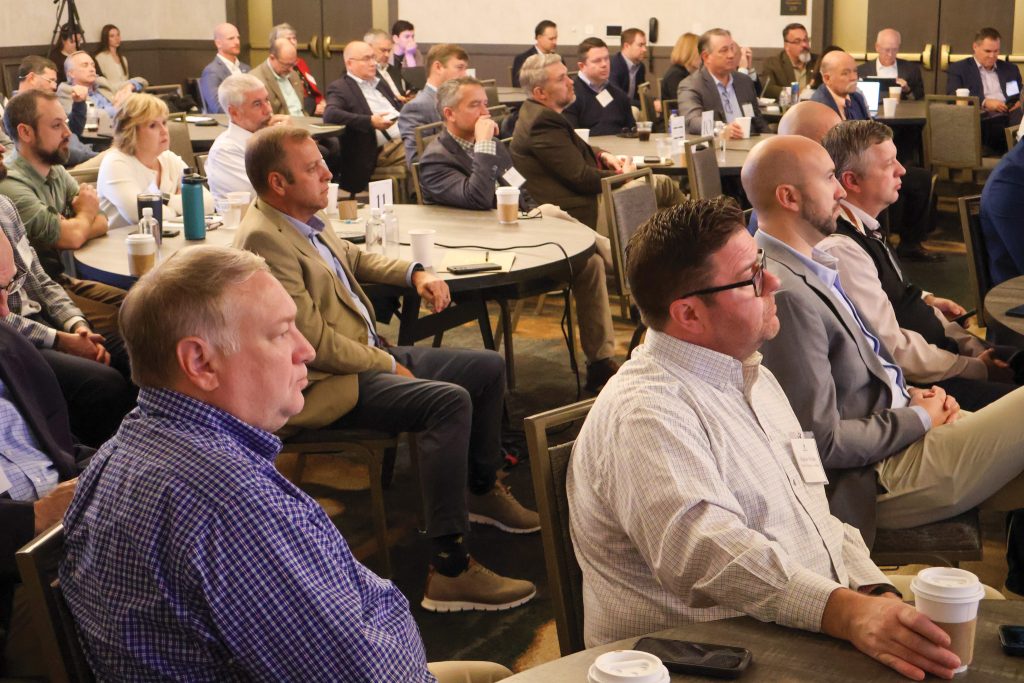
Congressional turnover, project delivery and river reliability were recurring topics at the 23rd Annual Waterways Symposium, held November 10 through 12 at Hotel Distil in Louisville, Ky.
Waterways Council, Inc. (WCI) and The Waterways Journal presented the symposium. The November 11 program included speakers on Washington policy, artificial intelligence (AI), geopolitics, agricultural transportation and energy and commodity markets, followed by the National Rivers Hall of Fame 2026 National Achievement Award presentation.
Outreach To New Members
The symposium opened November 10 with WCI’s annual membership meeting, where Tracy Zea, WCI president and CEO, and WCI staff briefed members.
WCI staff said the House will seat 110 new members in January, “a quarter of the membership.” WCI is prioritizing outreach to new members from districts and states with waterways projects, members of the appropriations committees and members of the House Transportation and Infrastructure Committee.
Returning members will likely learn their committee assignments between Thanksgiving and Christmas, staff said. The new Congress convenes January 4.
WRDA And Appropriations
Jen Armstrong, WCI vice president of government relations, said the House passed the Water Resources Development Act of 2026 by a vote of 415 to 9 in September. The Senate Environment and Public Works Committee approved its version unanimously July 15.
Armstrong said a final bill could be attached to must-pass legislation, as WRDA was attached to the defense authorization bill in 2020 and 2022.
Armstrong also noted that the Inland Waterways Users Board has not met since December 2024. That means it has been almost 700 days “since industry has had a voice” in recommendations on how the inland waterways program is prioritized and executed, she said.
The House Fiscal Year 2027 Energy and Water bill includes $417.2 million for inland waterways construction, including Lock and Dam 25 on the Upper Mississippi and Montgomery Locks and Dam on the Ohio, Armstrong said. The Senate has not passed any of its 12 appropriations bills.
Washington Outlook
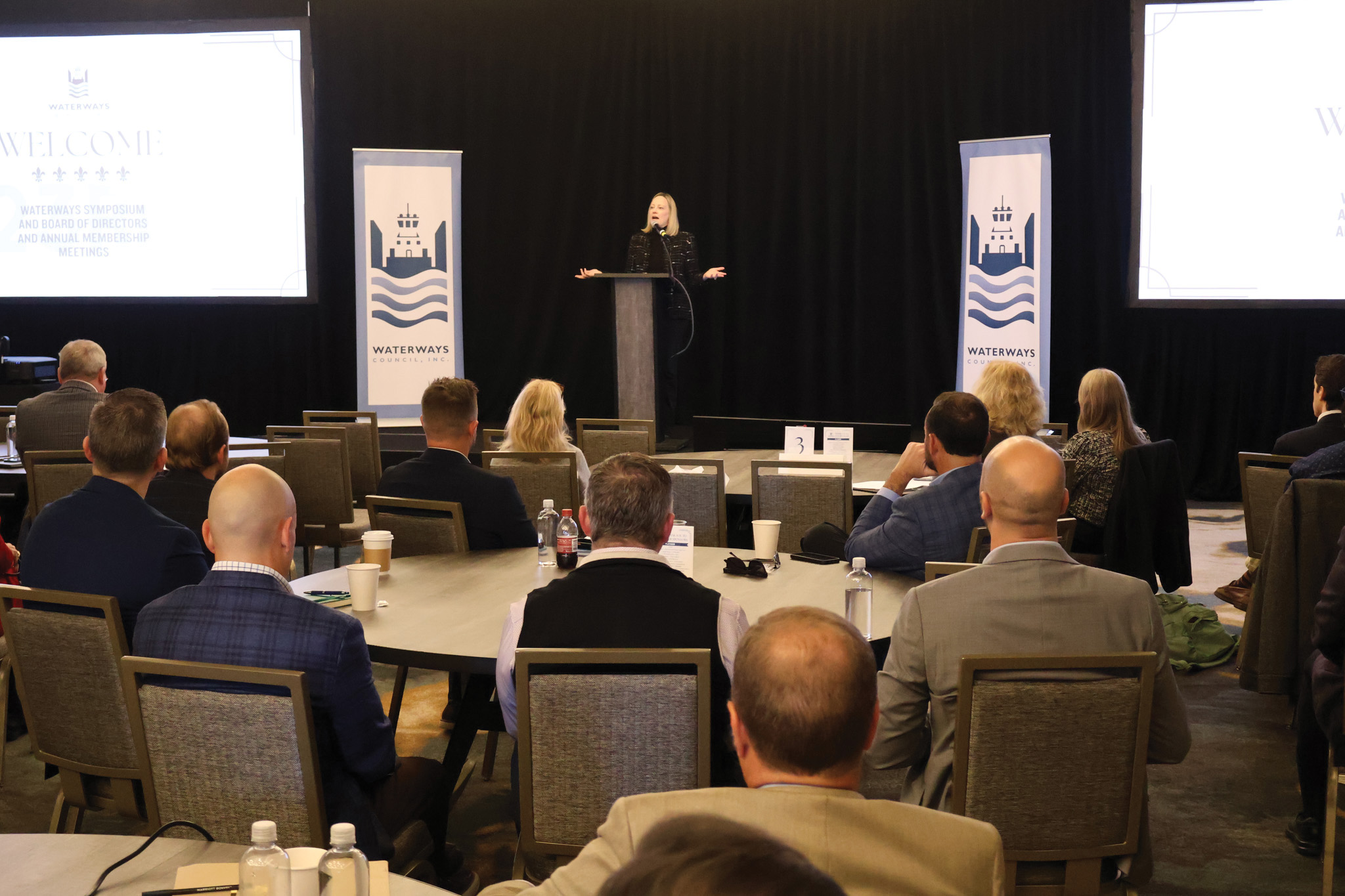
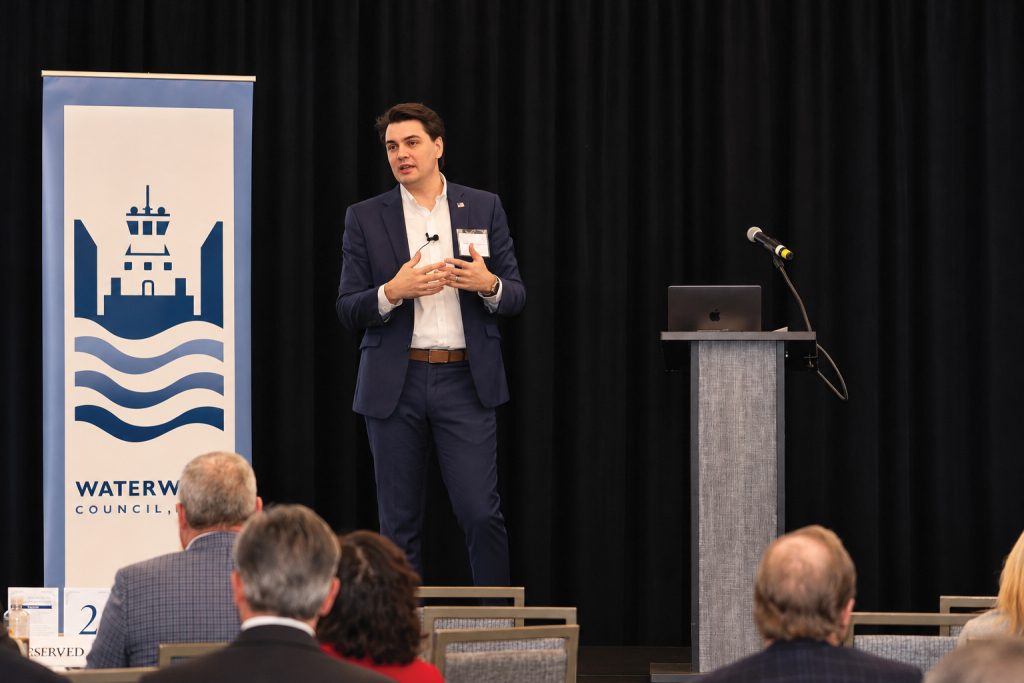
Anna Palmer, founder and CEO of Punchbowl News, opened the November 11 program with an outlook for the new Congress.
Palmer said December 11, the deadline for government funding, is “the key number and the date that you should be thinking about.”
Oversight will come first in the 120th Congress, Palmer said. “I think the word everyone should be putting in bright lights is oversight,” she said. She described the order as “oversight first, legislate second.”
Palmer said AI data centers came up repeatedly in campaigns as an energy and infrastructure issue. “The data center issue is not going away,” she said.
Palmer said membership on committees of jurisdiction will change, and turnover extends to congressional staff, with thousands of new staffers expected in the House. “There’s just going to be a lot of need for education,” she said.
Artificial Intelligence
Nick Pericle, technology strategist and founder of Tenexity, demonstrated AI tools during his presentation.
“Over the last year, literally the last 12 months, AI has taken exponential leaps forward in its ability to be applied to real work,” Pericle said.
He showed a research query on 2027 barge market conditions that searched 298 sources in seven minutes and produced a dashboard on diesel, river levels and grain exports. He also showed an analysis of a shipping manifest spreadsheet that flagged incomplete data.
Pericle said results depend on how much detail users provide. Business accounts keep proprietary data walled off and do not use it to improve the models, he said. He also said congressional staff now use AI tools for research.
Pericle said he limits what AI tools can do on his behalf. “I don’t let it take action where there is money involved, where there is an agreement or a contract,” he said.
Geopolitics
Lt. Cmdr. Mike St-Pierre, a Royal Canadian Navy officer and coordinator for Canada with the Mackinder Forum, delivered the lunch keynote and said his views were his own.
St-Pierre described competition with China across industrial production, shipbuilding, undersea cables and other domains. He said traditional chokepoints, including the Strait of Hormuz, the Strait of Malacca and the Black Sea, are contested.
Regulatory constraints have slowed large building projects, including inland waterways projects, St-Pierre said, and reshoring production will be a long-term effort.
“America’s geographic advantage is phenomenal, and, despite the instability abroad, will only advantage your industries,” St-Pierre said.
He said leaders should plan for continued volatility and that practical experience will matter more than accreditation.
Project Delivery And Exports
Mike Steenhoek, executive director of the Soy Transportation Coalition, said success in the soybean industry “is largely a function of how competitive, how cost-effective, how reliable, how resilient our supply chain is.” About 60 percent of U.S. soybean exports typically leave from the Mississippi Gulf and about 25 percent from the Pacific Northwest, he said. He described the coalition’s goal as “subtraction math,” reducing transportation costs at each link from truck to barge or rail to ocean vessel.
Steenhoek thanked WCI for its work to “really shine a spotlight” on cost overruns and project delays.
He cited the new Mississippi River bridge at Lansing, Iowa, which opened November 6 about five months ahead of schedule. Steenhoek said projects completed on time and on budget have clarity in four areas: what will be built, who is responsible and accountable, the schedule and the amount of funding and how it will be distributed.
“When there’s a lack of clarity in one of those four areas, you’re going to have dysfunction with project delivery,” Steenhoek said.
Steenhoek said river conditions improved in 2026, but “it doesn’t take a whole lot to all of a sudden get into low water conditions.” He listed factors including the volume and timing of precipitation and water use by municipalities, agriculture and data centers.
“You want to make sure it’s good for the year 10 years from now,” he said of shippers considering investments.
Steenhoek said exporters report the longest period of shipping out of the Mississippi Gulf without draft restrictions, which he tied to deepening of the Mississippi River Ship Channel. Grain and soybean sales are made months in advance, he said. “Soybean exports are not like operating a doughnut shop,” Steenhoek said.
He also said the coalition supports a House WRDA provision for the federal government to assume the cost of confined disposal areas needed for maintenance dredging of the Columbia River. “Every foot of draft reduction is the equivalent of roughly 100,000 fewer bushels of soybeans,” he said.
Steenhoek also described the coalition’s work with rural counties on lower-cost bridge replacement. “We need to focus not just on the revenue side of the equation, but also on the cost side of the equation,” he said.
Climate And Carbon
Steve Goreham, author of “Green Breakdown: The Coming Renewable Energy Failure,” questioned efforts to regulate carbon dioxide as a pollutant and argued that natural forces play a larger role in climate than is often recognized.
Citing Greenland ice core data, Goreham said temperatures have risen and fallen over the past 10,000 years, with “many multi-century periods” when the planet was naturally warmer than today. He said nature puts about 20 times as much carbon dioxide into the atmosphere each day as human industry and removes about the same amount, and he estimated that human activity accounts for about 1 or 2 percent of Earth’s greenhouse effect.
Turning to transportation, Goreham said electric propulsion is “really not possible” for long-haul ships because of their weight and the distances they travel, and that biofuels typically cost about twice as much as bunker fuel. He said wind and solar cannot run a reliable grid alone and expressed doubt that the world will reach net zero.
Data And The Barge Fleet
Ken Eriksen, managing member of Polaris Analytics and Consulting, said the Corps of Engineers is about 22 months behind in publishing waterborne commerce data. “Data is a lifeblood to economic and financial decisions,” he said.
Eriksen said U.S. corn exports set a record of more than 3 billion bushels in the 2025-26 marketing year.
Citing the WJ Inland Record Barge Fleet Profile, Eriksen put the 2025 fleet at about 21,800 barges: roughly 12,800 covered hoppers, 5,100 open hoppers and 3,900 tank barges. More than 5,000 of them are 25 years old or older, including about 2,700 covered barges, more than 2,000 open barges and about 700 tank barges, while new construction has run below 400 barges a year, he said. He also pointed to the more than 5,000 data centers operating in the United States, about 2,300 of them in states with access to the Mississippi River System, as a source of construction materials and components that could move by barge.
Awards
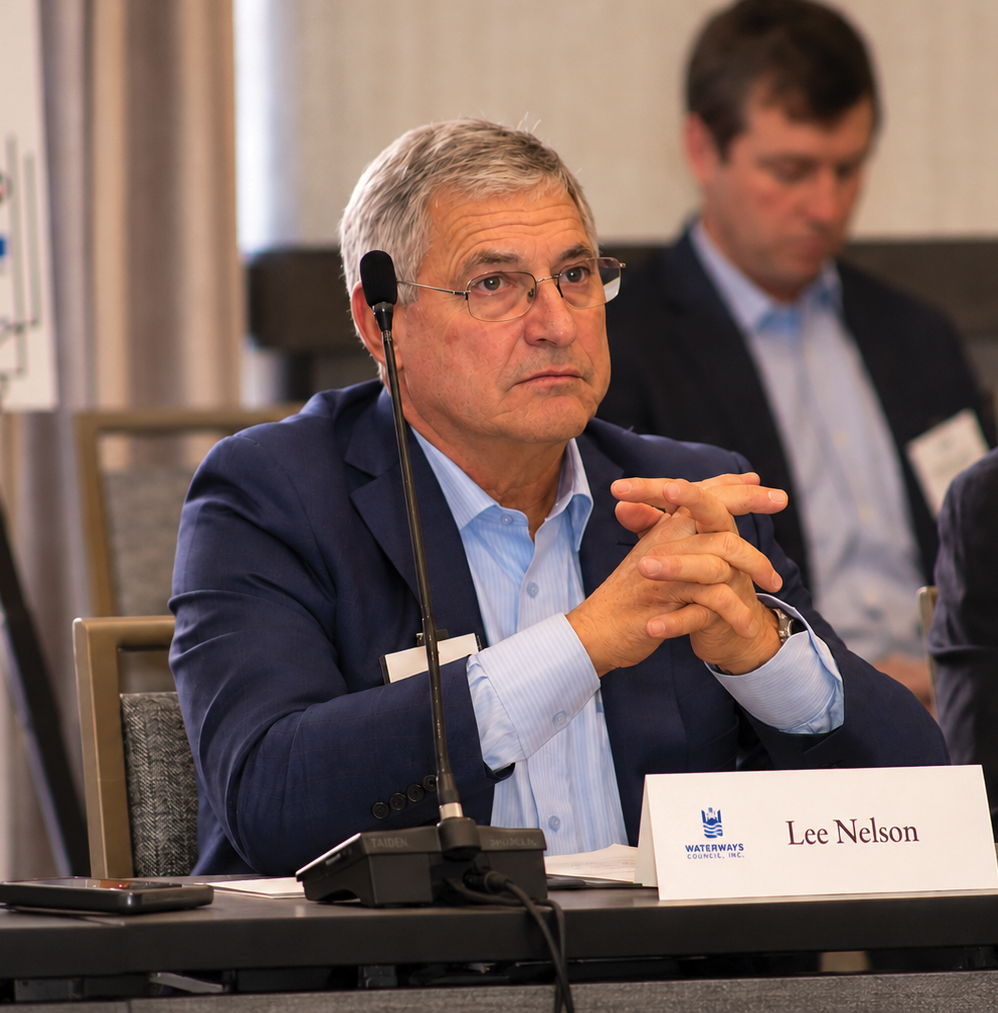
Lee Nelson, president and CEO of Upper River Services in St. Paul, Minn., received the National Rivers Hall of Fame 2026 National Achievement Award at the close of the November 11 program.
Kurt Strand, president and CEO of the Dubuque County Historical Society, presented the award with Zea.
The National Rivers Hall of Fame, established in 1985, is part of the Dubuque County Historical Society, which operates the National Mississippi River Museum & Aquarium in Dubuque, Iowa. It inducts people into the Hall of Fame and presents annual National Achievement Awards.
The presentation quoted one of the nominations, which described Nelson as “a tireless advocate for the entirety of our nation’s inland river system.”
Nelson first worked on the river in 1979 and earned his Coast Guard license as a towboat pilot and captain. He joined Upper River Services as a pilot in 1986 and has led the company since 1991. He helped develop the framework for the Navigation and Ecosystem Sustainability Program (NESP).
“You have to question the judgment of anyone who willingly spends a career in a business where the water is either too high, too low, too fast, too slow or frozen solid,” Nelson said.
Nelson thanked his colleagues at Upper River Services and encouraged the industry to recruit young people into river careers.
“We can have a strong, efficient commercial navigation system and a healthy river ecosystem,” Nelson said.
WCI announced November 12 that its board elected Nelson chairman for a two-year term. He succeeds Jeff Webb, president of Cargill Marine & Terminal. “We are in good hands under his leadership and counsel,” Zea said in the announcement.
WCI also held a November 10 toast for Senior Vice President Deb Calhoun, who retires at the end of the year. Calhoun told members her report that day was her 46th consecutive board meeting report and her last.
Calhoun has been part of WCI since its beginning. As a consultant, she worked with Waterways Work!, a WCI predecessor, which later merged with DINAMO to form WCI. She received the National Rivers Hall of Fame National Achievement Award in 2019. Nick Boykin, who joined WCI October 5 as director of communications and membership, succeeds her.
As reported in the November 13 issue of WJ, the Seamen’s Church Institute has named Calhoun the winner of its Distinguished Service Award, which will be presented December 10 at the River Bell Awards Luncheon in Paducah, Ky.
Featured photo caption: Anna Palmer, founder and CEO of Punchbowl News, opens the November 11 program of the Waterways Symposium in Louisville, Ky., with an outlook for the new Congress. (Photos courtesy of Waterways Council, Inc.)