

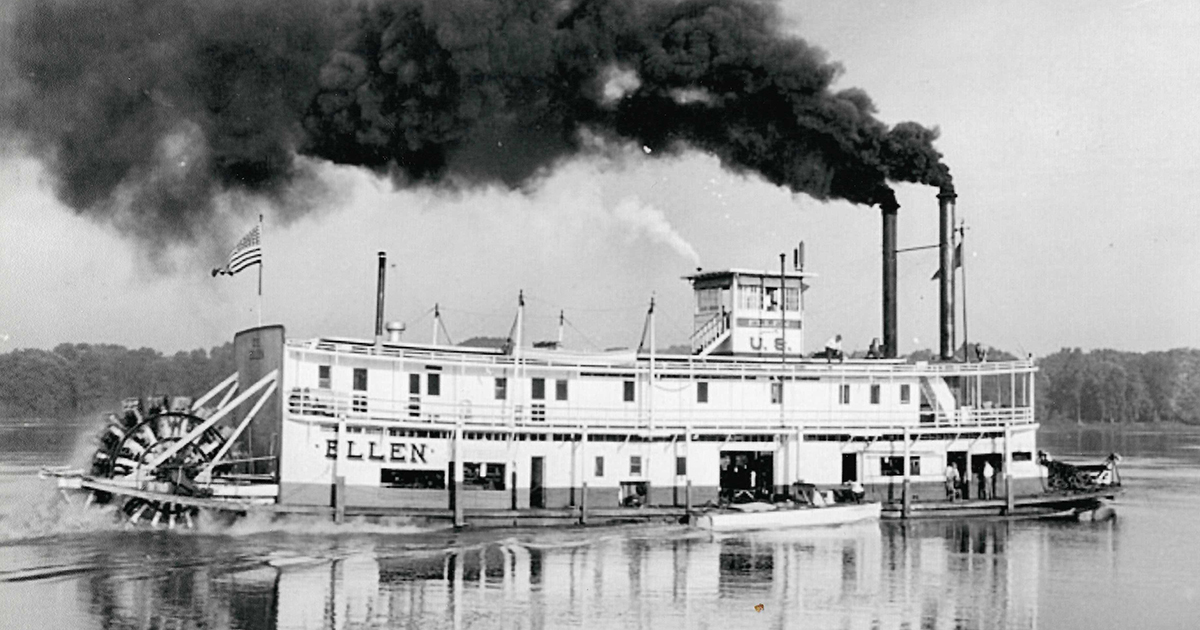
The Ellen Had Many Alterations During 60 Years Of Service
The giant agricultural concern known as Cargill Inc. began in 1865 when William Wallace (W.W.) Cargill purchased his first grain storage facility in Conover, Iowa. He would continue to grow his ag business while also investing in timberlands, bauxite mining, ranching, railroads and land development. One of the timber companies that he was principal in was the Sawyer Austin Lumber Company of La Crosse, Wis.
In 1907, this firm had a steam sternwheel towboat built at La Crosse. It was of wooden construction with a hull measuring 145.5 feet by 26 feet. Its engines, with cylinders that were 14 inches in diameter with 6-foot stroke, rolled a sternwheel that was 18 feet in diameter. The boat was named Ellen in honor W.W. Cargill’s wife, and while it was used to raft logs, Cargill also utilized the vessel for pleasure trips. According to Way’s Steam Towboat Directory, Capt. Charles White Sr. was master of the boat. When a young Austen Cargill, grandson of W.W. Cargill, was bitten by a rattlesnake while ashore at Trempeleau, Wis., Capt. White cauterized the wound.
After the death of W.W. Cargill in 1909, his son-in-law, John H. MacMillan Sr., took the reins of the firm and began selling off less profitable, non-grain trading portions of the company. During this divestiture, the Ellen was sold to the U.S. Engineer Department in 1911. The purchase price was reported to be $12,000, and the boat was placed in the Rock Island (Ill.) District. The boat became the flagship of the district. In 1927, a new steel hull was placed under the Ellen, and the dimensions were then 156 feet by 30 feet.
In the 1930s, President Franklin D. Roosevelt was scheduled to make a trip on the Upper Mississippi. As part of the preparation for this journey, extensive alterations were made aboard the Ellen. An elevator was installed, and the cabin was air conditioned. The presidential trip was ultimately cancelled, but considering these improvements, along with the comforts previously installed for the benefit of the Cargill family excursions, the Ellen became known within the Corps of Engineers as the “District Engineer’s royal barge.” Capt. James Maxwell was long the master.
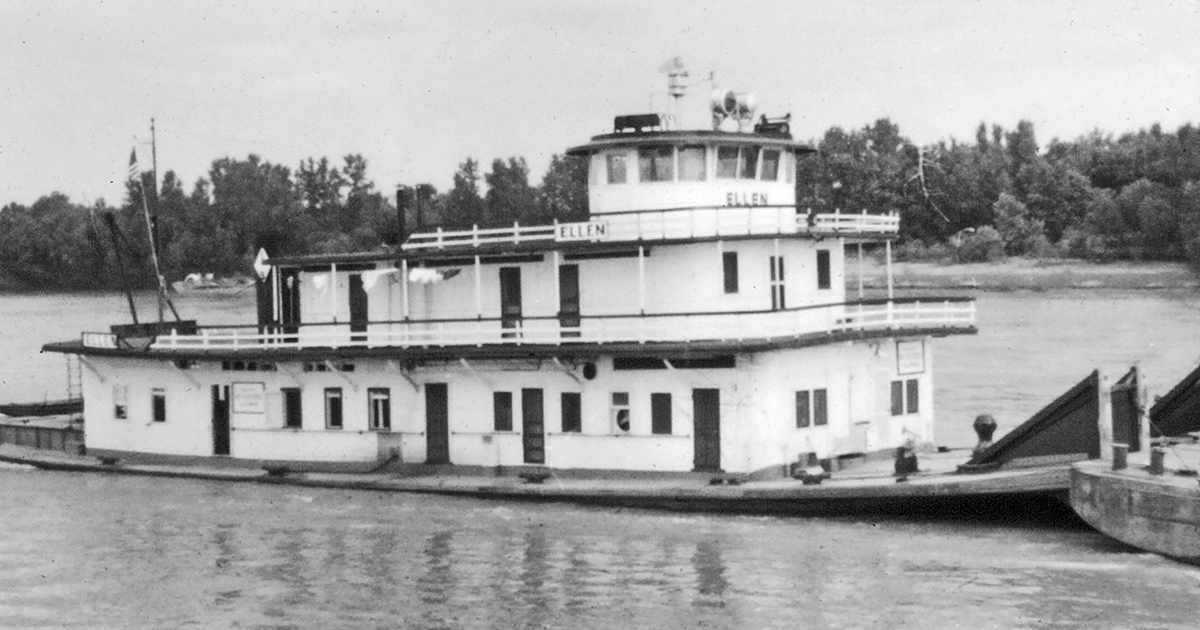
In 1943, the Ellen was sold at a public auction to Ralph M. James, who promptly resold it to Standard Oil of Ohio. The next year, the boat was again sold, this time to Industrial Marine Service, Memphis. The vessel went through an extensive rebuilding program where the steam machinery was removed and the hull altered to convert it to a twin-screw diesel craft. The hull dimensions remained the same, but the wooden superstructure was extensively altered and topped with a modern pilothouse, which was almost oval in shape, with the front and back flat but sides rounded. Power was by a pair of Cooper-Bessemer JS-6 engines that, according to the Inland River Record (IRR), were rated 800 hp. at 325 rpm, though the List of U.S. Merchant Vessels always stated the boat had 1,230 hp.
Industrial Marine never changed the name of the Ellen, and it was seen throughout the inland river system towing tank barges. At the time that the conversion of the Ellen was performed, Industrial Marine had two other boats, the Robert R. Gipson and James E. Graham, both smaller single-screw vessels built at Memphis by the owner. In 1948, the company built a “new” boat utilizing an LSM hull with upper works from an LSI. The boat was named Invader. This vessel had a pilothouse similar to the Ellen’s.
The fleet of Industrial Marine continued to grow with vessels acquired from other concerns, such as the Anker L. Christy and Mama Lere. In 1958, the company built another vessel (named Defender) that looked a little like the Invader, but with a more standard cabin and pilothouse arrangement.
According to the IRR, the Ellen was again rebuilt in 1965, with the wooden cabin replaced by one of steel and the boat repowered with a pair of Cat D398 engines that totaled 1,530 hp. There is some doubt that this rebuild actually took place because it was last listed in the 1967 IRR. Other sources state that it was dismantled in 1967.
In the early 1980s, this author was working on a boat that was on charter to Ashland Oil. We were standing by at the landing of Columbia Marine Service at Southern Harbor, Ludlow, Ky. I had walked up to the office to visit Miss Virginia Bennett, the payroll clerk, and another employee named Mickey Frye. I asked if I had time to walk down the river bank a ways to see something. We took the stroll and soon came upon a shallow-draft boat hull well up the bank. Mickey asked if I knew what it was, and when the answer was no, he said, “That’s the Ellen.”
To make sure that 40-year-old memories are correct, I asked Capt. Bill Kinzeler, whose family-owned Columbia Marine was also consulted. He confirmed that the hull in that location was indeed the Ellen. He could not recall any circumstances of how it came to be there. A few years after that episode with Frye, a park expansion by the city of Ludlow buried the hull of the Ellen by fill. No visible evidence of the Ellen remains, but those who know, know.
Featured image caption: The steamer Ellen in service for the U.S. Engineer Department. (From the collection of Capt. William F. Judd)