

Bolt-In Design Accelerates Lock Repairs
Lockport Lock, Illinois River Mile 291, is expected to remain closed until the evening of May 19 as repair crews install new pintle sockets.
The closure, which began March 31, temporarily disrupts all marine traffic transiting between the Mississippi River and the Great Lakes, including the city of Chicago. Locks on the Illinois Waterway have single chambers, so when one lock is out of service, the entire system is interrupted.
During a scheduled dewatering for vertical lift gate installation that began January 28, 2025, crews found that the pintle sockets — which act as the bottom hinge for the lower miter gates — were cracked. A team of engineers proposed and carried out an innovative temporary repair, wrapping the cracked pintle castings with a carbon fiber-reinforced polymer, described as akin to a Band-Aid. That allowed the gates to reopen April 4, 2025.
Michael Walsh, chief of the Waterways Project Office for the Chicago Engineer District, said the district knew that the pintle sockets would need to be replaced as a permanent solution, but the carbon fiber wrap and a series of strain monitors on both the pintle sockets and the gates’ girders allowed time for new pintle sockets to be ordered and manufactured. Still, replacing the old sockets as soon as the work could be completed is essential, Walsh said, as stress is placed on the pintle sockets every time the lock chamber fills.
To speed the fabrication of new pintle sockets, the Corps was able to “piggyback” off an existing fabrication contract the Rock Island Engineer District — which manages the Illinois Waterway alongside the Chicago District — had with G&G Steel of Russellville, Ala. That allowed the pintle sockets to be manufactured as part of that contract.
Additionally, the Chicago District worked closely with the Inland Navigation Design Center, which reviewed the project and helped local engineers with an innovative design.
Lockport Lock went into service in 1933, and the most recent miter gates were installed 40 years ago, in 1986. Each of the lock’s miter gates has a pintle, a bronze ball, at its bottom. The pintle socket fastens around that ball, allowing the gates to rotate open and closed. While original designs for the pintle sockets call for the metal sockets to be welded in place, new technology allowed them to be produced by machining a billet that can be bolted on instead.
“In the future, if there is another failure, the replacements would be substantially shorter with a bolt-in design over a fully welded cast design,” Walsh said. “Castings are hard to weld to begin with, so the bolt-in design is really, I think, going to speed things up for our installation this time around, make the connection more reliable and also speed up any potential future replacements that may need to happen.”
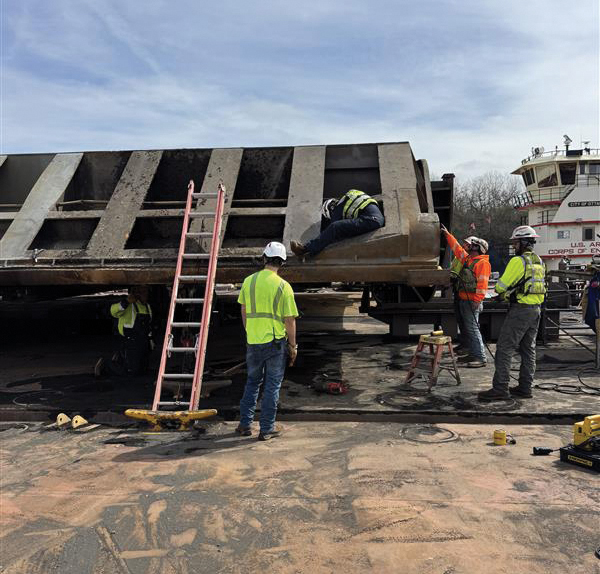
A crew from the Rock Island District began dewatering the lock the afternoon of April 3. Along with replacing the sockets, the crew will remove the quoin blocks in the adjacent wall, complete weld repairs to the miter gates, cut the old pintle sockets out, install the new ones and install the new quoin blocks, Walsh said. The quoin blocks allow the pressure from water against the lock chamber to be spread throughout the entire lock structure instead of only against the gates. The gates’ pintle socket castings cracked because of an improper load, when misalignment with the quoin block gaps placed too much pressure on the sockets, he said.
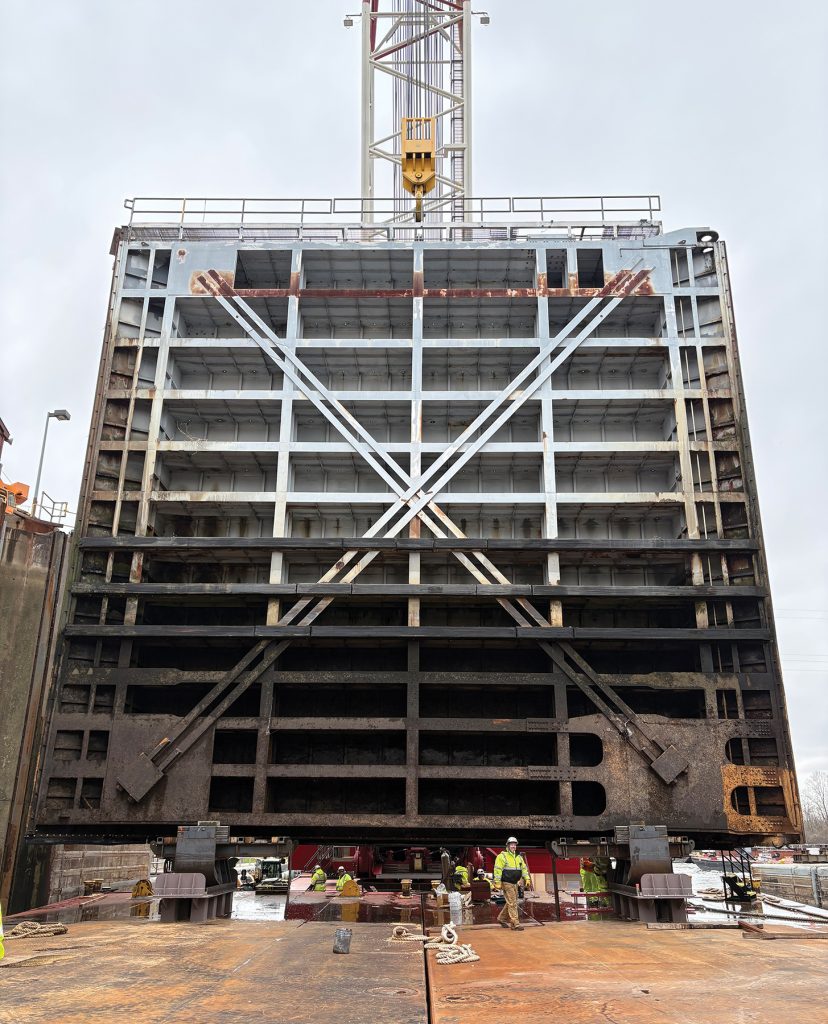
When the work is completed, the crew will rewater the chamber, set the repaired miter gates in the wet, then dewater the chamber and perform a final fit test before rewatering the lock again and returning it to service.
Crews have already been able to get a look at the carbon fiber wraps that have been in place for the past year.
“They appeared to be holding up really well,” Walsh said. “We’ll know more when the engineers evaluate it.”
One area no bigger than the size of a silver dollar was starting to delaminate, but there were no visible cracks in the wrap, he said.
The Chicago District announced plans for the lock closure August 7 and has worked closely with the navigation industry to schedule it, Walsh said. That included avoiding the busy summer traffic season and the fall harvest season, Walsh said.
“We try to work with industry as much as we can to schedule these closures so that they are at the least impactful, but we realize there is no perfect time for a closure,” he said.
Additionally, while very little contingency is built into the schedule, additional work that can be completed at the same time as the major repair is taking place during the closure to minimize future needs for additional closures, Walsh said. That work includes some minor adjustments to the upper gates, which were installed last year, and possibly some minor valve work on the lower end.
Walsh added that, fortunately, the repair schedule is unlikely to be affected by typical spring high-water periods and would only be impacted by the kind of flooding that takes place an average of once every 500 years. However, spring storms that contain lightning can shut down a job site for hours, depending on the storm’s duration, and high wind could impact the schedule by making it unsafe for some crane picks or maneuvers, he said.
With major, consolidated closures along the Illinois Waterway completed in 2020 and 2023, once this work is finished, that should conclude planned rehabilitation on the waterway’s navigational structures, Walsh said. No other closures are planned on the system this year.
Featured photo caption: Crews begin dismantling quoin blocks and prepare for pintle removal at Lockport Lock on the Illinois Waterway. (Photos courtesy of the Corps of Engineers)