
A Treasured Scrapbook Inspired Some Research
Richard Dale James, formerly of Baden, Ohio, near Gallipolis, and now a resident of Wyandotte, Okla., was in the area recently to visit his parents. During his stay a group assembled for lunch in Huntington, W.Va., one day that included Richard, his father, a cousin, this author, Jim Ross, a regular contributor to The Waterways Journal (WJ) and longtime friend to the James family, and Ross’ son, Adam. Richard had worked as a deckhand on boats of G&C Towing and M/G Transport during summers while in college. He ultimately became an attorney in Oklahoma until his recent retirement.
As can be imagined, there was much river talk, humorous stories and laughter, a time that lifts the spirit and dredges up (mostly) pleasant memories. That day Richard loaned me an old scrapbook that had belonged to family friend Palmer Fisher, who had a long career on the river as a deckhand and mate. The August 7, 2023, issue of the WJ carried a photo of Fisher and Richard’s great uncle, Walter James, while they were working for Union Barge Line during World War II.
The scrapbook is actually a very large payroll ledger book. Palmer (pronounced “Parmer” by friends) had pasted clippings on the first several pages that had been cut from newspapers and the WJ. The payroll records that follow begin on January 1, 1927, and are for the Steamer Margaret of the Inland Waterways Company, which was a forerunner of American Barge Line.
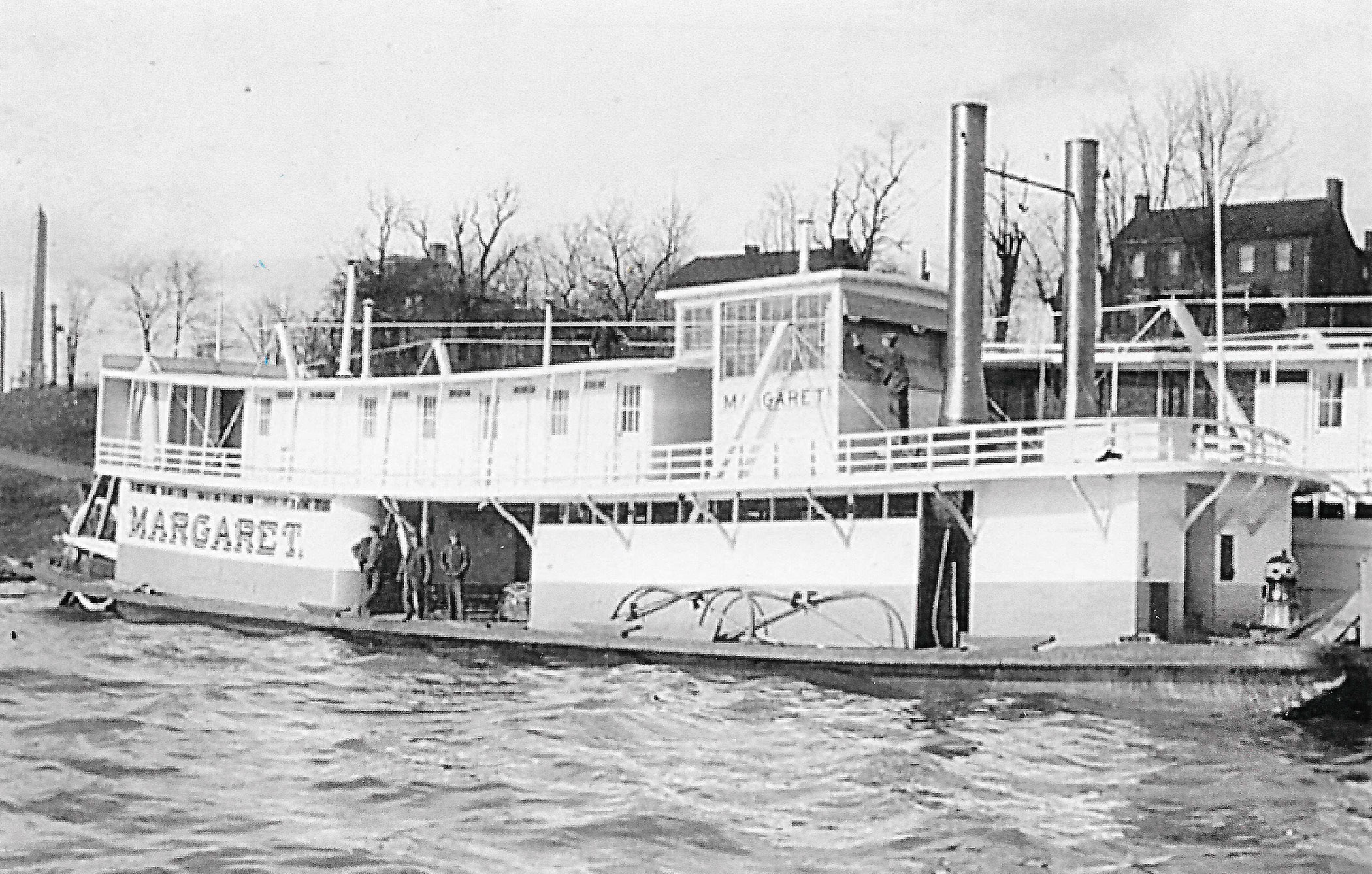
According to Way’s Steam Towboat Directory, the Margaret was built at Evansville, Ind., in 1894 for the Ayer & Lord Tie Company of Paducah, Ky. It had a wooden hull that measured 142 by 26 feet. No information is given about the machinery installed. It was noted as moving two tows of cross ties down the Cumberland River in spring 1914, the largest handled at that time. It continued to bring large tows down from Clarksville, Tenn., with Capt. Charles R. Ford, master, and Capts. Joe Holland and James Leek, pilots.
Capt. Nelson M. Broadfoot was listed as master of the Margaret in 1919 with Ed Latham, chief engineer and Elmer Henderson second engineer. In 1925, the List of U.S. Merchant Vessels (List) gives the owner of the Margaret as the Bank Mortgage Company, Louisville, Ky., and in 1926 it was owned by the Inland Waterways Company of Wilmington, Del., with a home port of Louisville. Capt. Sewell Smith (whom a book could be written about) was an early master of the Margaret for Inland, with Capt. William F. Brookhart, pilot.
Capt. Sidney Booth was master late in 1926, and it is his signature found throughout the payroll ledger scrapbook of Palmer Fisher, and Capt. Brookhart was still pilot. The last full pay period for the Margaret is shown as August 1 – 15, 1927. There were then several periods showing just Capt. Booth and two engineers. In December 1927, there is again a full crew list, as well as a different vessel name at the top, Steamer Inland. The Margaret had been completely rebuilt at the Ayer & Lord Marine Ways (a subsidiary of its former owners) and renamed.
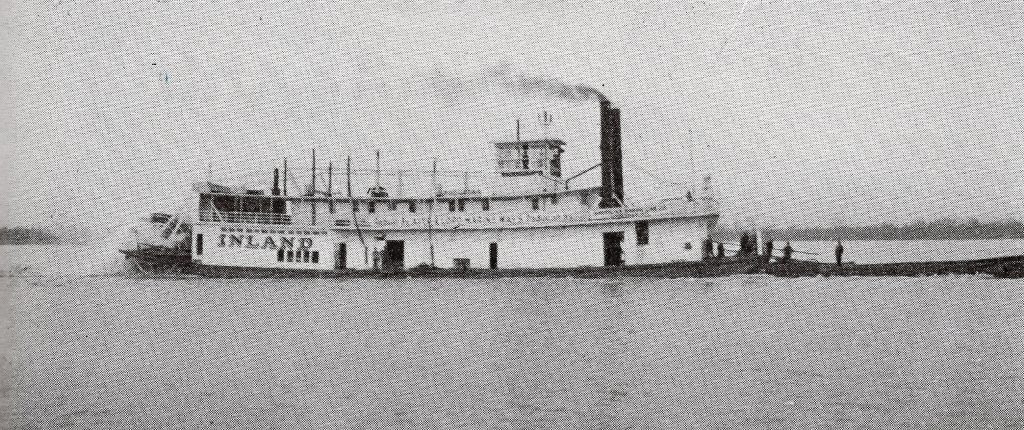
The new name of the boat was Inland, and the rebuild was so extensive that it was now considered a new vessel with a build date of 1927. The hull was still wood with new dimensions of 134.7 by 28 feet. There is still no description of machinery, though Way’s notes that the engines from the Margaret were used, and the List gives a rating of 500 hp., while the Margaret had been shown at 460 hp. Way’s states that the Inland “did lots of work for her size,” and the Inland Waterways Company soon became American Barge Line.
A headline story in the January1, 1938, issue of The Waterways Journal details that the Inland was lite boat easing into the Costanzo Coal Company landing at Warwood, W.Va., below old Ohio River Lock 12 to pick up a fuel flat on December 22, 1937, when it struck the sunken hull of the towboat Voyager and sank. Capt. Charles H. Ellsworth was master, and, as soon as the boat began taking water, he ordered it abandoned for fear the cold river water would cause the boilers to explode.
The boat settled to the bottom without an explosion and was raised successfully, but, while the damaged hull was being further patched, a charge of dynamite went off in the cabin on January 13, 1938, and fire destroyed the cabin and pilothouse. The wreck had been sold to Capt. R.J. Hiernaux, who still planned the boat but later sold the hull to Jim Bonnelli in 1940. He used it to build a showboat named Cotton Blossom, towed by the Margaret Hall. This showboat burned at Memphis on February 27, 1943.
It may be of interest to the rivermen of 2026 that the payroll ledger for 1927 gives the monthly pay rate as follows. Master, $350; pilot, $300; chief engineer, $185; second engineer, $165; mates, $75; and deckhands, $50. The cook was listed at $39.50. Bear in mind again that these were monthly wages. $1 in 1927 would be worth approximately $19 today.
Featured photo caption: Str. Margaret in1915. Unknown location or photographer. (Photo courtesy of Capt. Bill Judd )