
NABRICO Towwboat Designs Made Great Strides Over a Decade
With the popular Inland Marine Expo taking place this week at Nashville, Tenn., this column has been detailing towboats built by the Nashville Bridge Company (NABRICO). The last column looked at the diesel sternwheel towboat Dixie, built in 1937 for Capt. Frank Paden of Sardis, Ohio. The boat had a steel hull measuring 76.5 by 18.8 feet and was powered by a 160 hp. Fairbanks-Morse engine.
J. Mack Gamble, author of the Upper Ohio News column in The Waterways Journal, had described the Dixie when new as “truly modern in both design and equipment.” The boat would prove to be the last sternwheel towboat built by NABRICO. The company had been turning out prop-driven diesel towboats for many years prior to this and, after 1937, the vessels the company built began taking on unique new looks and gained a stellar reputation for performance.
Within the following 10 years, boats such as the Dorothy H and Walter G. Hougland for Hougland Barge Line of Paducah would set a standard for NABRICO-built towboats. In 1939, NABRICO built the single-screw Bull Calf, which boasted the first Falk air-flex clutch on the inland rivers. Throughout the years of World War II, like the other major inland shipyards, production was focused on vessels for the war effort.
After the war ended, domestic production resumed. In 1946, two towboats are listed as having been built by NABRICO. While the two were very similar in size and appearance, the first was a single-prop craft of 1,200 hp. The second was a 1,500 hp. Twin-prop boat named Elisha Woods (WJ July 21, 2025) and built for Charles C. Smith and Company, Houston, Texas.
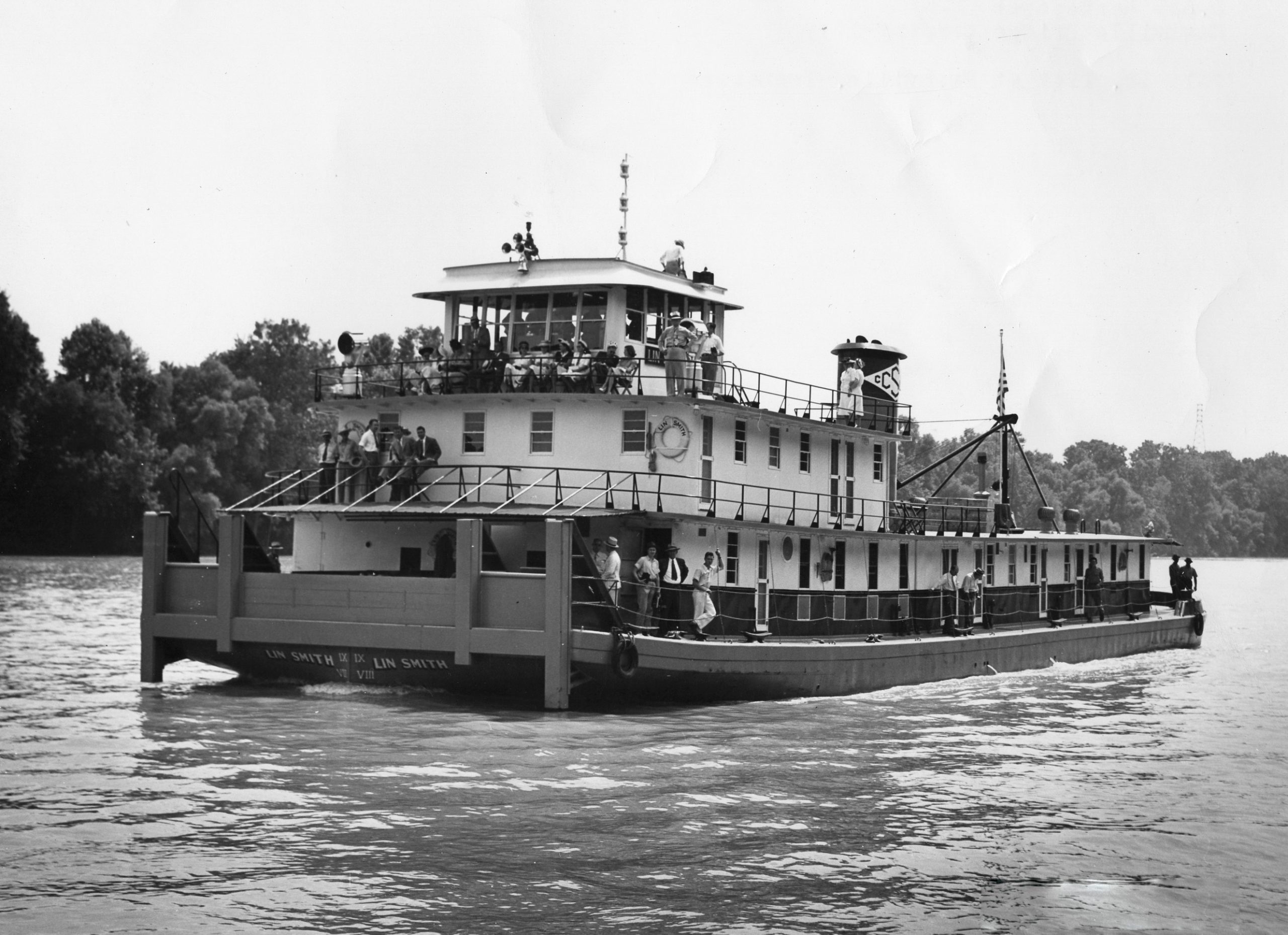
In 1947, 10 years after the “modern” 160 hp. diesel sternwheel Dixie had left the NABRICO yards, a truly modern towboat was crafted there. The triple-screw vessel was of all-steel construction with a hull that was 140 feet long and 38 feet wide. The hull depth was 9.6 feet, and substantial power was provided by three Cooper-Bessemer JS-8 diesel engines totaling 3,300 hp. at 450 rpm. Normal operation was to be 3,000 hp. at 420 rpm. This made the boat one of, if not the most powerful towboats on the rivers at that time.
This large towboat was also owned by Charles C. Smith and Company. and was named Lin Smith. The Smith company was listed in the Inland River Record as having nine other vessels at the time, most of them smaller tugs. The big Lin Smith had a full lower cabin with a shorter upper cabin. Above this was a large pilothouse that was rimmed with the distinctive NABRICO style visor. Despite being a triple-screw boat, there were only two tall stacks mounted on the roof behind the upper cabin, with two exhaust pipes in the one on the port side.
Radar had made its initial appearance on the rivers in November 1946, but photos of the Lin Smith new at Nashville show no evidence of a radar scanner on the pilothouse roof. The logos for Charles C. Smith and Company, a diamond shape with the letters CCS inside, were on the outsides of each stack.
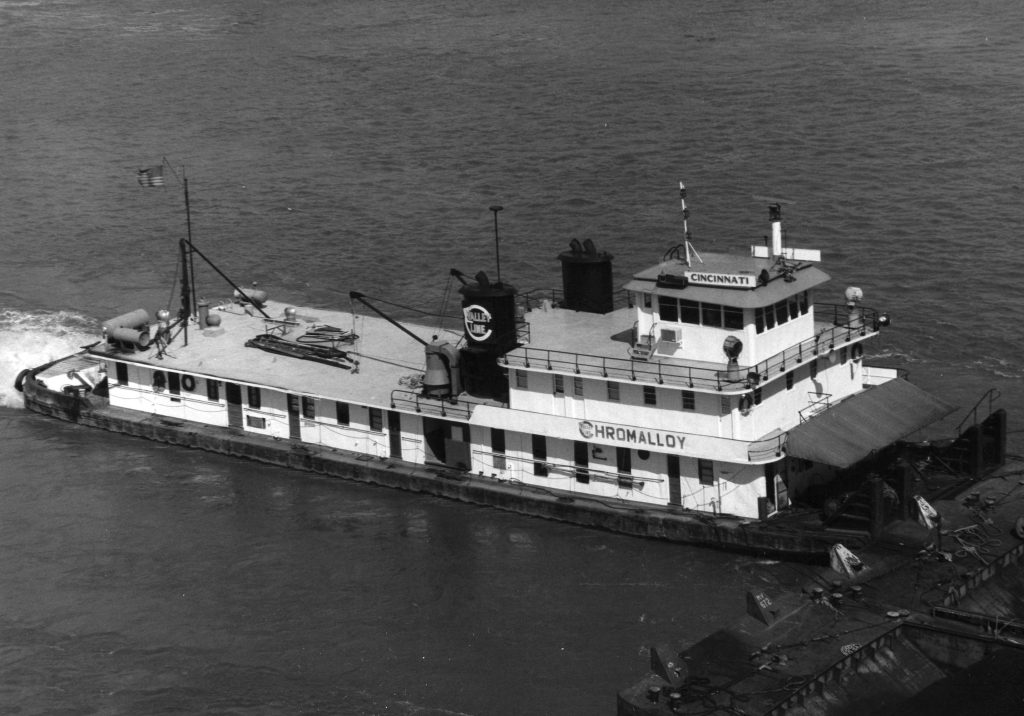
At some point, the Lin Smith must have been on bare boat charter to Canal Barge Company of New Orleans. While the owner was listed in the IRR and the List of U.S. Merchant Vessels as Charles C. Smith, undated photos show the boat with white stacks and the red old English “C” logo of Canal. In 1956, it was sold to the Mississippi Valley Barge Line Company (Valley Line) and renamed Cincinnati. The boat’s radio call letters were WA 7204.
In 1972, the boat was repowered with three GM 12-645E2 engines, giving it 3,600 hp. It continued in service to the Valley Line until 1988, when it was sold to Pennsylvania Barge Lines, Inc., West Homestead, Pa. According to the IRR, it was sold in 1991 to American Boat Company, Cahokia, Ill. The IRR noted in the OFF THE RECORD section of the 2000 edition that the boat was being removed from the listings since it had been out of documentation since 1989.
Featured photo caption: The new Lin Smith at Nashville September 12, 1947. (Photo courtesy of the Dan Owen Boat Photo Museum collection)