Maritime Throwdown Nears Decade Mark
What began as a side project dreamed up in a towboat wheelhouse has grown into one of the inland maritime industry’s most recognizable demonstrations of seamanship, safety and workforce development.
As Maritime Throwdown approaches its 10-year anniversary, founder Capt. Kenny Brown is reflecting on a journey that started with a simple idea: create an “American Ninja Warrior”-style competition for towboaters while showcasing the skills that professional mariners use every day.
“I wanted to have a side hustle,” Brown said. “I wasn’t trying to build something to get off the boat. I loved what I was doing. I said, ‘Let me try one of these crazy ideas I’ve got.’ ”
The original concept focused on tow building, but Brown quickly realized that scaling such a competition across different sectors of the maritime industry would be difficult. Instead, he centered the event around line-handling, a skill common to everyone from small-vessel operators to crews aboard large ships.
“From the smallest skiff to the largest ship, lines we had in common,” Brown said. “We can all handle lines, and we can all compete and have a good time.”
The first Maritime Throwdown event was far from the polished production seen today. Brown recalls a simple course consisting of three light poles and a handful of obstacles. Convincing people to participate proved difficult because many assumed it was merely a line-throwing contest.
“Nobody understood the concept,” he said. “I couldn’t explain it good enough.”
Attendance was modest, and Brown left the inaugural event questioning whether the idea would survive.
“I was like, ‘Oh my God. My wife’s going to kill me,’ ” he recalled.
Instead, she encouraged him to continue.
“She said, ‘Plan next year.’ She saw something in the crowd and the people that were there. There weren’t a whole lot of people there, but she saw something.”
That encouragement proved pivotal.
Over the next decade, Maritime Throwdown evolved through constant refinement. Brown studied competitors, observed techniques and modified the course to better reflect real-world deck operations. Obstacles were designed not simply to test speed but to reward efficiency, preparation and safe work practices.
“The competitors I watched that scored high were doing everything highly efficient,” Brown said. “That’s really what we’re looking for as captains.”
As the competition matured, so did its scoring system. What began as a race against the clock eventually incorporated detailed scoring metrics that reward proper technique and decision-making.
“We took away just the measurement tool of time,” Brown said. “We added the score metrics in, which is one of the most powerful pieces of the entire program.”
Safety has remained central from the beginning. Brown credits an early conversation with a maritime attorney for shaping the competition’s risk-management philosophy.
“He told me, ‘I can tell you’re passionate, but I don’t want to touch it because of liability,’ ” Brown said.
While initially discouraging, that conversation forced Brown to think carefully about every element of the course.
“Everything that I did, I was thinking about the risk associated with it and how could I mitigate it,” he said.
The result has been a competition that emphasizes skill development while maintaining a strong safety culture.
Over time, Maritime Throwdown’s mission expanded beyond competition. Brown increasingly saw the platform as a tool for workforce recruitment and public outreach.
One of his earliest indications came during the first event when a vessel operations manager unexpectedly arrived after seeing information online.
“He told me, ‘I’ve got a pocket full of cards ready to recruit people,’ ” Brown said.
That interaction reinforced a broader vision.
“We hope to recruit, train and retain,” Brown said.
Today, Maritime Throwdown regularly appears at public events, industry conferences and training programs. Brown believes the hands-on nature of the competition creates opportunities to introduce new audiences to maritime careers in ways traditional recruiting efforts often cannot.
“We get to explain the industry,” he said. “It’s right in their back yard, and they don’t even know it exists.”
The organization has also expanded into formal training initiatives. Companies increasingly bring Maritime Throwdown into safety meetings, mariner development programs and workforce training events.
“We’re reinforcing the safety culture while they’re learning,” Brown said. “We’re not trying to replace anybody’s training program. We’re the creatine and caffeine to that training program.”
That training component has gained traction as operators look for new ways to engage crews and reinforce best practices. Brown said companies have incorporated Maritime Throwdown into safety days, mariner development programs and leadership training, using the competition’s familiar line-handling exercises to emphasize communication, risk awareness and efficient deck operations.
Another significant milestone has been the development of portable training rigs that allow organizations, schools and industry groups to host competitions and training exercises without relying on the Maritime Throwdown team to be physically present.
Texas A&M Maritime Academy became the first organization to receive one of the units, and Brown sees the concept as a pathway to broader industry engagement.
The goal, he said, has never been rapid growth for its own sake.
“I wanted the foundation to be so strong that it didn’t go away,” Brown said. “Training is the first thing that goes when everything gets slow. We want this program to be so valuable that it can’t go anywhere.”
That focus on long-term sustainability has increasingly positioned Maritime Throwdown as more than a competition. Training events, safety programs, recruiting initiatives and industry partnerships now make up a growing share of its activities, extending the concept well beyond the championship stage.
As the organization approaches its 10-year milestone, Brown believes the industry’s continued support will determine how far the program can expand. What began at a rodeo arena has evolved into a structured platform for skills development, workforce recruitment and safety engagement.
2026 Maritime Throwdown Finals
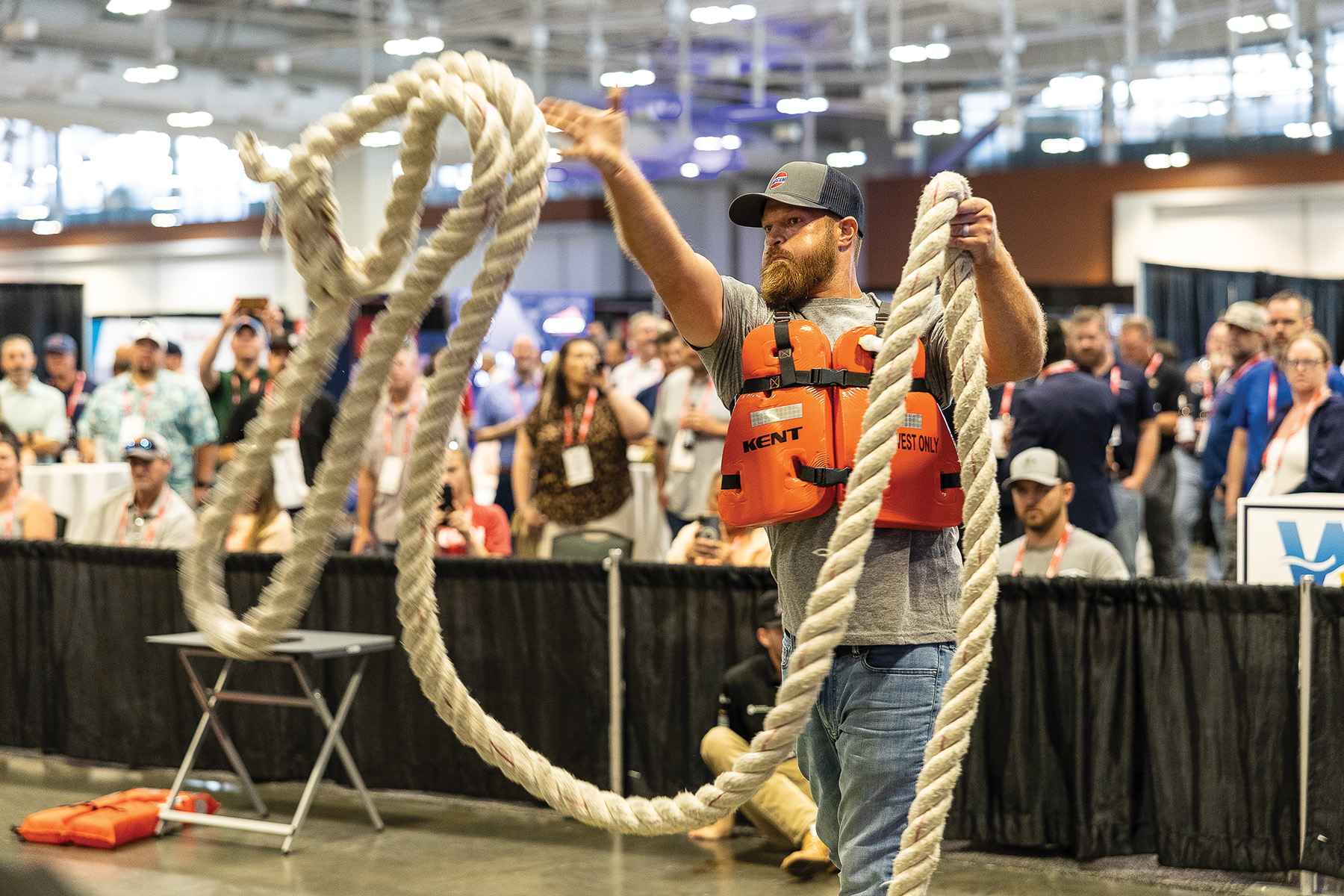
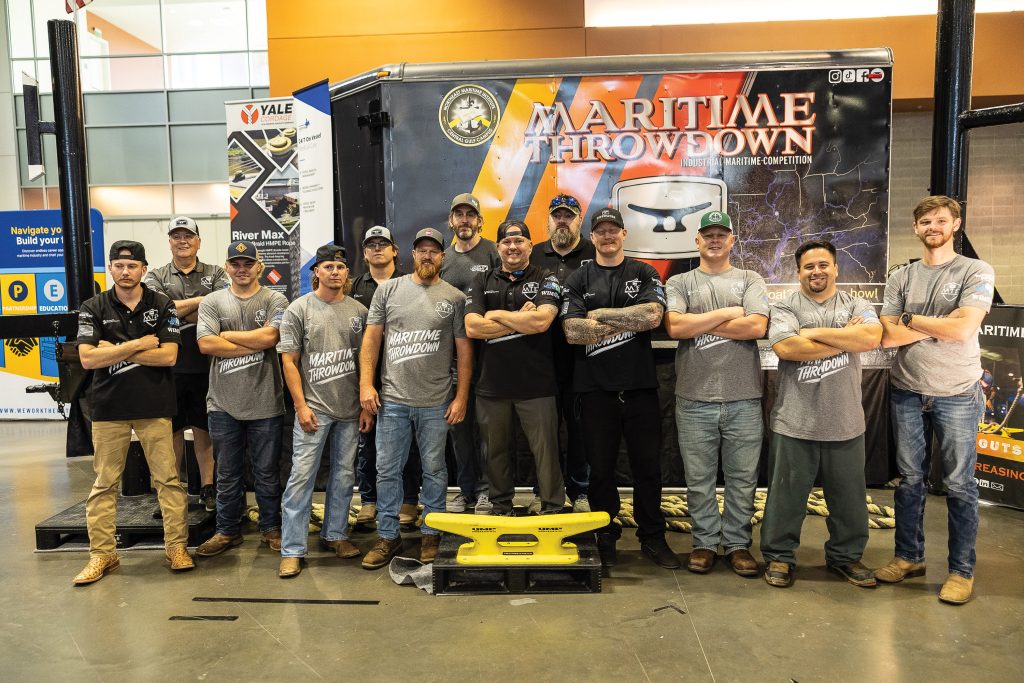
The 2026 Maritime Throwdown Finals were held May 27 during the Inland Marine Expo (IMX) in Nashville, Tenn. Seven competitors representing inland, coastal and harbor operators from across the country competed for the championship and a $10,000 grand prize. Qualifiers advanced through a series of wildcard events and leaderboard rankings held throughout the year.
Competing in the finals were defending champion Paul Cassebonne of Blessey Marine; Michael Kirk of Ingram Marine Group; Gavin Spencer of Businelle Towing Company; Aaron McGraw of Tidewater Marine; Kamron Istre of Martin Marine; Raymond Leonard of Broussard Brothers; and Sullivan Benson of Turn Services.
When the competition concluded, Spencer of Businelle Towing Company claimed the 2026 Maritime Throwdown championship and the $10,000 top prize. Istre of Martin Marine finished second, while Benson of Turn Services earned a third-place finish.
Featured photo caption: Michael Kirk of Ingram Barge Company competes in a line-handling event during the Maritime Throwdown Finals at the Inland Marine Expo (IMX) in Nashville, Tenn. Kirk demonstrated his rope-handling skills as IMX attendees gathered around the competition arena to watch the action. (Photos courtesy of ECN Photography)