
Built To Help Win A War More Than 80 Years Ago And Still Working
Given that the Allied landings on D-Day at Normandy occurred 82 years ago last week and that this is a special dredging issue, it is only fitting that this column look at a towboat built to help win World War II (WWII) and that was later converted into a dredge.
The inland shipyards of the United States turned out thousands of vessels for the war effort during WWII. Established facilities began building almost immediately after the attack on Pearl Harbor, and other yards, such as those at Ironton, Ohio, and Evansville, Ind., were set up expressly for the purpose of building vessels to support the war effort.
In addition to deep sea craft like LSTs, tugs, minesweepers, destroyer escorts and a few submarines, there were 21 large steam prop towboats for river service built as well. These boats were owned by the Defense Plant Corporation (DPC), a subsidiary of the War Department. Rather than being operated by the government, they were leased to existing river companies. Some years ago, David Massie compiled a detailed history of the DPC boats, expanding on an earlier history by Virginia Bennett.
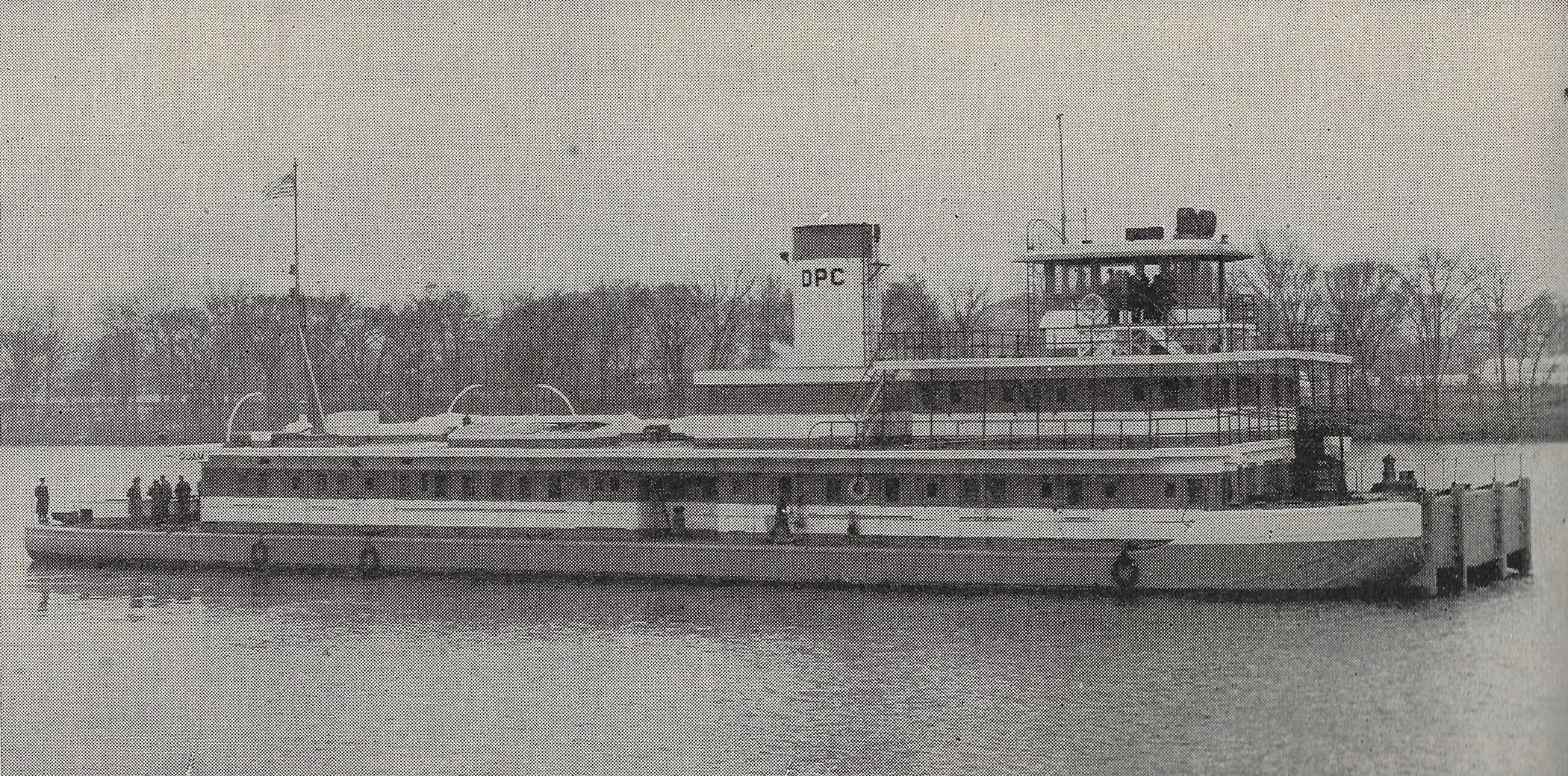
The boats were designed by George C. Sharp, New Orleans, and much like the famed Liberty Ships built by coastal yards, the DPC towboats were built quickly. The hulls and lower cabins were steel, but the upper cabin and pilothouse were of wooden construction, and interior walls were faced with simple Masonite material. They were designed with an unorthodox high bow that made it difficult to face up to loaded barges. The lower deck had a full-length cabin with an open stern, and there was a smaller upper cabin surmounted by a large pilothouse with angled front corners. A single large smokestack rose above a large “fiddley” on the roof.
These were large boats that were 180 feet long and 52 feet wide. They were rated 2,000 hp. from a pair of four-cylinder, triple expansion engines that were 16’s, 26’s, 32’s, 32’s with 2-foot stroke. Steam was supplied by a Foster-Wheeler “A” type generator, 275 psi at 100-degree superheat, burning Bunker C fuel oil. The four-blade props were 108 inches in diameter with 79 inches of pitch. They were named for early WWII battles and leased out to companies for $200 per day. The Guam, built by Marietta Manufacturing, Point Pleasant, W.Va., was the first, launched on August 17, 1943.
While the big boats proved to be strong pushing and backing, the late Robert L. Gray, long in the Marine Department of Ashland Oil & Refining, which operated two DPCs, related that there were a host of early problems with the boats, mainly with the steam generators and machinery. It was so bad at first that an industry committee was formed to try to improve the badly needed vessels.
After the war, all the DPC boats were returned to the government and ultimately sold to private ownership, except for four that were assigned to Army Corps of Engineers districts. At least eight were eventually converted into dredges, and at least one of these venerable vessels is still in service at the Port of Portland, Ore., and therein lies somewhat of a mystery – which one is it?
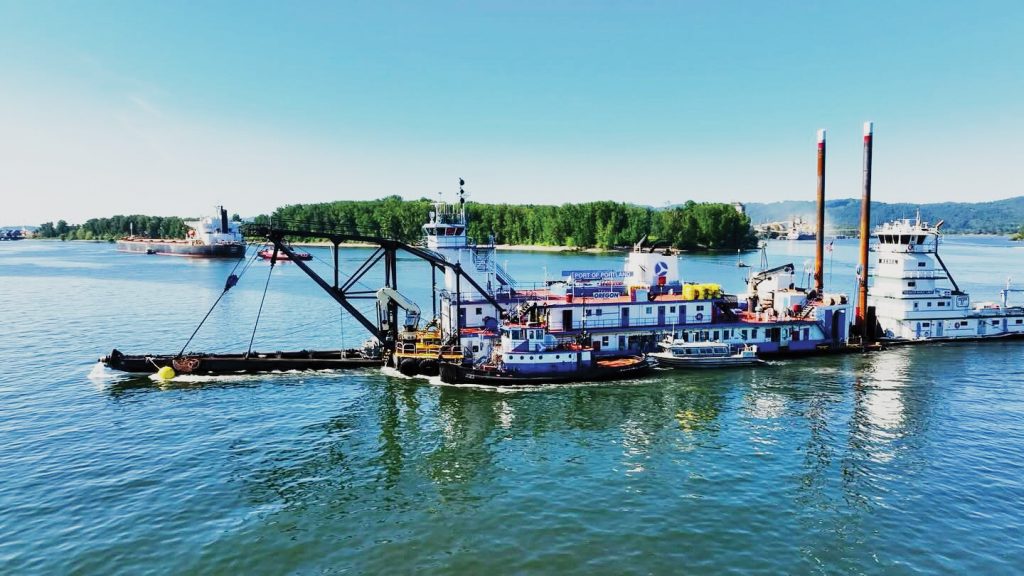
The dredge Oregon, owned and operated by the Port of Portland, works in Portland harbor and to the mouth of the Columbia River from June to December each year. Descriptions of the dredge state that it was built in 1943 as a “Mississippi River towboat” and was converted to a dredge in 1965 by the Bauer Dredging Company, Port Lavaca, Texas. Way’s Steam Towboat Directory indicates that two of the DPC boats were sold to Bauer, the Attu, later named Somervell by the Corps of engineers that became Bauer’s dredge BDCO 52, and the Bou Arada, later the Sohio Fleetwing and Pittsburgher. The Massey narrative lists a third, the Guam, later the H.E. Lewis and America, that became Bauer’s dredge BDCO 28.
The Bou Arada was converted into a clamshell dredge named Avocet by Ratcliff Materials, Mobile in 1971 and was sunk as an artificial reef in the early 1990s. Massey shows the Attu and Guam as having later been “scrapped,” yet one of them has to be the Dredge Oregon at Portland. Information on the history of the craft is very limited. I spoke with current Leverman Bob Holt and former Dredge Capt. Mark Stilwell, who worked on the Oregon for 30 years.
Neither knew for sure what the original name was, though Stilwell thought it may have been the Guadalcanal. That particular DPC is shown as having been scrapped at New Orleans after 1960. At any rate, the Oregon seems to be in great shape with the distinctive high DPC head readily evident in photos. The fore part of the stack may be original as well. 1960s era Cooper-Bessemer diesels that drove the main pump and generators were replaced with modern environmentally compliant, fuel-efficient engines in 2016, and in 2021-22 the stern of the hull was removed and replaced with a new section.
If anyone knows for sure which DPC towboat the Oregon is, please let us know!]
Featured photo caption: The Str. Guam new at Marietta Manufacturing Company from an ad in the August 20, 1949, WJ. (Photo from the author’s collection)