

Corps Supplements LOMA With Mobile Units
The U.S. Army Research and Development Center, part of the Vicksburg Engineer District, is deploying mobile trailers to supplement the Lock Operations Management Application (LOMA) and the related Lock Performance Monitoring System (LPMS) that tracks river traffic, provides real-time situational awareness and collects operational data.
LOMA is a real-time situational awareness and tracking network used to monitor commercial river traffic and manage navigation locks. The program maintains a network of shore sites that receive automatic identification system (AIS) broadcasts from vessels and, in turn, broadcasts safety messages via the same radio protocols. The majority of these transmission spots are located at Corps-owned lock and dam sites. However, because of the current distribution of the sites, there are gaps in AIS coverage and broadcast abilities.
To help mitigate these hazards and alleviate gaps in broadcast coverage, researchers at the U.S. Army Engineer Research and Development Center (ERDC) are using deployable mobile trailers to ensure that critical messages can be transmitted to vessel traffic.
Dr. Marin Kress, a research physical scientist with ERDC’s Coastal and Hydraulics Laboratory, said LOMA includes 170 permanent shore sites spanning 25 waterways, but that still doesn’t provide total coverage.
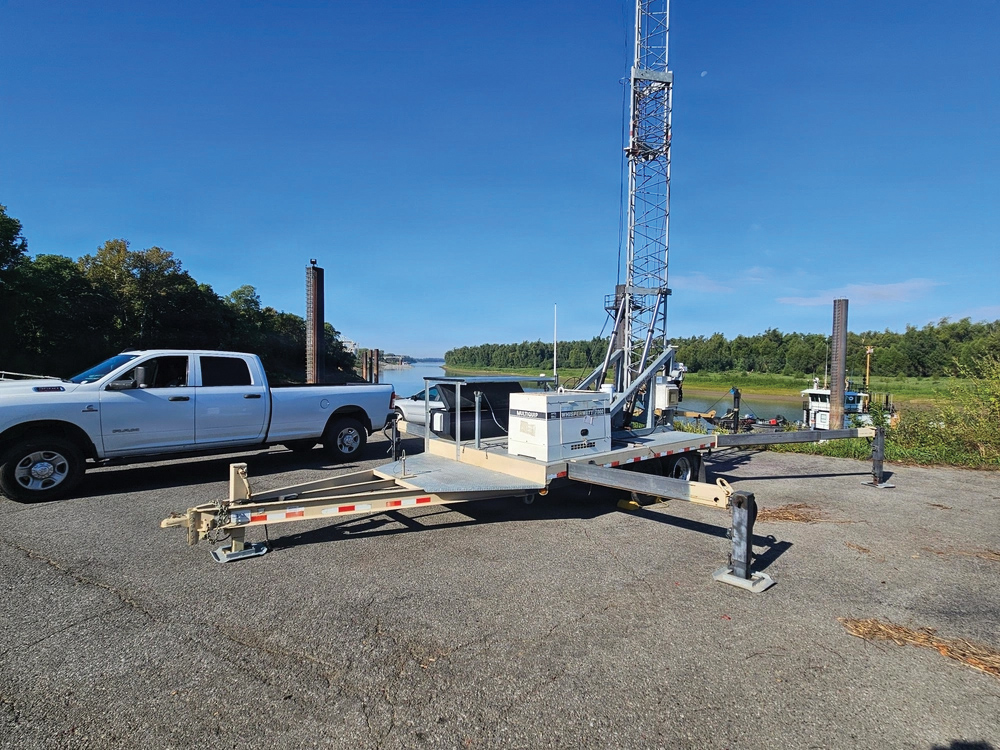
To fill in the gaps, ERDC researchers are using rapidly deployable trailer-mounted mobile units to enhance or expand LOMA capabilities in the absence of permanent receivers or in areas of challenging terrain.
In 2024, the LOMA program received a request from the Vicksburg District to deploy a trailer to Lake Providence Port in Louisiana to broadcast virtual aids to navigation, or VATONs, marking newly identified shoals affecting the navigation channel. During the six-month deployment from September 2024 to March 2025, more than 3,800 vessels moved through the area, transporting more than $16 billion in commercial goods.
ERDC researchers also used LOMA mobile trailers to keep the Mississippi River open at Hickman, Ky. In Hickman, officials were considering shutting down river traffic due to rock formations capable of slicing open the bottom of a barge combined with falling river levels and missing channel buoys that couldn’t be immediately replaced. The Memphis District reached out to ERDC and requested the deployment of a LOMA trailer to the area to broadcast VATONs, warning vessels of the hazard and allowing river traffic to continue, while giving the U.S. Coast Guard ample time to replace missing buoys.
With the success of these deployments, the LOMA team is looking to expand their mobile capability. Kress said the team has three units, all deployed to different field locations. Two more are waiting to be retrofitted.
An increase in the mobile fleet is part of the future vision for the program, as it would help to expand LOMA coverage across the entire waterways system, allowing for the broadcast of safety information as well as other river information services that can be used to improve navigation.
“We want to keep delivering better products to keep changing the game and improving the system for everyone on the water,” Kress said.
Featured photo caption: Researchers at the U.S. Army Engineer Research and Development Center deploy a mobile trailer equipped with U.S. Army Corps of Engineers Lock Operations Management Application (LOMA) capabilities to help alleviate gaps in broadcast coverage and allow critical messages to be transmitted to vessel traffic in Hickman, Ky. (Photo courtesy of U.S. Army Corps of Engineers)