

WCI Tour Highlights System, Funding
Seeing the inland river system is an important part of understanding how it works. For that reason, Waterways Council, Inc., hosts annual tours for
journalists and other invited guests.
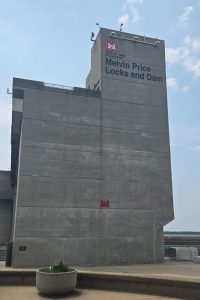
The August 5 tour began with a trip to Melvin Price Locks and Dam on the Upper Mississippi. The Corps of Engineers provided information about both the history and role of the locks and dam in river navigation. Adam Schimpf, operations manager with the St. Louis Engineer District’s Rivers Project Office, led the group.
Originally built in 1936, the current locks and dam replaced the original Upper Mississippi Lock and Dam 26 in 1994. The tour included a presentation and lunch before guests headed to the observation deck.
From the fourth floor, the group watched the towboat Big J.O., owned by Yazoo River Towing, move through the lock. As water levels slowly rose, the towboat and its barges lifted to meet the upper river. Once the levels equalized, the horn sounded, signaling the towboat to continue upriver.
The tour provided a firsthand look at the massive infrastructure supporting commercial navigation and highlighted the important role locks and dams play in keeping goods moving along the Mississippi River.
Corps Funding Update
After the tour, Jen Armstrong, WCI’s vice president for government relations, spoke regarding the Inland Waterways Users Board and the Corps’ Capital Investment Strategy.
Armstrong brings deep expertise into Washington, D.C. policymaking as it relates to Corps of Engineers funding and budgets. She is a subject matter expert in Congressional appropriations and the U.S. Army Corps of Engineers’ Civil Works program, having previously served as clerk and staff director of the U.S. Senate Energy and Water Development Appropriations subcommittee. That subcommittee has provided more than $53 billion to the Department of Energy, the Corps of Engineers, the Bureau of Reclamation and other independent agencies. Prior to her work with the Senate, Armstrong was with the Corps of Engineers as a water resources planner, project manager and government affairs liaison specializing in coastal storm damage reduction, ecosystem restoration and navigation. Before joining WCI, she was the director of navigation policy and legislation at the American Association of Port Authorities.
Armstrong noted that the Inland Waterways Trust Fund is fueled by a 29 cents per gallon fuel tax paid by inland waterways operators. It’s that “skin in the game” that gives the industry advisory status to the Corps via the 11-member Inland Waterways Users Board — although, unfortunately, the IWUB has been inactive for 18 months as the industry waits for it to be reconstituted.
Armstrong said the “biggest challenge” to lock and dam maintenance and rehabilitation is “how the Corps is funded” by Congress. Prior to 2006, the Corps operated with its contractors on a “continuing contract” basis in which it could obligate federal funds before they had been appropriated by Congress. Some members of Congress objected to this, however, and Congress ended the practice in 2006.
This change forced the Corps to halt work on a project when funding ran out and complicated its construction cycles. It’s one big reason why the Corps has completed only three large-scale projects in the 28 years since continuing contracts were ended, Armstrong said. Funding uncertainties increase risk for contractors, who build in the increased risk premium into bids and contract estimates.
In consultation with the IWUB, the Corps has developed a Capital Investment Strategy, a 20-year planning framework to prioritize construction and rehab funding for lock and dam projects. It must be updated every five years, in accordance with the 2014 Water Resources Reform and Development Act.
The Corps is always working on three budget cycles at once, Armstrong said. Some members of Congress have responded by fast-tracking certain projects in the restored earmark process, but that’s not an ideal fix.
Armstrong said the Senate has passed a “clean” continuing resolution to fund the government and avoid a looming shutdown. The House has not yet passed its version of a continuing resolution, but in an election year, she said, no one in Congress wants to be accused of provoking another shutdown. The window for passing funding bills will move to mid-December, but that leaves little time to address Corps funding issues when Congress has so much else on its plate.
Dam Safety Issue
Armstrong also discussed WCI’s position on how the dam components of locks and dams should be handled. Within the Corps, lock and dam funding interacts with dam safety through risk prioritization. High life-safety risk dams receive 100 percent of capability funding, which can divert scarce civil works dollars away from commercial lock and dam modernization, unless projects are dual-purposed or supported by the Inland Waterways Trust Fund.