

Another Vessel Designed To Revolutionize The Industry
In recent columns, we have looked at radical new designs for barges and then a towboat. This column will again detail a vessel that was designed with the idea of changing how things were done on the Mississippi River system.
Capt. Alexander McDougall was born in 1845 on the Isle of Islay in Scotland and immigrated with his family to Canada in 1854. At age 16, he went to work on the Great Lakes. He advanced through the ranks from deckhand to mate and, in 1870, became captain. As his career progressed, he was involved in commercial fishing, stevedoring and even oversaw the construction of some Great Lakes ships. He eventually settled in Duluth, Minn.
In the late 1880s, he established a shipyard at Duluth and, in 1889, launched a barge with shapes never before seen on the Great Lakes. Due to a lack of resources at his shipyard, the ends of the vessel had been built elsewhere and shipped to Duluth for completion. The result was a 191-foot-long barge with a flat bottom, but no flat deck topsides. Above the waterline, the sides became rounded, continuing across the top, with small turrets that the compartments were loaded and unloaded from.
The bow was of a spoon shape, and this all provided that no water that shipped aboard the deck during rough seas could stay on deck but would roll off. The design was laughed at and was first referred to as “pig boats” but would soon come to be known as “whalebacks.” With investment from Colgate Hoyt, an associate of John D. Rockefeller, McDougall turned to building ships, and, between 1889 and 1898, some 40 whaleback ships were built for Great Lakes service.
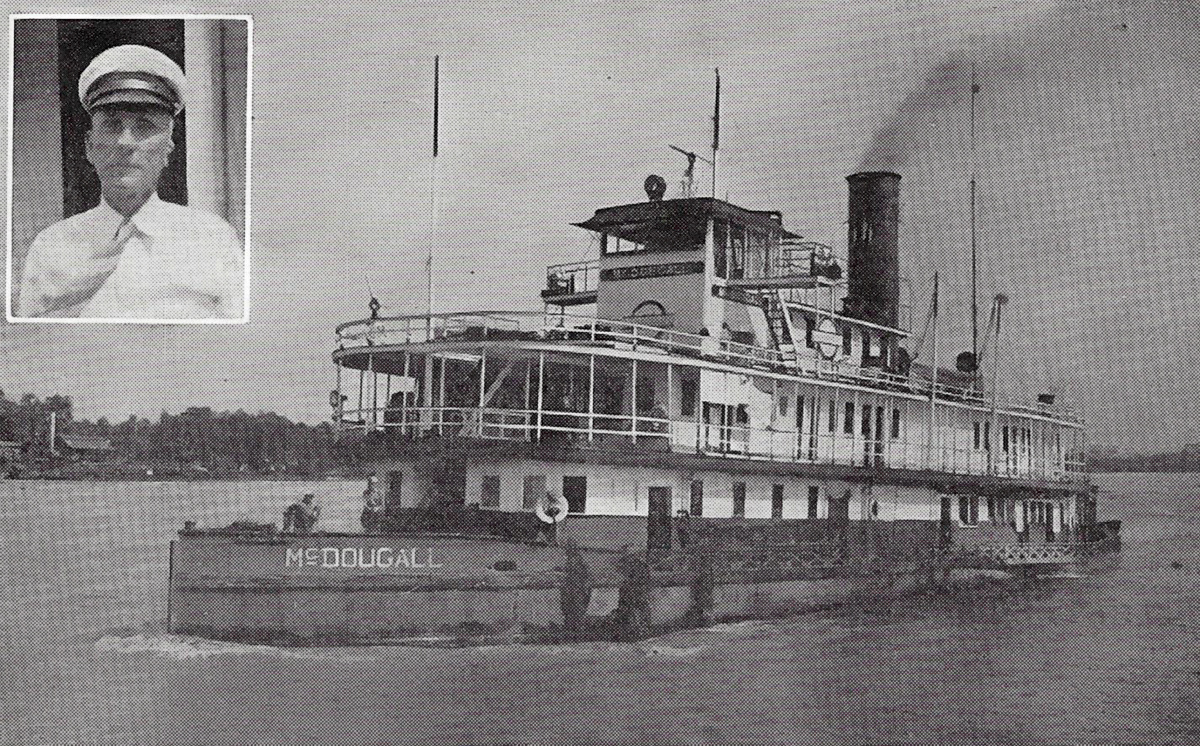
In 1899, McDougall became interested in the Mississippi River system. He felt that it would be more efficient to pull barges rather than push them on the rivers. A boat was constructed at St. Louis by the St. Louis Steel Barge Company, owned by Alexander McDougall. This craft was 168 feet long, 32 feet wide and the hull was pointed at both ends.
The boat was named McDougall and was a twin-prop steamboat with two oil-burning Scotch marine boilers. The compound engines were 16s, 34s with 27-inch stroke rated 850 hp. at 400 rpm, turning 102-inch-diameter propellers. Since barges on the Great Lakes and oceans were pulled rather than pushed, McDougall had visions of a towboat fleet on the Mississippi performing the same way. Trials of the McDougall towing barges in this fashion in the St. Louis harbor were a failure.
After this, I have not found any information on what the boat was doing until it was requisitioned by the U.S. Navy in October 1918. It was sold to the Navy in November 1918, but the name was not changed, and during World War I it was used in the New Orleans area for tug and towing duties. In March 1919, it was sold back to the St. Louis Steel Barge Company.
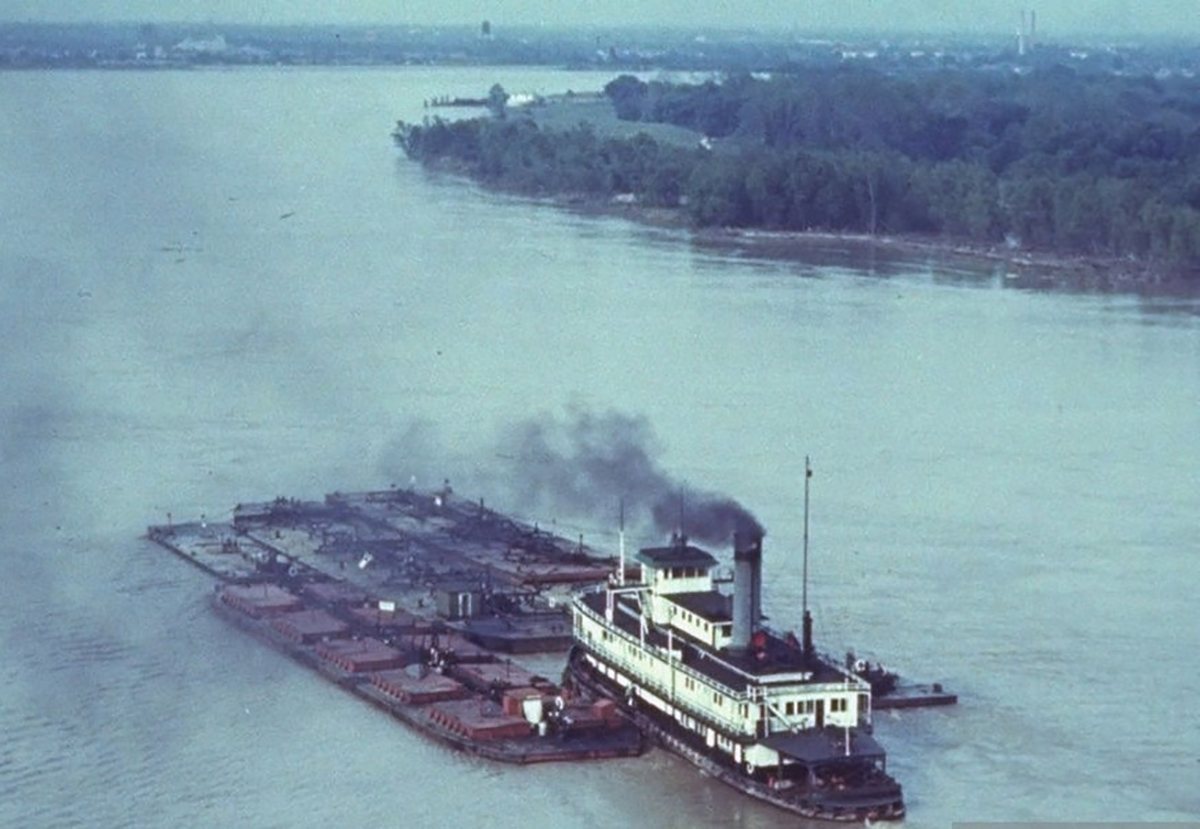
In 1920, the McDougall was sold to Standard Oil of New Jersey, Louisiana Division, and again it was not renamed. The boat was used around the massive Standard Oil refinery at Baton Rouge and to deliver tows of petroleum products from there to the New Orleans area. Over the years, the McDougall worked around and in conjunction with some well-known steam sternwheel towboats of the Standard fleet, including the Amos K. Gordon, D.R. Weller, Jack Rathbone and Big Mama herself, the gigantic Sprague, largest towboat ever built.
The McDougall never had towknees built on the bow, and aerial photos of it underway with a tow show it sitting in a duckpond and lashed to the barges from the sides. An article in the January 13, 1940, issue of The Waterways Journal had originally been published in a Standard Oil publication called The Stanocolan and described the McDougall.
The piece gave descriptions of the machinery aboard the boat and then said, “The thing about the McDougall that sets it apart from other river boats is that it is pointed on both ends, has straight up-and-down sides and a perfectly flat bottom. It is probably the only river boat built after this design.”
The crew was listed as “Capt. Leland LeNormand, master; Capt. E.F. Higbee, pilot; G.H. Chapman, chief engineer; Fulton Talbot, second engineer; W.L. Saurage and T.C. King, oilers; Walter Carbo and D.R. Murphy, firemen; C.J. Gilliot, mate; C.J. Guidry, J.A. Whitaker, E.J. Whitney and Jack Craig, deckhands; John V. Latil, pumpman; Roosevelt Hunter, cook; and Clarence Borden, cabin boy.”
The McDougall served Standard for some 28 years and was dismantled in 1948, the same year that the mighty Sprague was retired. Alexander McDougall passed away in 1923 after a most successful career on the Great Lakes. Though his hawser towing idea on the Mississippi failed, the boat he designed for it went on to a very useful career for Standard Oil.
Featured phot0 caption: The McDougall as shown in the January 13, 1949, WJ. Inset of Capt. Leland LeNormand. (Photo from the author’s collection)