

A Radically Different Barge
This Old Boat column is not about a boat, but rather a particular style of barge. After all, what would a towboat be without barges to push?
The Mississippi Valley Barge Line Company, better known as simply the Valley Line, had beginnings in a company known as the Standard Unit Navigation Company that had built an innovative towboat at the Nashville Bridge Company in 1929. It was named SUNCO A-4 and had caterpillar type paddles on the sides (WJ September 21, 2021). In 1930, the company had four large steam prop towboats constructed.
Early drawings of the big prop steamers indicate that they were designed for the Standard Unit Navigation Company, but, by the time they went into service, they were owned by the Valley Line. Both companies were created with the involvement of Carl J. Baer, a native of Gallipolis, Ohio, who was a resident of St. Louis at the time. Two of the big towboats were built by Dravo at Neville Island, Pa., named Ohio and Tennessee and equipped with Skinner Uniflow reciprocating engines. The other two boats, named Indiana and Louisiana, would be built by Ward and have steam turbines powering electric motors. All were 191 by 40 feet and boasted some 2,000 hp.
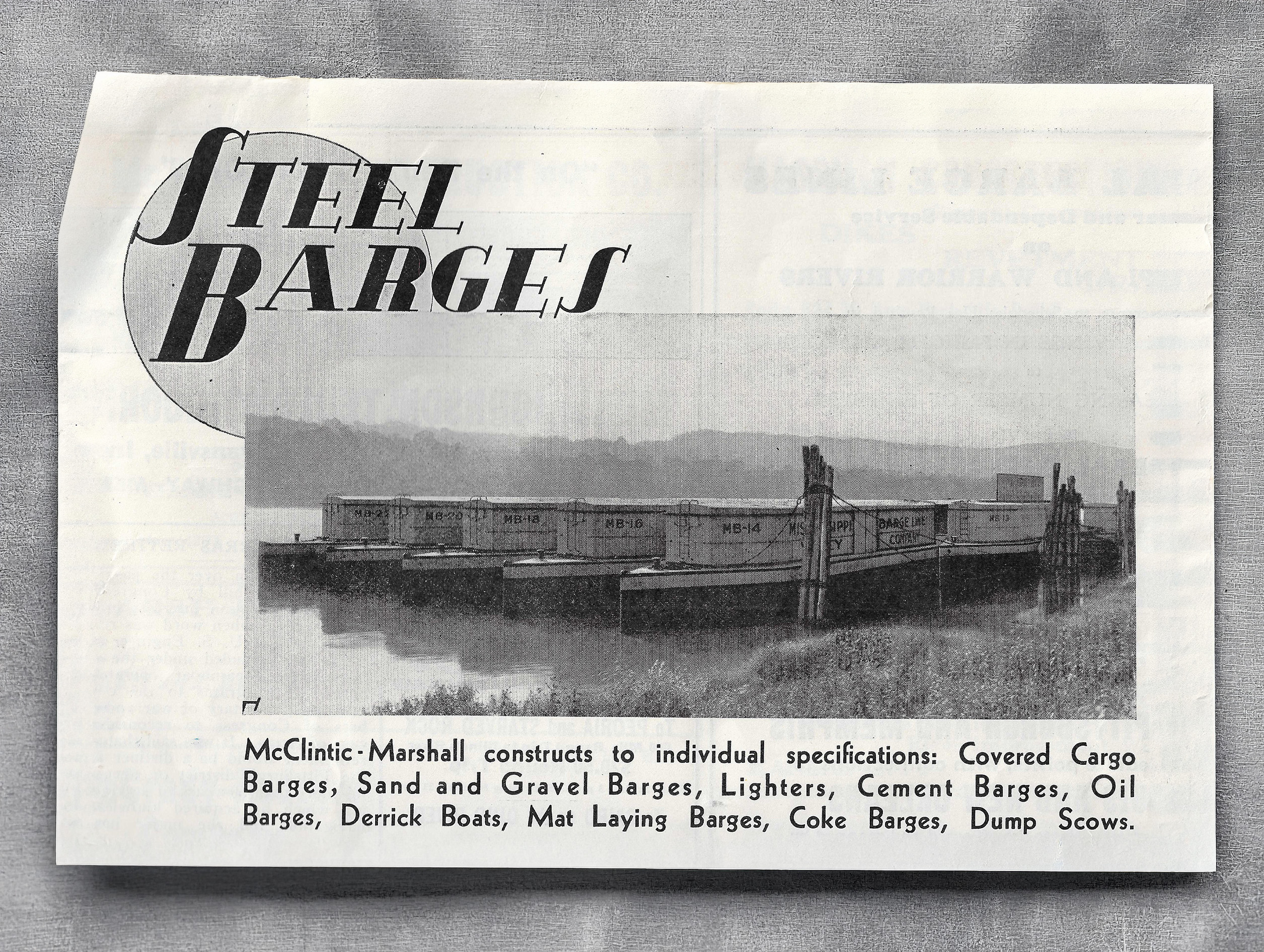
To go with these large boats, the Valley Line had a group of barges constructed. There may have been hopper barges built as well, but the ones looked at in this column were not built in a usual style that was somewhat rectangular with square ends. Instead, these were of a very radical shape and design.
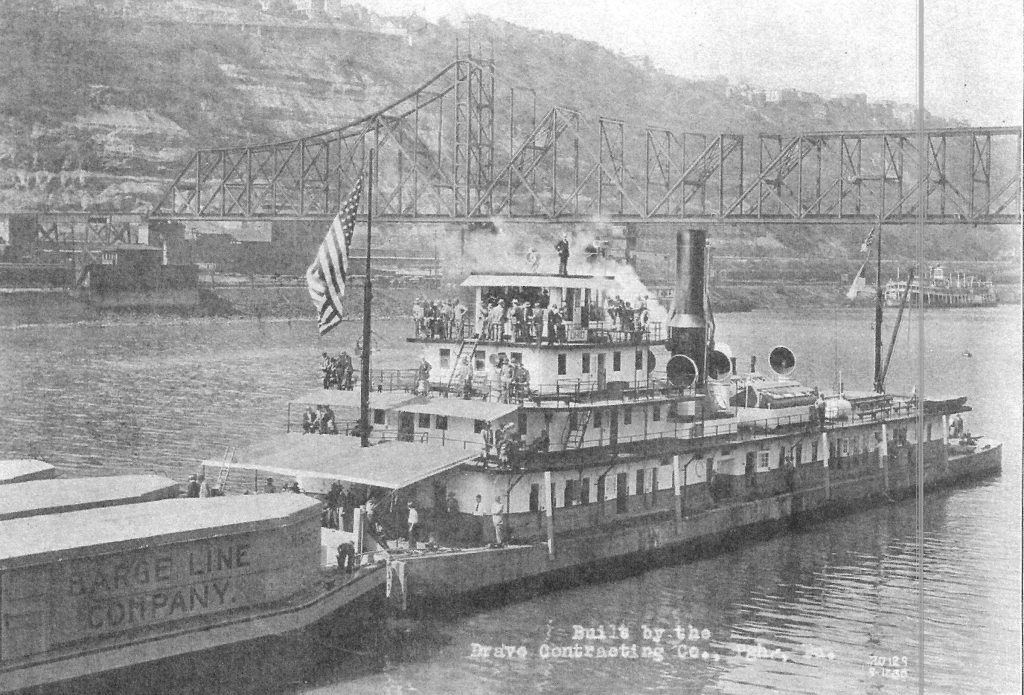
The steamer Ohio, one of the Valley Line boats built by Dravo, was the first to enter service. A photo taken during christening ceremonies at Pittsburgh on September 17, 1930, shows it faced up to a group of strange-looking barges. The ends came to a sharp point, and the corners leading to the end were not curved but had flat-angled sides. The barges were covered by a rather tall structure that had sliding doors on the sides, which were emblazoned with “Mississippi Barge Line Company.” The flat sides of the corners of the deckhouse had “MB” and a dash followed by a number.
The barges appeared to be about 100 by 26 feet. They were obviously general cargo barges designed to handle a wide range of freight. The October 11, 1930, issue of The Waterways Journal had a lead story in the Cincinnati news column headlined “First Regular Tow of New Mississippi Barge Line Goes South.” The Ohio, with 17 barges in tow, “pulled away from the new half-million-dollar terminal” that the Valley Line had built at Cincinnati and headed to New Orleans with the first tow for the fledgling company.
Carl J. Baer, vice president of the firm, was aboard, and Capt. William Mills was master. The cargo carried in the barges included “a wide variety of freight, including three carloads of furniture bound for California by way of New Orleans.” This same column had news of three area packets, the Senator Cordill, Tom Greene and Kentucky. These freight barges and others like them would help speed the death knell of the packets, with the final coffin nail coming with improved highways.
I had the opportunity to go all over and through one of these “point” barges, as they came to be known, many years ago. They were very heavily built with riveted steel construction. There was a double hull (double skinned). The top of the deckhouse was in sections that could be lifted off, and there were smaller hinged doors in the top sections. This made loading by crane easy. The large doors on the sides slid open for loading from a dock. In addition to all of this, the floor of the deckhouse was made up of heavy wood planking that could be removed so cargo could go in the hold in the bottom of the barge.
These vessels seemed to be very well thought out, with one exception. They fit together honeycomb fashion with the ends nestled together, and there was no way to get a straight flat side. They were a pain to place in tow with any other type of regular-shaped barge and then created “duck ponds” that someone could fall into.
They fell out of fashion as more cargo became of the bulk variety carried in open or covered hopper barges. As they became surplus, many wound up as dock or landing barges. There are very few left, and a recent photo on social media depicted one going up the hill on the Monongahela River to be scrapped. It’s another piece of river history gone.
Featured photo caption: A McClintic – Marshall Corp. ad in the July 9, 1932, WJ showing a fleet of newly built point barges. (Photos from the author’s collection)