
Marine Solutions Builds Engineering Practice
Marine Solutions Inc. began with divers working below the waterline, inspecting structures, removing sediment and clearing trash racks. That field experience gradually led the Nicholasville, Ky.-based company into marine construction and, more recently, a growing design-build and consulting practice aimed in part at smaller ports and terminals.
The progression was driven as much by what Marine Solutions encountered at waterfront facilities as by its own expansion. Many small terminal operators have limited engineering resources, and some no longer have an in-house engineering department able to turn an inspection report into a repair plan, prepare bid documents and manage construction.
Bradley Syler, vice president of Marine Solutions, said the company’s early engineering work centered on routine inspections. Some of those assignments led to design work as problems were identified, while the company’s commercial diving operation expanded into construction, including self-performing pile driving.
Those capabilities began coming together in smaller design-build projects about five years ago. Marine Solutions found an opening among private terminals and smaller public facilities whose projects may be too small to attract a mega-project contractor.
“For us, a $10 million design-build project is a great project,” Syler said. “It’s a good space for us to operate in.”
The model brings inspection, engineering and construction into one process. That continuity is particularly useful underwater, where incomplete condition information can create design gaps or change orders. Divers can document the problem, engineers can develop the repair, and construction crews can assess how it will be installed from floating equipment.
Brian Giltner, senior engineer, joined Marine Solutions after a career that included conventional consulting engineering, bridge work and seven years of teaching civil engineering at a university. At Marine Solutions, he works on complex assignments and helps train younger engineers for structural design.
Giltner said much of the bridge experience transfers directly to marine infrastructure. “On my bridge side I was using sheet piles; here I’m using sheet piles,” he said. “It’s all the same thing. We’re just using it in a slightly different way.”
The loads and operating conditions, however, are distinctly marine. Vessels, fluctuating water levels, currents, debris, corrosion and cargo exposure all affect deterioration and repair. Syler noted that freshwater facilities generally see less corrosion than saltwater ports, but commodities such as fertilizer can create highly corrosive conditions at an inland terminal.
The company also is seeing a need for more systematic inspections. Giltner recalled examining one facility believed to have been built in the late 1930s or early 1940s that apparently had never been inspected. By the time the owner called, a concrete cell cap had dropped about 7 feet. Divers found a split approximately 6 feet long, through which fill material had escaped.
“Part of our job is education,” Giltner said. “If we could have caught this sooner, we could have saved you some money.”
Unlike highway bridges, which have federally mandated inspection intervals, privately owned port and terminal structures generally depend on the owner’s maintenance program. Syler and Giltner pointed to ASCE Manual of Practice 130, which had a second edition released in 2025, as industry guidance. Inspection intervals vary with environmental exposure, material and condition, generally ranging from about two to six years.
Rethinking The Tri-Tie Dolphin
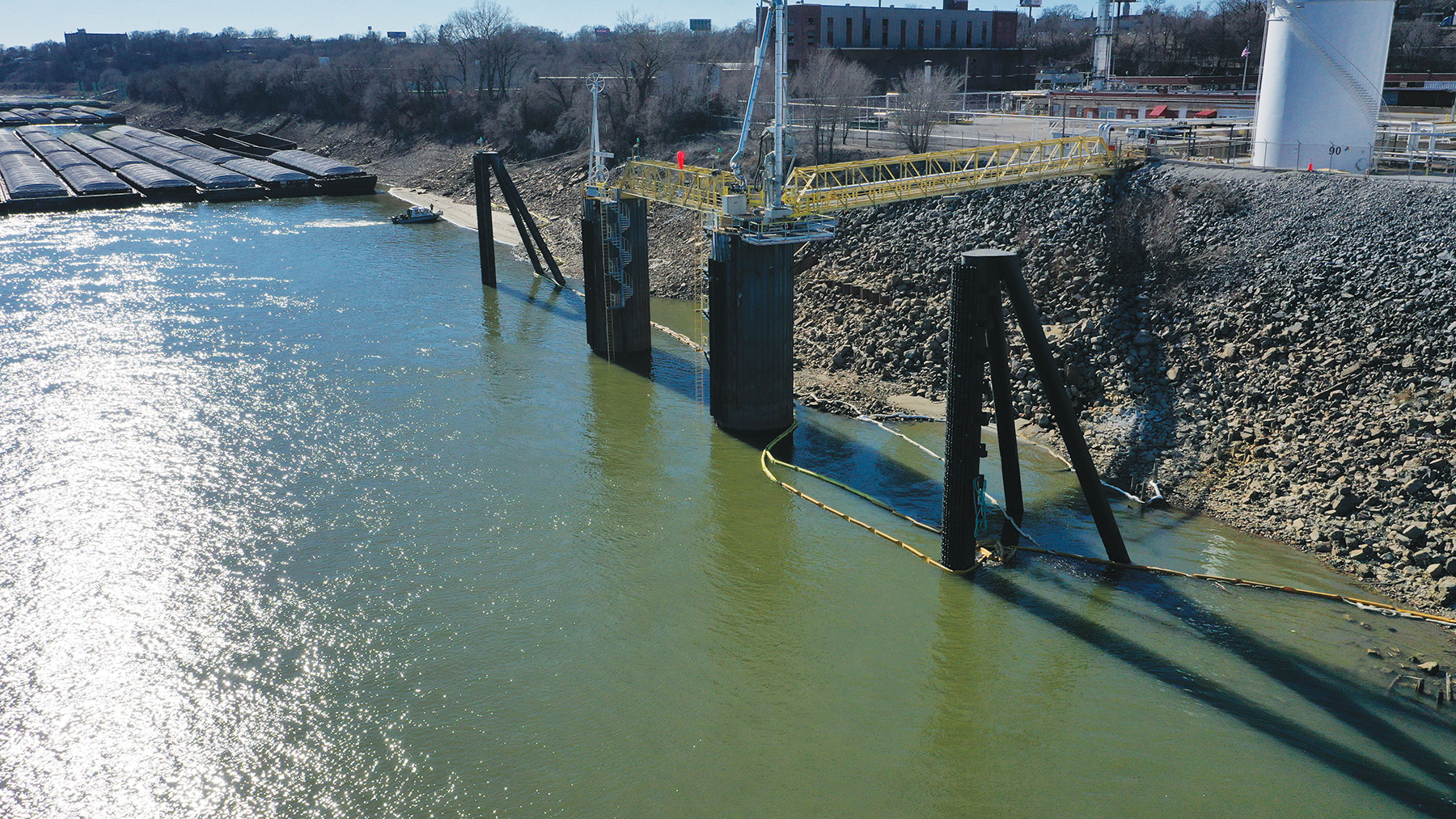
The feedback loop among Marine Solutions’ divers, engineers and construction crews is illustrated by the firm’s Tri-Tie Dolphin. A conventional tri-tie mooring dolphin consists of a vertical king pile and two batter piles, commonly connected by multiple levels of bracing. Marine Solutions’ version removes the lower bracing and transfers the load through larger connection plates at the pile cap.
The idea arose during work for a terminal in St. Louis, where construction crews noted the difficulty of fitting lower braces after piles had been driven. Pile positions vary within driving tolerances, requiring crews to measure, cut, fit and weld braces in the field. Inspectors also frequently found cracking at the lower connections.
Marine Solutions determined that moving the connection to the top and allowing the piles to give slightly when struck produced a simpler structure that could better absorb the force of a berthing vessel. A heavily braced dolphin is stiffer, concentrating more of that force at its connections.
“We find when we inspect them, they break there a lot,” Syler said of the lower bracing on conventional dolphins. Each repair can require crews to grind and weld again at the same location, he added, making it more vulnerable to future cracking.
Giltner compared the principle to impact barrels placed in front of a highway obstruction. Both systems manage energy by allowing movement, although the dolphin is designed to recover and do so repeatedly.
“That’s what these are doing. These are absorbing the same shock,” Giltner said. “We have to let it absorb the energy: flexible but strong.”
Removing the lower bracing also addresses practical river problems. Braces near the waterline can catch trees and debris, adding pressure on the structure and creating more maintenance. They can also be difficult or impossible to install during high water. The Tri-Tie’s connections are made at the pile cap above the waterline, reducing field welding and making construction less dependent on river stage.
“That lower bracing also hangs up debris,” Syler said. “We don’t have the same kind of vessel impacts as the deepwater guys, and they don’t have timber coming down the rivers that we see.”
The simpler configuration removes several places where cracks can develop and limits most of the future inspection and repair work to the connections at the pile cap. It also eliminates much of the custom fitting required when braces must be installed between piles that do not land in precisely the position shown on the plans.
Each Tri-Tie Dolphin is still designed for the individual site. Marine Solutions considers the vessels using the facility along with wind, current, waves and changing water levels. The company also seeks input from terminal personnel and deck crews so mooring fittings are placed where they can be used safely and efficiently.
The first Tri-Tie Dolphin using the approach was installed in St. Louis about a year ago. Syler said the company continues to identify other applications as its inspection, engineering and construction personnel compare what they see in the field.
Marine Solutions is also discussing broader maintenance roles with some terminal owners. Syler recently wrote about the possibility of a contractor managing a facility’s inspection and maintenance program, including regular checks for damaged mooring hardware and longer-term capital planning. He expected the idea to be years away but received several inquiries from owners asking whether Marine Solutions could provide the service.
The company also assists with some permitting and grant-related work, although it typically brings specialized partners onto the team when a project requires environmental, archaeological or grant-writing expertise. Syler said that type of coordination could become part of a larger maintenance agreement, particularly for small ports seeking public funding for repairs.
Featured photo caption: Marine Solutions’ Tri-Tie Dolphins use a vertical king pile and two batter piles connected at the pile cap. Eliminating lower bracing allows the structures to absorb berthing forces while reducing debris accumulation, field welding and maintenance requirements. (Photo courtesy of Marine Solutions)