The Diesel Crucible
The recent columns regarding the steam sternwheel towboat W.P. Snyder Jr. becoming a museum exhibit in Marietta, Ohio, in 1955 touched on the fact that steam vessels were being replaced by diesel boats at the time. Had World War II not interrupted, that transition may have happened even earlier. When Capt. Frederick Way Jr. released the first edition of the Inland River Record in 1945, he had steam and diesel craft listed in separate sections. He noted in the forward that the total horsepower of the two means of propulsion was almost evenly divided at that time.
The last steam towboats built for river service were the 21 twin-prop vessels built for the Defense Plant Corporation during World War II. Those vessels were parceled out to private companies to operate for the war effort. Prior to these, the last steam sternwheel towboat was built by the Marietta Manufacturing Company, Point Pleasant, W.Va., in 1940. Named Jason, the boat was built on speculation and languished at the shipyard for months until it was sold to Union Barge Line in 1941.
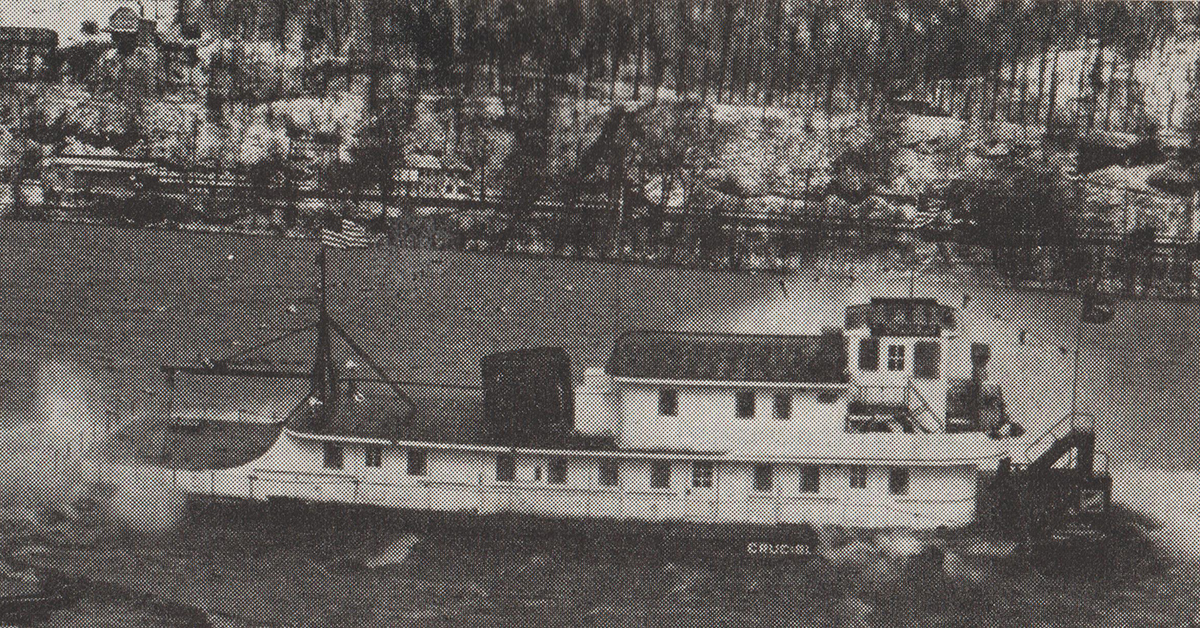
Following the war, as shipyards moved to construction of private vessels instead of military craft, many diesel towboats began entering service expressly to replace steam sternwheel boats. The new diesel towboats were not only more powerful and maneuverable, but they also required fewer crewmembers to operate. In 1951, Dravo Corporation, Neville Island, Pa., built a series of eight nearly identical towboats. These boats measured 108 feet by 26.5 feet and were powered by two National Superior engines that provided a total of 1,066 hp. Falk manufactured the reduction gears, and the vessels’ 72-inch propellers turned in kort nozzles.
These boats were built in an assembly line fashion. They were pool style with the raised pilothouse set forward of the upper cabin to reduce the height and facilitate the transit of low bridges in the Pittsburgh area. Three of the boats were for Pittsburgh Coal/Consolidation Coal Company, two were for Jones & Laughlin Steel; one was for U.S. Steel, and one was for Island Creek Fuel & Transportation.
The last of the series was built for the Crucible Steel Company of America. It was named Crucible and joined a fleet that consisted of the two steam sternwheel towboats (W.P. Snyder Jr. and W.H. Colvin Jr., built in 1918 and 1919, respectively). By 1953, the Colvin was dismantled. The Snyder served as a spare boat until 1955, when it was gifted to the Ohio Historical Society as detailed in recent columns.
Photos of the new diesel Crucible, taken soon after it was built, capture it with a brass bell of about 12 inches in diameter mounted to the front of the pilothouse. Within a short time, a large bell, which had been on the steamer Crucible, was placed aboard. This bell was originally on the steamer Oakland and carried the inscription, “Cast by A. Fulton Sons Pittsburgh, Pa.” On the face was “Str. OAKLAND Capt. Billy Smith AD 1872.”
In 1961, the Crucible was sold to Island Creek Fuel & Transportation. In 1962, Island Creek traded it to Hillman Barge & Construction Company, Brownsville, Pa., as partial payment for the new James L. Hamilton. In 1966, it was sold to Merdie Boggs & Sons, Catlettsburg, Ky., which renamed it Bryan B and repowered it with Cat D398 engines of 1,530 hp. Soon after this repowering, the boat sank after it struck a submerged object below the Greenup Locks and Dam, but it was promptly raised and returned to service.

In January 1970, the Bryan B burned at Morris, Ill., on the Illinois River. Following this, Yates Marine Construction, Charleston, W.Va., rebuilt it. A new, higher pilothouse placed during this rebuilding dramatically changed the looks of the boat. In July 1972, it was sold to C&J Towing Inc., Ashland, Ky. In 1984, it was sold to Phillip W Inc. of Ashland. In 1985, it was repowered with Superior 40SX engines of 1,600 hp.
In 1988, the Bryan B was sold to Grafton Repair & Fleeting Company, Grafton, Ill., which renamed it Windy Nairn the following year. The boat was last listed in the 1995 edition of the Inland River Record, with the owners described as “out of business.” It was shown in the Off The Record section of the 1996 edition with the notation “location unknown.”
This writer broke in as pilot aboard this boat under the C&J ownership and was on it over several years. It handled very well and performed above its rated horsepower.
————
Featured image caption: The launch of the Crucible in 1951. (Dravo Corporation photo from the author’s collection)