

Aerosol System Tackles Vessel Fires
A new aerosol fire suppression system developed as part of a partnership between Fire Suppression Industries and Airmar Technology aims to extinguish vessel fires quickly and safely.
Unlike carbon dioxide systems that remove breathable oxygen from an enclosed space, the proprietary technology will remain buoyant up to an hour in an enclosed engineroom, said Joe Kuesis, partner at Fire Suppression Industries.
When indicated by a heat sensor or manually triggered, the tiny blend of aerosolized particles, roughly 100 times smaller than in a household fire extinguisher, fill the room with a nontoxic, noncorrosive, nonconductive fog, said Zack Floyd, business development manager for Airmar Technology.
“It’s not going to suffocate you like the carbon dioxide systems will,” Floyd said.
Additionally, he said, if it covers or coats battery banks, it won’t start a fire by conducting electricity. If it lands on a member of the crew, it doesn’t cause any harm. The product, which doesn’t have a name yet, went through more than a year of testing to become listed as nontoxic by the U.S. Environmental Protection Agency (EPA).
Most importantly, Kuesis said, it’s already been proven to work and work quickly. Kuesis showed a demonstration video where a throwable version of the technology knocked a house fire down to embers in 45 seconds. In a vessel fire, he said, there are no wood embers, so it almost immediately extinguishes flames caused by liquids or gases.
“Whatever is on fire in that engineroom is going to go out,” Kuesis said.
The technology for an aerosolized fire suppression system has been around for decades, he said, with Fire Suppression Industries manufacturing throwable versions of the technology that are already present on some vessels as a first-response option carried in addition to more typical carbon-dioxide based systems. It took Kuesis and Floyd talking at an industry conference to understand how to combine Fire Suppression Industries’ aerosol technology with a sensor system and wiring harness from Airmar, which already manufactures related products for maritime use under the SmartBoat brand.
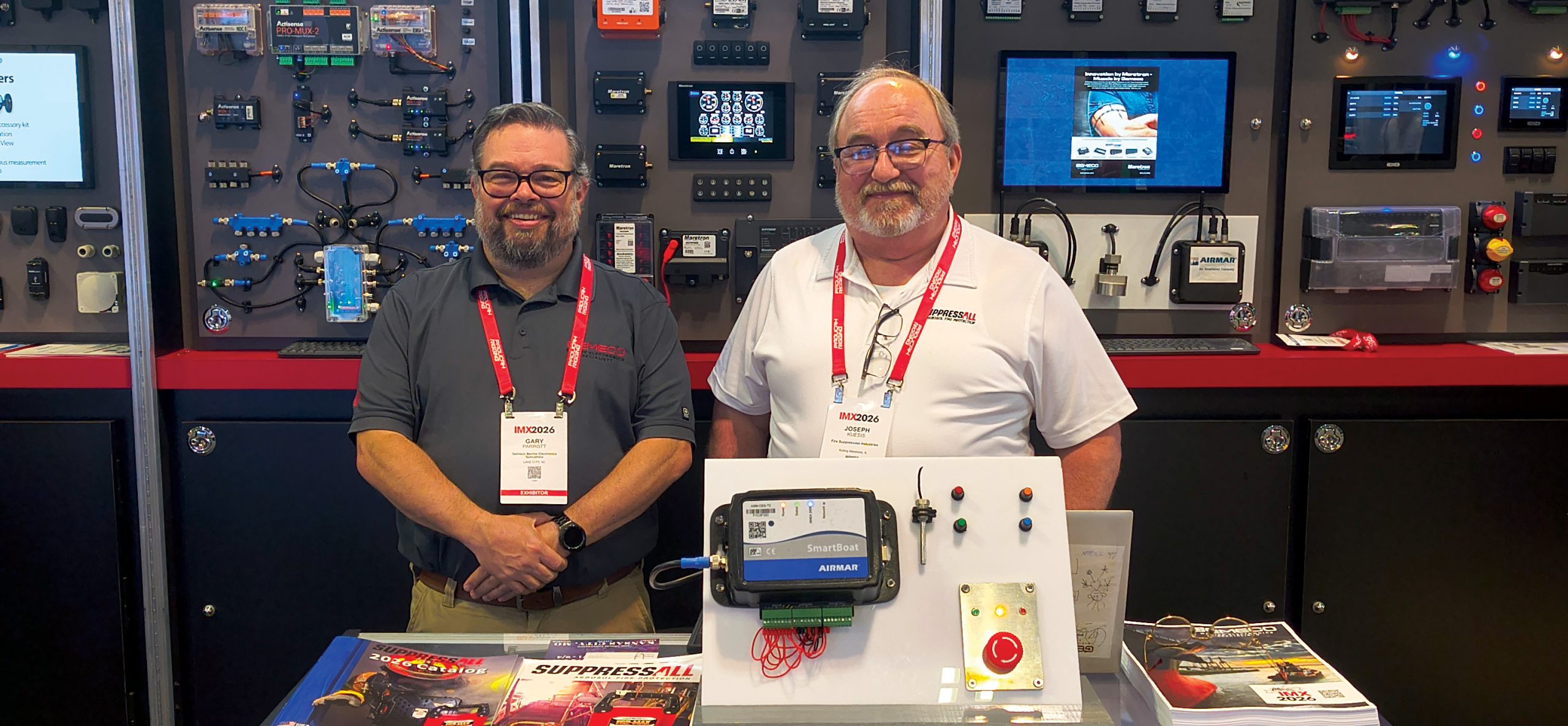
A prototype of the new system debuted at the 2026 Inland Marine Expo in May. Purchases are possible now, but marketing and sales through Airmar are not expected to begin online until the first quarter of 2027, Floyd said.
“We’ll work with the companies to custom configure the system for each boat, based on the dimensions of the space where we’ll deploy,” Kuesis said.
Manufacturing can be quickly completed as the product is made entirely in the United States, they said. Training is provided. The aerosol generators themselves fit easily into confined spaces, at 11 inches by 11 inches by 8 inches.
“It’s not very large at all, and it’s very powerful,” Kuesis said. “It doesn’t take long to install it, and our generators have a 15-year shelf life, so you don’t have to do much of anything to it for 15 years.”
If a system is activated, it also costs only a fraction of what a carbon dioxide-based system does to reset, he said.
A unique aspect of the system is that it can easily integrate with existing technology on towboats, Floyd said. As a National Marine Electronics Association (NMEA) 2000 network-certified product, existing displays in the wheelhouse and engineroom can be configured to indicate system activation. It can also send emails or text messages remotely using Wi-Fi or ethernet options. Any troubleshooting can also take place remotely.
Extensive live and online testing of the product is currently wrapping up, Kuesis said. While it is currently not certified by the Coast Guard as a primary fire suppression system, he said the companies plan to eventually seek that designation.
For more information or to schedule a demonstration, contact Kuesis at jkuesis@flameresponseusa.com.
Featured photo caption: Gary Parrott and Joe Kuesis demonstrate the new aerosol fire suppression system at the 2026 Inland Marine Expo in Nashville, Tenn. (Photo by Zac Metcalf)