

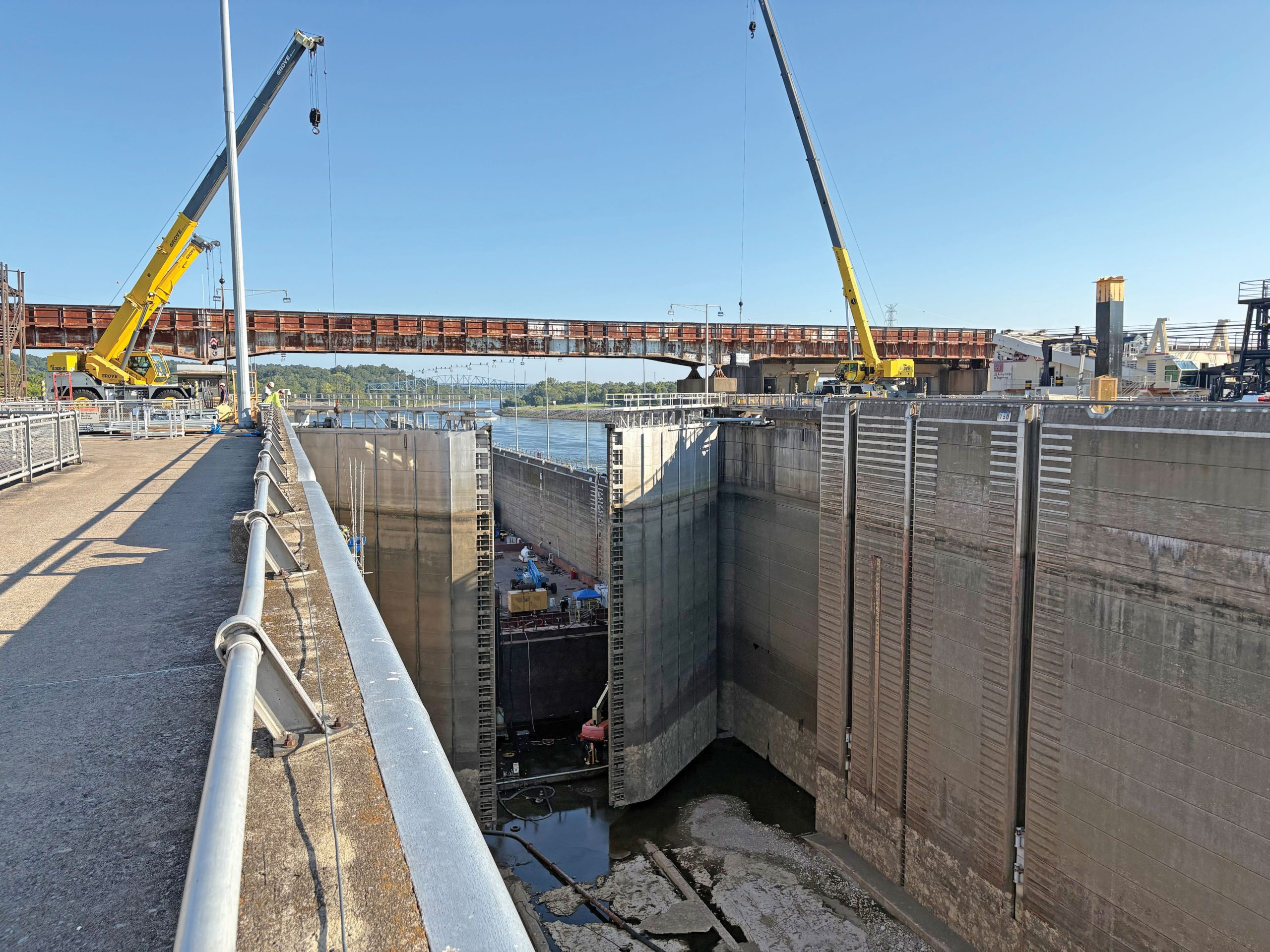
Barkley Lock Closes For Miter Gate Repairs
Barkley Lock, Cumberland River Mile 30.6, will be closed through September 30 for miter gate repairs, causing increased delays at Kentucky Lock on the Tennessee River.
The two locks, located near Grand Rivers, Ky., are 2.6 miles apart via the Barkley Canal.
“It’s pretty common whenever we close Barkley that we will typically see a significant delay at Kentucky,” said Caleb Skinner, supervisory navigation facility specialist at the Nashville Engineer District.
While Kentucky Lock typically experiences a delay of eight to 10 hours per vessel, the average delay surpassed 56 hours as of September 1, according to the Corps of Engineers’ online lock queue report. Twenty vessels were in the queue at that time.
The Corps of Engineers closed and dewatered Barkley Lock on August 10, allowing crews to inspect key components and begin repairs.
Brian Mangrum, chief of the district’s Technical Support Branch, said the work to be completed includes but is not limited to cleaning and inspecting the miter gates and quoin blocks, weld repairs to the miter gates, replacing the diagonal supports on three of four miter gates, filling and emptying valve inspections and installations of valve maintenance platforms.
The budget for the job is $5.9 million, and the regional heavy repair fleet is completing the work. The chamber was last dewatered in 2015.
“The scope of work for this job was developed using inspection findings from 2023 and 2024,” Mangrum said. “Additionally, an unscheduled outage occurred in 2025 due to the failure of one of the diagonal support features on a miter gate. During those emergent repairs, it was identified the diagonal supports on the three remaining gates had the same weld deficiencies that contributed to the diagonal failing. Replacement of remaining diagonals was added to the scope of work of the current scheduled maintenance.”
Skinner said the work was carefully coordinated with the Tennessee-Cumberland Industrial Committee to minimize vessel transit delays while also addressing the needed repairs as quickly as possible.
“We are very tight knit,” Skinner said of the Corps and industry groups. “We talk constantly, and we try to work to get the best solution for everybody.”
Following the dewatering, crews completed a thorough inspection before beginning repairs in the latter part of August.
At the same time the regional repair fleet is completing work within the chamber, some crews local to the project are completing other work, such as welding on an emergency gate that was uninstalled and is adjacent to the lock chamber. The gate can be raised to stop water flowing through the lock chamber in the event of an emergency failure but is more often used as a bridge that allows crossing from one lock wall to the other, Skinner said. He added that the gate would be reinstalled during a future closure.
Skinner also looked ahead to future work at the lock, scheduled for fiscal year 2027. Those work packages, which he expects to be scheduled for next spring or summer, will include valve sector gear replacement.
The lock chamber measures 800 feet long by 110 feet wide, providing a normal lift of 57 feet between the lower Cumberland River and Lake Barkley. Construction began in 1957, and the Corps of Engineers opened Barkley Lock to river traffic in July 1964 before completing the dam in July 1966. Vice President Hubert H. Humphrey formally dedicated Barkley Dam on August 20, 1966.
The lake, lock and canal are named in honor of Alben W. Barkley, who served as the 35th vice president of the United States under President Harry S. Truman. A native of western Kentucky, Barkley served as a U.S. representative and Senate majority leader before becoming vice president. He later returned to the Senate in January 1955, serving until his death on April 30, 1956.
Featured photo caption: Crews work on the dewatered Barkley Lock. It is scheduled to remain closed through September 30. (Photo by Lockmaster Jeff Neely)