
WJ Special Issue: Workboat Show: Eastern Shipbuilding Extends 50-Year Legacy
Fifty years after its formation, Eastern Shipbuilding has three shipyards across northwest Florida, roughly 1,300 employees and continues to look toward the future.
The company has earned a reputation for extreme versatility, quality and on-time delivery, said Joey D’Isernia, chairman and CEO of Eastern Shipbuilding Group, Inc.
Building On Its History

D’Isernia’s father, Brian, founded the company in 1976 by building fishing vessels. Over the last five decades, it has now delivered 367 vessels, many of which have commercial or military applications.
“Our portfolio spans everything from tugs and fireboats to custom dredges and large passenger vessels,” D’Isernia said. “A few of our proudest milestones include delivering the three iconic Staten Island ferries, delivering New York’s fireboat fleet in response to 9/11 and winning the Washington State Ferries contract after the state opened up competition to top-tier builders outside of Washington for the first time.”
D’Isernia said that because the company remains privately held, it has had the flexibility of reinvesting earnings directly back into facilities, equipment and people, helping it to continue to succeed.
Facilities And Projects
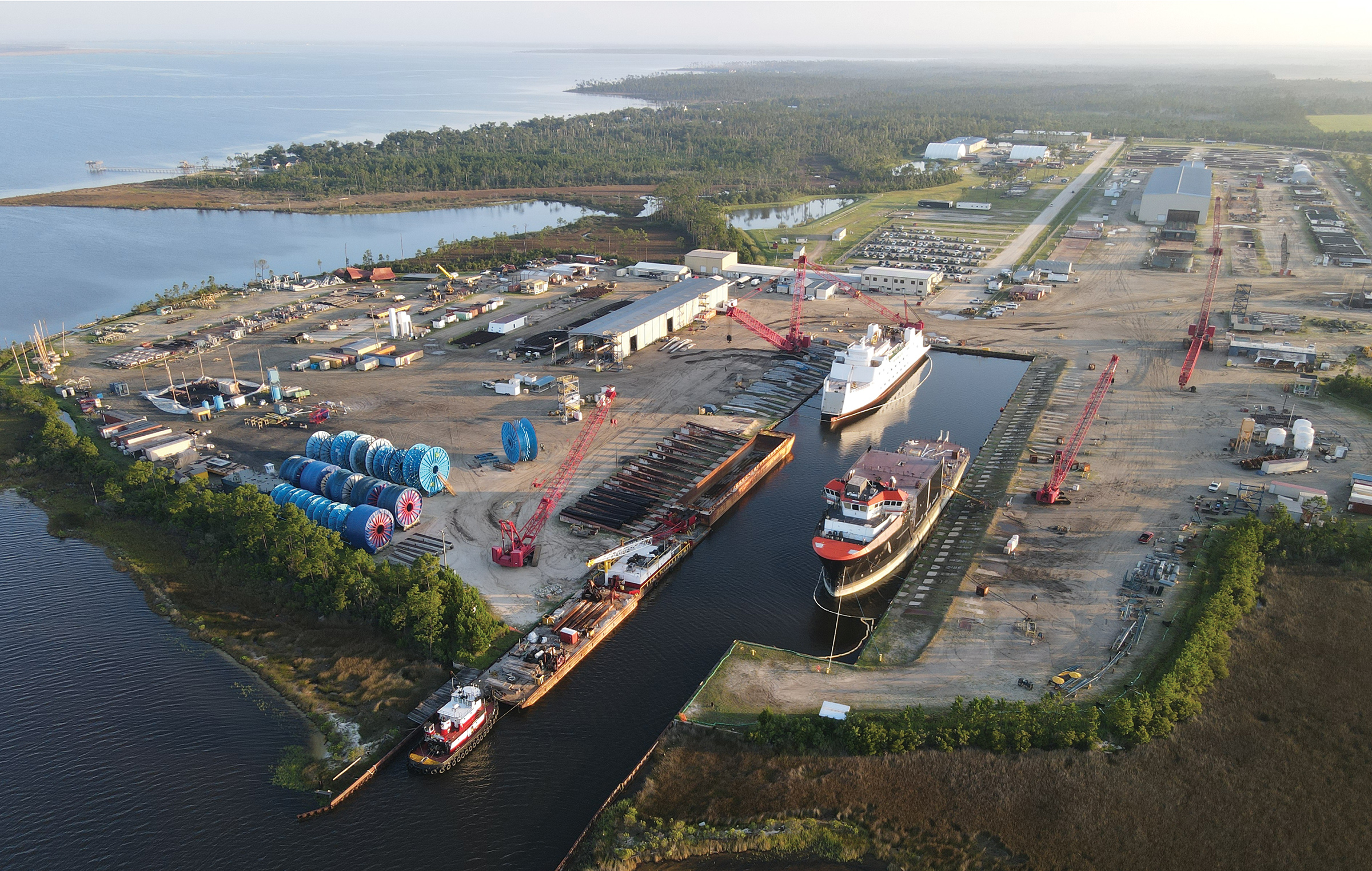
Those facilities include the 300-acre Allanton shipyard, where Eastern Shipbuilding handles large-scale commercial and government construction; its 50-acre Nelson Street facility, optimized for distributed naval manufacturing and other government projects; and its Port St. Joe yard, which provides the company capacity for large outfitting and vessel completions.
Projects Eastern Shipbuilding has completed in the past few months help show the breadth of its capabilities.
At the Nelson Street facility, D’Isernia said the team successfully completed and delivered a fully outfitted grand block to Huntington Ingalls Industries for the U.S. Navy’s Arleigh Burke-class guided missile destroyer program.
The shipyard also has worked on modular units for Huntington Ingalls Industries to support the Navy’s future USS Philadelphia (LPD 32), a San Antonio-class amphibious transport dock.
“On the commercial side, the first two of our four contracted 84-foot harbor tugs for Saltchuk Marine are finalized and preparing for delivery,” D’Isernia said. “These are high-performance workboats built to handle serious ship assist and escort operations.”
He said the yards are all incredibly busy right now with a mix of commercial, government and defense work.
“At Allanton, we are fabricating the remaining two 84-foot Saltchuk harbor tugs,” he said. “Right alongside them, we are building two major dredging assets in collaboration with Royal IHC: a 6,500-cubic-yard hopper dredge for the U.S. Army Corps of Engineers and a massive 10,000-cubic-yard hopper dredge for The Dutra Group.”
Meanwhile, at the Port St. Joe yard, the company is completing two 360-foot multipurpose subsea construction vessels for Hornback Offshore services. The Nelson Street team is wrapping up another destroyer grand block for DDG 137 and building more units for San Antonio-class amphibious transport docks.
The Work Ahead
“We are transitioning into the production phase for one of the most exciting contract wins in our history: three 400-foot hybrid-electric ferries for Washington State Ferries,” D’Isernia said. “These vessels feature an advanced design that allows them to complete their missions entirely on battery power. Our electrical design team is top-notch, and this is a fantastic opportunity to showcase our engineering capabilities. Washington State recently exercised its option for the third ferry, which provides long-term work for our Allanton Shipyard and gives us a steady production pipeline extending all the way through 2032. We also have additional defense backlog secured through another grand block award for the Navy’s destroyer program.”
The primary constraint in U.S. shipbuilding today is finding a skilled workforce, D’Isernia said. It is a challenge that Eastern Shipbuilding is approaching through several different streams.
“It is a challenge that extends through the entire supply chain, and you can’t solve it with short-term campaigns,” he said. “After Hurricane Michael in 2018, we completely rethought how we recruit and train, creating our BUILD initiative. We’ve established over a dozen talent pipelines. We partnered with Gulf County to launch a dedicated Maritime Training Academy, and we work closely with regional high schools, vocational schools and state colleges, including our marine electrician apprenticeship program in partnership with Tom P. Haney Technical College.”
D’Isernia said one program he loves, in particular, involves high school welding students who design and build artificial reefs.
“We deploy them right here off our coast,” D’Isernia said. “It connects technical training directly to the local outdoor community, giving these students immediate pride in their craft.”
Continuing to look toward the future, Eastern Shipbuilding is heavily investing in covered fabrication space and realistic automation, D’Isernia said.
“We focus on smart, practical tech that improves efficiency without introducing unnecessary risk,” he said. “This includes automated pipe spooling, precision pipe-bending machinery and robotic welding stations that take the physical strain off our craftsmen.”
Strengthening American Shipbuilding
Strengthening the domestic shipbuilding industrial base is a national and economic security priority for the United States, D’Isernia said.
“It isn’t a partisan issue,” he said. “While federal attention on defense shipbuilding is welcome, Washington also needs to look at the commercial sector. We need to level the playing field for domestic ship operators by enacting meaningful subsidies, tax incentives and depreciation benefits that make fleet renewal economically viable. At the end of the day, a shipyard can have the best facilities in the world, but shipbuilding is about people. Shipbuilders have grit and determination, and it’s our job to give them the tools to succeed, including long term sustainable work which attracts and retains skilled craftsmen and women.”
Featured photo caption: Eastern Shipbuilding’s Allanton, Fla., facility is one of the company’s three shipyards across northwest Florida. The 300-acre facility is where Eastern completes much of its large-scale commercial and government construction. (Photo courtesy of Eastern Shipbuilding Group, Inc.)