
The Missouri River Inspection Boat Sergeant Floyd
With the Missouri River Navigator’s meeting scheduled to take place at Jefferson City, Mo., February 18–19, my thoughts naturally have turned to that stream. Most are familiar with the Lewis & Clark Expedition. This “Corps of Discovery” was commissioned by President Thomas Jefferson soon after the Louisiana Purchase of 1803 for the purpose of exploring and mapping the new territory as well as meeting Jefferson’s goal to find “the most direct and practicable water communication across this continent, for the purposes of commerce.”
This now-famous expedition, celebrated at the time and now recognized as an enormous success, was led by Army Capt. Meriwether Lewis, who chose his friend Second Lt. William Clark as the co-leader. (Both Lewis and Clark would have towboats named for them, built in 1948 for Butcher-Arthur, but that topic is for future old boat columns!)
The explorers started out from Camp Wood, near present day Wood River, Ill., on May 1, 1804, and returned on September 23, 1806.
The journey from the mouth of the Missouri River to the Pacific Ocean and back over the course of 28 months was not easy. It involved rowing, poling or pulling boats and hiking, along with encounters with unfriendly native tribes and wild animals. Despite these risks, only one of the 42 men who started out died during the trip. This was Sgt. Charles Floyd, the quartermaster, who took sick and died from what many today believe was a ruptured appendix. This occurred in August 1804, on the first leg of the trip. He died near present day Sioux City, Iowa, and was buried on a bluff overlooking the Missouri, which was subsequently named Floyd’s Bluff. The grave has been moved four times since then, and a white sandstone obelisk was erected in 1901. In 1960, the Sergeant Floyd Monument was designated a National Historic Landmark.
Following the Lewis & Clark journey, early settlers had to travel west much as the explorers had, ascending the Missouri River by pulling or rowing small vessels. Steamboats began running on the difficult Missouri at least by 1819, and many sank from hitting snags or other navigation hazards. Attempts to establish barge towing began in 1872, 1877 and 1880, all resulting in failure. The Suiter Plan, developed by Charles Suiter with the Army Corps of Engineers in 1881, finally presented a way to somewhat tame the wild waterway with a series of training structures and revetments. By 1930, this plan was well underway and succeeding.
To keep the channel open on the newly improved Missouri River, the Engineer Department ordered four large steam sidewheel dredges from the Marietta Manufacturing Company, Point Pleasant, W.Va. (see The Waterways Journal, August 29, 2022). To inspect the reaches and identify problem areas for the dredges to dig out, the department also ordered an inspection and survey vessel to be assigned to the Kansas City District.
The order for the new boat was placed with the famed Howard Ship Yards and Dock Company at Jeffersonville, Ind. According to “From Paddlewheels to Propellers,” a history of the Howard firm by Charles Preston Fishbaugh, the keel was laid at noon on March 17, 1932. The contract was a blessing to Howards as the company had been in a difficult financial condition because of the Great Depression and due to some customers defaulting on agreements.
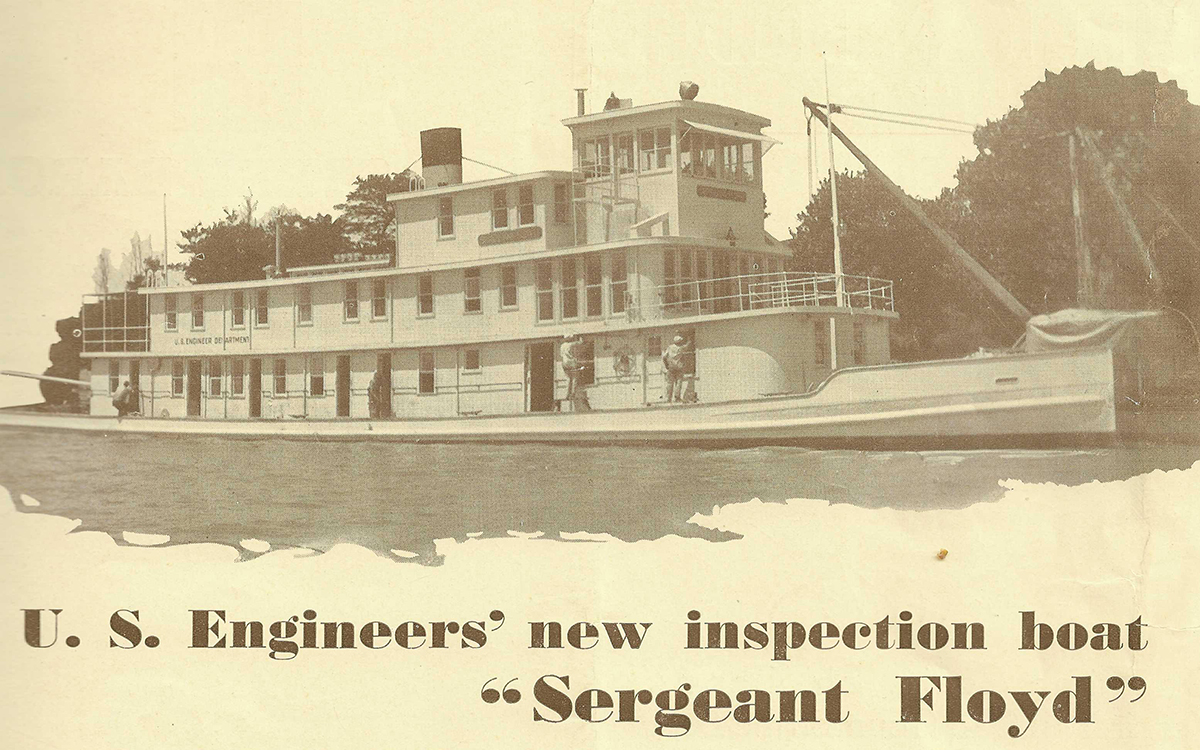
The inspection boat had a steel hull that measured 138 feet, 4 inches by 30 feet, 9 inches with a hull depth of 5 feet, 6 inches. There was a high model bow with no towknees, and the superstructure was constructed of wood. The lower deck had a full main cabin. A long upper cabin was above that. There was a small cabin on the third level with an elevated pilothouse forward of it. The crew complement was 22 people, but accommodation was provided for 32 people. Power was provided by a pair of 300 hp. Fairbanks-Morse diesel engines. The boat was named Sergeant Floyd in honor of the single man lost on the Lewis & Clark trip 127 years before.
The Sergeant Floyd was launched on May 31, 1932, and delivered to the Kansas City District on August 5 of that year. For the next 43 years, it served its intended purpose on the Missouri River. Though it had no towknees, it was often pictured towing barges and equipment. Originally assigned the radio call letters WYER, these were later changed to AENF. It went through a refit program in 1962-63 where the original engines were replaced with two Cooper-Bessemer diesels totaling 1,200 hp. In 1975, it was refurbished into a floating exhibit for the U.S. bicentennial and spent 18 months traveling the inland rivers and portions of the Gulf Intracoastal Waterway, telling the story of how the Corps of Engineers contributed to the development of the nation.
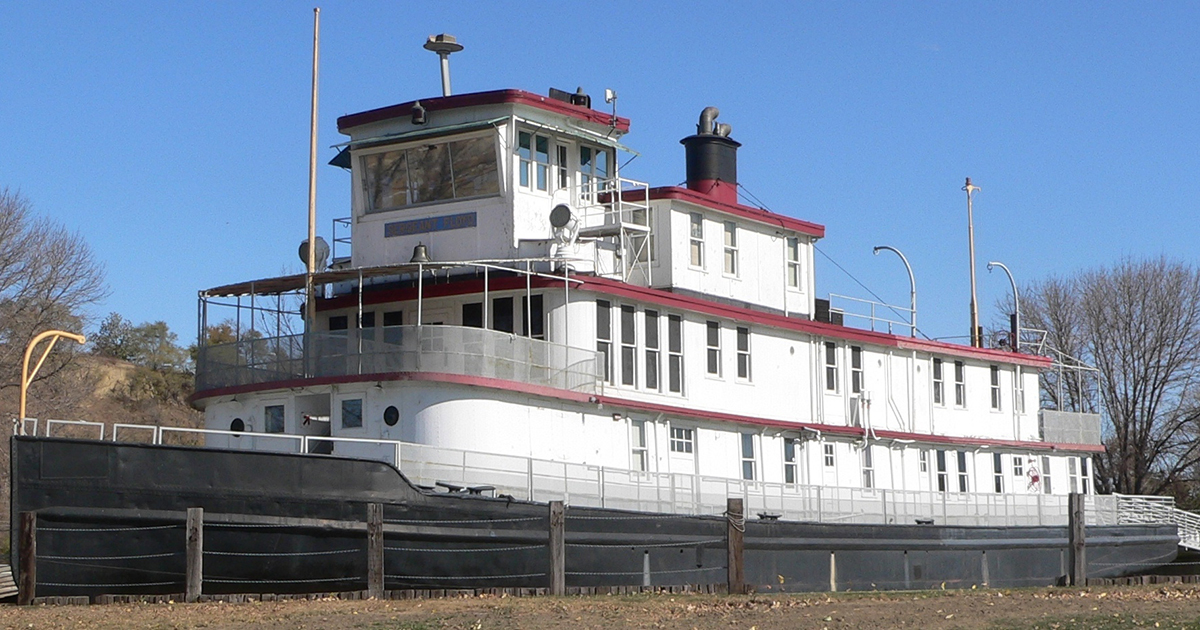
Following this, the boat was permanently moored at St. Louis as a floating museum owned by the Corps of Engineers. In 1983, it was declared surplus property and offered for sale. The city of Sioux City, Iowa, acquired the vessel, placing the Sergeant Floyd on the bank there, where it serves today as a state welcoming center and river museum.
Featured image caption: The Sergeant Floyd on display at Sioux City, Iowa. (Photo courtesy of the Sgt. Floyd River Museum & Welcome Center)