

Stop Work Order Issued On Brandon Road
The Corps of Engineers issued a stop work order July 24 to the team working on the Brandon Road Interbasin Project for reasons that have not been made clear. Corps spokesperson Eugene Pawlik told news sources the project was under “administrative review,” but refused to answer questions about the order.
Multiple calls to the Detroit Engineer District requesting comment were not returned.
The news provoked swift reactions from the Illinois governor and members of Congress from both parties who sit on committees that oversee the Brandon Road project.
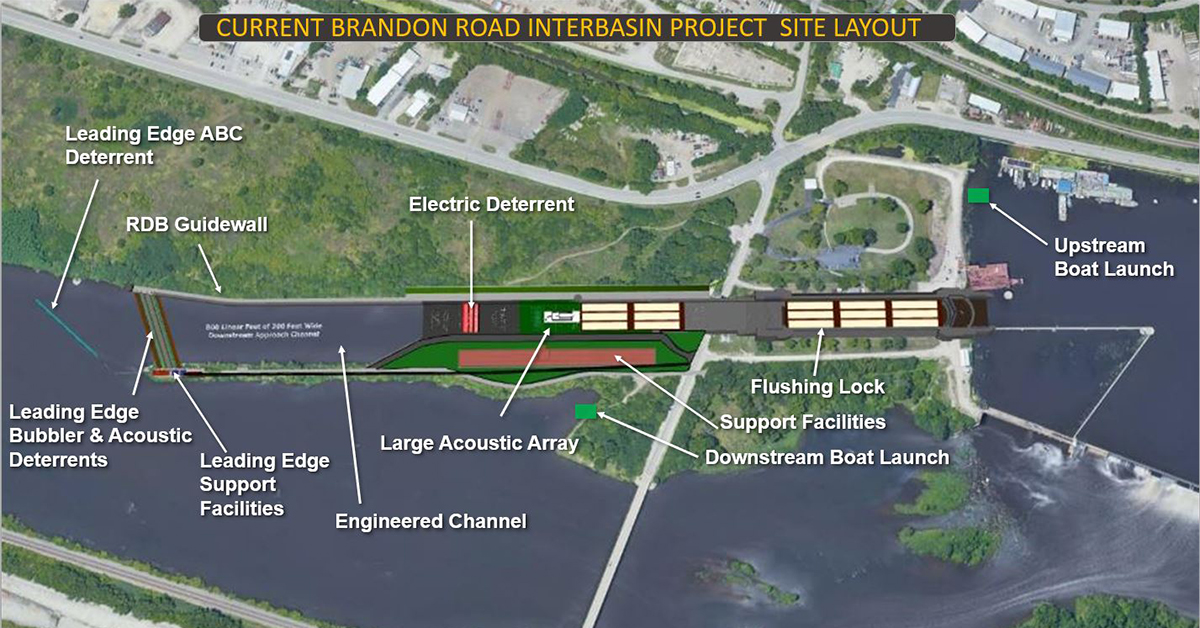
The project is a series of interlocking barriers and devices designed to keep invasive Asian carp out of the Great Lakes. With an estimated current cost of $1.15 billion split between the federal government and Great Lakes bordering states of Illinois and Michigan, it has faced years of design development as well as a series of repeated delays, including disputes over the relative cost-share borne by states.
On April 14, the Corps of Engineers announced that La Crosse, Wis.-based J.F. Brennan Company Inc. had won a $113.9-million firm-fixed-price contract to construct leading-edge deterrents for the project on the Des Plaines River in Joliet, Ill. It was one of multiple construction-related contract awards announced, marking a milestone in the effort to block invasive species from the Great Lakes. An earlier $15.5-million site preparation and bedrock removal contract issued in November 2024 to Miami Marine Services was completed in July 2025.
In May, Assistant Secretary of the Army for Civil Works Adam Telle announced that project management would be transferred from the Corps’ Rock Island District to the Detroit District.
Swift Reactions
On July 30, Illinois Gov. JB Pritzker called on the Trump administration to immediately reverse its work stoppage on the project. He said the stoppage “put(s) at risk a $52 billion regional economy that supports more than 1.5 million jobs.”
“Under my administration, Illinois has spearheaded this project to protect the entire Great Lakes region. Yet, the Trump administration repeatedly throws up roadblocks and has now ordered work to stop altogether with no explanations. … It’s time for the Trump administration to uphold the federal government’s obligations, stop playing political games and move this project forward,” he said.
The Illinois Department of Natural Resources sent a letter to the Corps of Engineers shared with local news sources requesting that the federal government meet to discuss how to move forward with the project. The letter said Illinois learned of the stop-work order from contractors on site rather than from federal officials and that, despite repeated attempts by IDNR leadership to communicate with the federal government, the state did not receive a response until after the work stoppage had already been authorized.
Greg McClinchey, director of policy and legislative affairs for the Great Lakes Fishery Commission, said the commission had not been notified of the stop work order. “If it’s true, it’s obviously disappointing,” he said.
Members of Congress who sit on committees overseeing the project also weighed in. On July 31, a bipartisan group including Reps. Bill Huizenga (R-Minn.), Debbie Dingell (D-Ohio), Marcy Kaptur (D-Ohio) and Dave Joyce (R-Ohio) sent a joint letter to Office of Management and Budget (OMB) Director Russell Vought and Assistant Secretary of the Army for Civil Works Adam Telle. They wrote, “The project has been thoroughly reviewed by Congress, the U.S. Army Corps of Engineers and local partners. Its funding has been authorized and appropriated by Congress, and the non-federal sponsors have met all applicable cost-share obligations and secured the necessary property for construction.”
The letter also pointed out, “The president has publicly conveyed his support for this effort numerous times since issuing his May 9, 2025, memorandum titled ‘Protecting the Great Lakes from Invasive Carp.’ ”
Kaptur posted on her website, “The Corps of Engineers must resume the work at once. Congress has spoken. The governors from the Great Lakes states have spoken. This project is under construction, and it must be built. There is no excuse for delay, and as ranking member of the Energy and Water Appropriations Subcommittee and a leader of the bipartisan Great Lakes Task Force, I stand fully ready to use all the tools in our arsenal to ensure this vital work resumes with great haste.”