

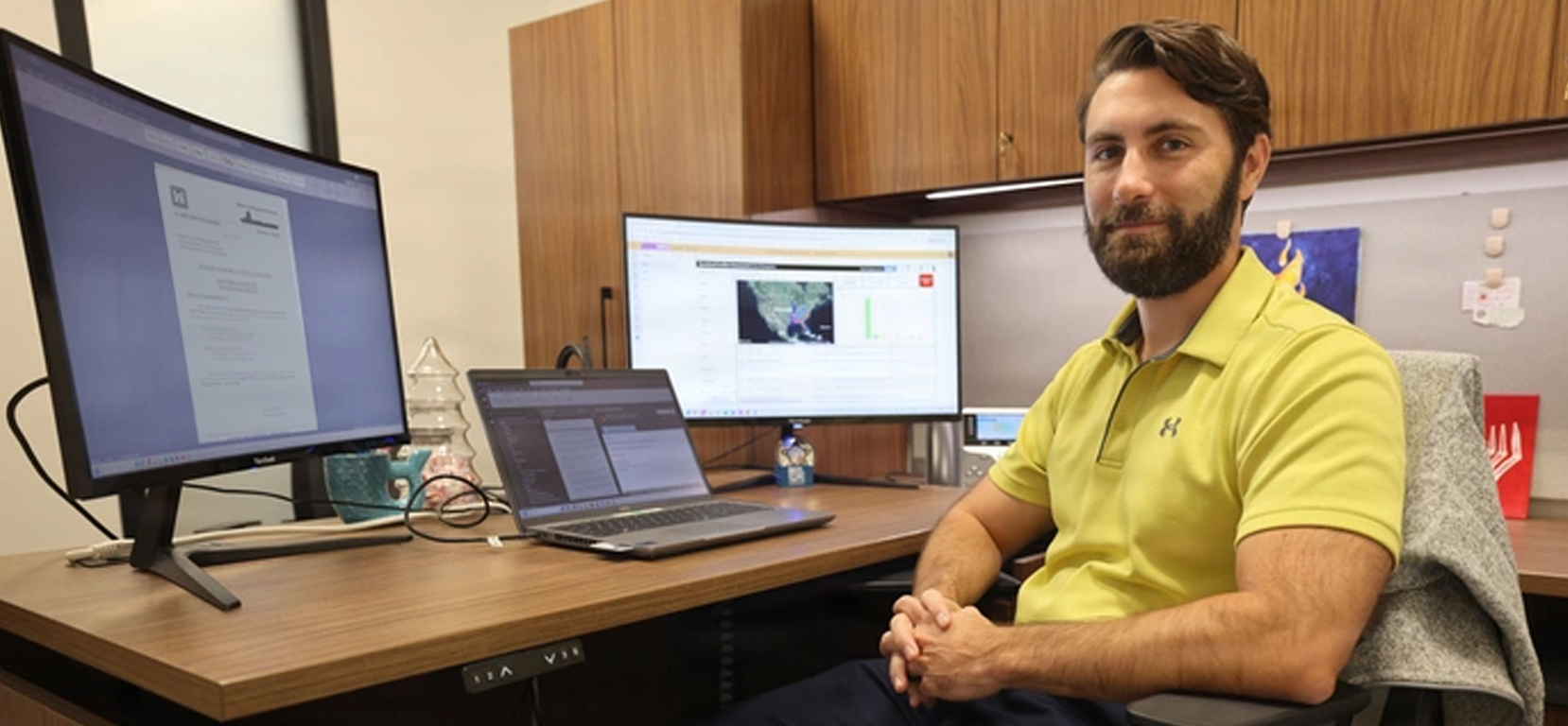
Reich Named Inland Navigation Manager Of The Year
Ryan Reich’s work managing inland navigation infrastructure has put him at the center of some of the U.S. Army Corps of Engineers’ most challenging waterway emergencies.
Reich, chief of the Inland Navigation and Infrastructure Section for the Mobile Engineer District, was recently named the Inland Navigation Manager of the Year. The national award recognizes his leadership and work during emergency closures at Demopolis Lock and Holt Lock and Dam in Alabama.
For Reich, however, the award represents more than his individual accomplishments.
“It’s an honor to win this award and to be recognized, but what this really means to me is that our team in the Mobile District has developed positive, trusting and professional relationships to work together effectively to deliver the mission,” he said.
Reich has spent 17 years with the Corps, including 13 years in engineering and four years in operations. That combination of technical and operational experience has helped prepare him for the challenges that come with managing critical navigation infrastructure.
One of his biggest tests came in January 2024, when a concrete sill beneath the upper miter gate at Demopolis Lock failed, breaching the lock chamber and stopping navigation on the Tombigbee River.
With commercial traffic halted, the response required coordination across multiple organizations and agencies. Reich helped bring together personnel from the Mobile District Operations, Tuscaloosa Site Office, Pittsburgh District and Engineer Research and Development Center, along with contractors, subcontractors, the Tennessee Valley Authority and commercial partners.
The response moved quickly.
“Everything was moving rapidly,” Reich said. “Gathering information, getting the correct team together, developing courses of action and presenting the recommendation to the Commander all happened in a single day.”
Reich helped coordinate the technical team, secure funding and resources, organize recurring meetings and site visits, oversee concrete testing and keep district, division and headquarters leadership informed throughout the response.
The result was a completed emergency repair in just four months.
“To go from a complete failure and breach to an emergency response, development of repair plans and a completed repair in just four months was a truly monumental effort,” Reich said. “It was very rewarding watching the different phases of the repairs and the adaptability of the team.”
Responding To Another Emergency
The lessons learned during the Demopolis response were put to use only months later when another issue was discovered at Holt Lock and Dam near Tuscaloosa, Ala.
In May 2024, lock personnel identified structural cracking and movement in a large concrete monolith along the lock wall. The discovery triggered the Corps’ emergency response procedures.
“The situation at Holt Lock proved that our emergency protocols were sound and successful,” Reich said. “The lock personnel noticed an issue, notifications went through the proper channels, and the process of gathering information and acting began.”
Reich helped organize the project team, coordinate inspections and lead meetings that ultimately resulted in a temporary safety closure of the lock on June 22, 2024.
The closure created another challenge: minimizing the impact on commercial navigation and local industries.
Reich and the group created a temporary steel bulkhead as an interim solution to the issue. The bulkhead decreased the hydrodynamic pressure that affected the damaged concrete monolith by blocking the water intake culvert.
The solution allowed the lock to safely reopen to commercial traffic on October 2, 2024, while permanent stabilization plans were developed.
“Seeing our team working so diligently to get the plans completed, contract awarded and the bulkhead fabricated and installed in such a short timeframe just proved how much pride everyone had in their work,” Reich said.
Vern Gwin, Mobile Engineer District chief of operations, said Reich’s ability to build and lead teams has been a key part of his success.
“Ryan’s strongest attribute is the ability to establish the best teams by putting together the top engineering expertise for the specific mission,” Gwin said. “We saw Ryan calmly and confidently lead a multidisciplinary USACE-wide team during the Demopolis emergency response and immediately turn and shift to the critical monolith stabilization at Holt Lock and Dam.”
Looking Ahead
While the award recognizes Reich’s response to two major infrastructure challenges, his focus remains on preventing similar emergencies whenever possible.
In his current role, Reich mentioned that one of his goals is making sure site offices have the tools and resources needed to complete their missions and keep the district’s waterways operating.
“It is our responsibility to the nation to make sure our waterways and infrastructure are operational and functioning properly,” he said.
That includes taking a more proactive approach to the district’s aging infrastructure.
“My plan is for the Mobile District to be able to address the issues of our aging infrastructure in a proactive way, instead of reactive,” Reich said.
For the next generation of engineers and maritime professionals, Reich encourages them to get involved and speak up.
“Ask questions. Get involved. Don’t be afraid to share your opinion or give input,” he said. “Your job becomes much more rewarding when people can rely on you and expect you to do a good job.”
For Reich and the Mobile District team, that work continues well beyond the recognition of one award. Maintaining the nation’s inland navigation system requires preparation, collaboration and the ability to respond when infrastructure fails.
Reich’s experience at Demopolis and Holt demonstrates the importance of all three.
Featured photo caption: Ryan Reich, chief of the Inland Navigation and Infrastructure Section for the Mobile Engineer District, works from his office in Mobile, Ala. Reich was recently named the Inland Navigation Manager of the Year for his leadership in managing critical waterway infrastructure and responding to emergency lock closures. (Photo by Charles Walker.)