

The Duncan Bruce – Again
In a recent column we detailed the innovative tunnel hull, screw wheel steam towboat James Rumsey, built by Charles Ward Engineering Works, Charleston, W.Va., in 1903. Against all odds, this boat bested a larger sternwheel steam towboat of near equal horsepower and was a true harbinger of the later transition from sternwheel to prop-driven towboats.
The Ward firm became known for building tunnel hull prop vessels and later began building some early diesel towboats. In 1925, the company had built the twin-screw diesel towboat Geo. T. Price for the W.C. Kelly Barge Line, also of Charleston. The Price boasted 720 hp. and was touted as the first twin prop line haul towboat expected to compete with sternwheel steamers.
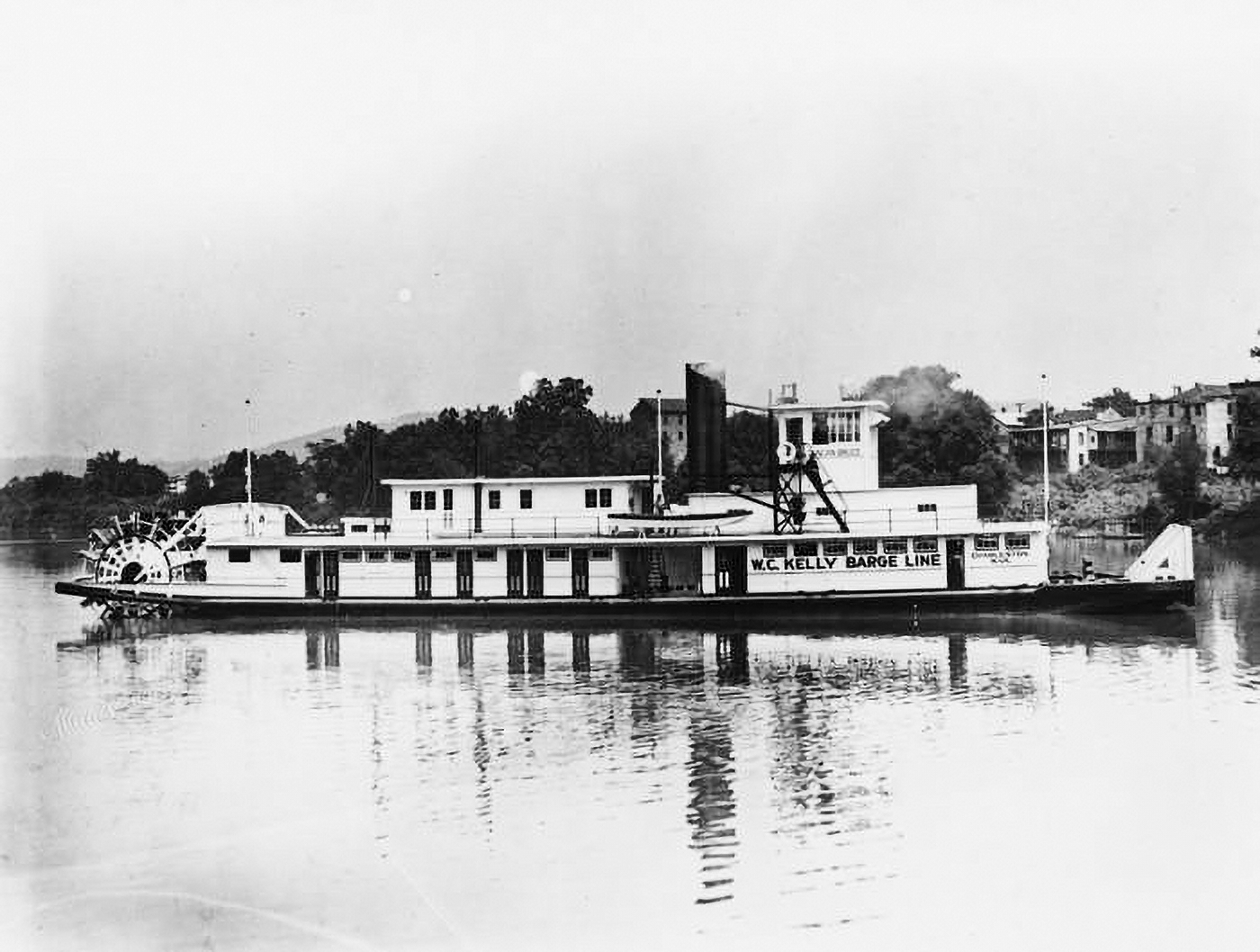
With all the effort made toward the propeller towboats, both steam and diesel, it was somewhat of a surprise that Ward built a large diesel-powered sternwheel boat in 1927. This boat was also for W.C. Kelly and was named Duncan Bruce. It has been described as a last attempt to revive the sternwheel boat, but was it Ward trying to “revive” the sternwheel boat or W.C. Kelly? A near duplicate of the Geo. T. Price was constructed for Kelly at the same time as the Bruce and was named W.A. Shepard.
Far from being a run of the mill sternwheeler, the Bruce possessed innovations that made it more maneuverable than a traditional sternwheel boat. There were independent twin sternwheels attached to the 135-by-35-foot steel hull. They were driven by Fairbanks-Morse 360 hp. diesel engines that were placed forward in the hull of the boat with a long series of shafts leading back to a complicated gearing system to turn the twin sternwheels.
The Bruce was completed in July 1927, and it entered service for the Kelly Barge Line soon after. In late 1927, W.C. Kelly joined with Andew and Patrick Calhoun to form American Barge Line. In December of that year, a contest of sorts was staged on the Monongahela River between the Bruce and the twin screw W.A. Shepard. The boats, equal in horsepower, were each faced to six loads of coal. In nearly every aspect, the prop-driven Shepard outperformed the sternwheel Bruce. The one exception was in flanking ability, and subsequent changes to the rudder configuration on the Shepard and her near sister Geo. T. Price corrected this.
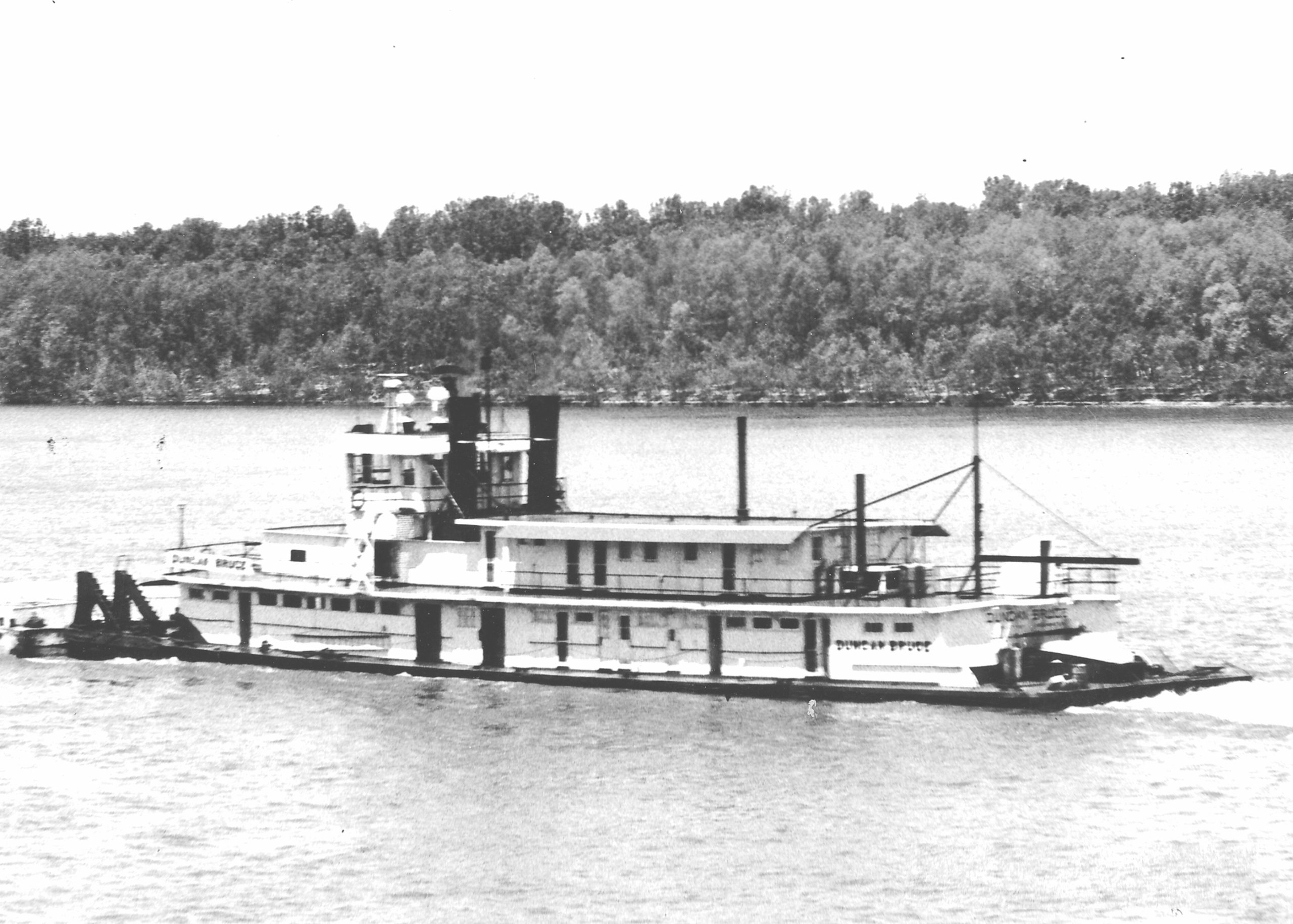
The gearing system on the Bruce had many problems. Vibration led to wear and cracking of components. News columns in The Waterways Journal from that era often mention the boat in or having been in a shipyard for repair. In 1933, the Bruce was converted from sternwheel to twin prop. At this time, its original 720 hp. Fairbanks engines were retained. On June 8, 1934, the Duncan Bruce was extensively damaged in a fire at Louisville, Ky. Photos of the aftermath show the boat essentially gutted by the fire. In this time frame, both the Geo. T. Price and W.A. Shepard were fitted with an additional wooden pilothouse atop the original due to towing cotton stacked high on barges. The smokestacks of these boats were also extended above the new pilothouse. Though I have never seen a photo of the Bruce with an added pilothouse, the photos following the fire show that its stacks had been extended, indicating the possibility that it did have the extra pilothouse prior to the fire.
The Bruce was rebuilt at Jeffersonville, Ind., and returned to service, still with the Fairbanks engines and extended stacks. In the winter of 1938-39, it was repowered with a pair of National Superior engines with a total of 1,350 hp. By all indications, the boat performed well with these engines, earning the nickname “Drunken Brute.”
The Duncan Bruce continued in the American Barge Line fleet until May 1947, when it was sold to O.F. Shearer and Sons. Many rivermen that I have known worked aboard the vessel during the Shearer ownership, including Capt. Bert Shearer, who was often aboard as master following the purchase. Capt. Ed Harris was a mate on it often, and Capts. Jim Lilly and Norman “Buck” Snodgrass are others who spent much time aboard.
In 1973, the Shearer river interests were acquired by Indiana & Michigan Electric (AEP), and the Duncan Bruce was sold to Capt. Robert H. Bosworth’s G&C Towing, Point Pleasant, W.Va. The boat was utilized on the upper Ohio and Kanawha rivers, and Capt. Carl Simpkins was master early on. Later, Capt. Carroll Yost commanded the boat.
In 1977, the Duncan Bruce was retired and sold to the Mansbach Metals Company at Ashland, Ky. Mansbach cut the cabin off, and the hull was sold to McGinnis, which utilized it as a crane barge. It eventually sank in the Owensboro, Ky., area, was raised in pieces and was brought to the Ashland area for final scrapping.
The Bruce, with the radio call letters WD 3049, was always a favorite of this writer, and I am not alone. Several months ago, I had a delightful lunch with one of its former deckhands, retired attorney Richard Dale James of Wyandotte, Okla., formerly of Gallipolis, Ohio, who came wearing a ball cap emblazoned with “Duncan Bruce WD 3049.”
Featured photo caption: The Duncan Bruce new at Wards in 1927. (Photo from the author’s collection)