

Charting The Course: Commodities, Capacity And The Inland Fleet
At the 23rd annual Waterways Symposium in Louisville, Ky., the economic outlook for commodities moving on the inland waterways came into clearer focus. Three things stood out. First, the economy is not the whole story. Inflation has stabilized, but its damage remains. Consumers are still spending, yet they are changing what they buy and how they buy it. Those shifting patterns of demand are already reshaping the commodity flows that ultimately load barges.
Second, follow the commodities, not just the headlines. Grain, oilseeds and coal exports remain important demand drivers, while petroleum and chemicals provide a different source of strength. Freight volumes ultimately follow where the commodities move.
Third, the biggest risk may be on the water itself: an aging barge fleet, limited new construction and looming retirements colliding with evolving demand. The result could be capacity constraints and barge rates that remain elevated.
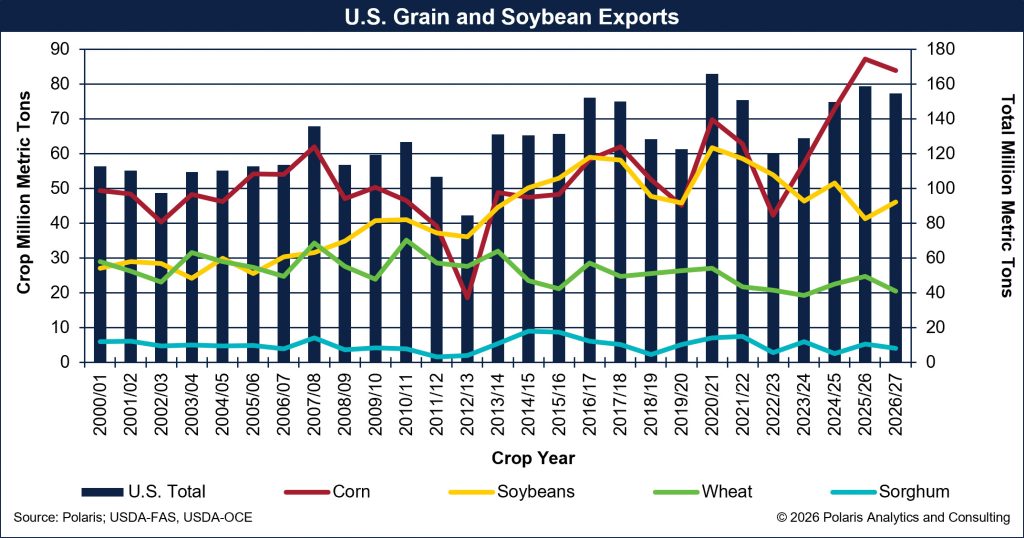
U.S. grain and soybean exports are sustaining high levels. The 2026/27 total is projected near 155 million metric tons, the third largest in U.S. history. Corn accounts for roughly 84 million metric tons of that total, soybeans about 46 million, wheat about 20 million and sorghum the balance.
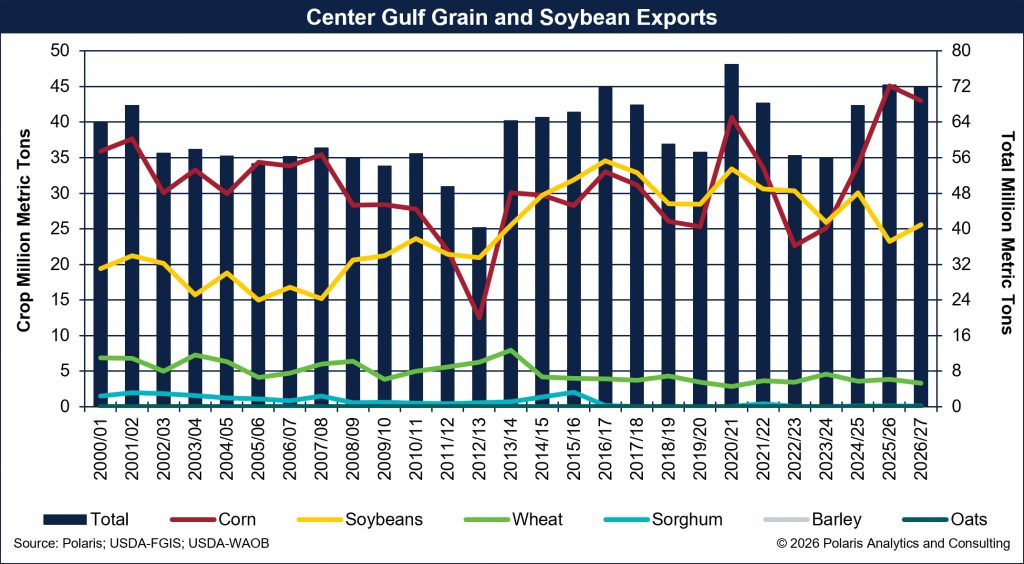
Center Gulf exports of grain and soybeans continue to retain higher volumes and shares. That strength supports covered-barge activity, particularly as corn and soybeans move from the interior to the Gulf for export.
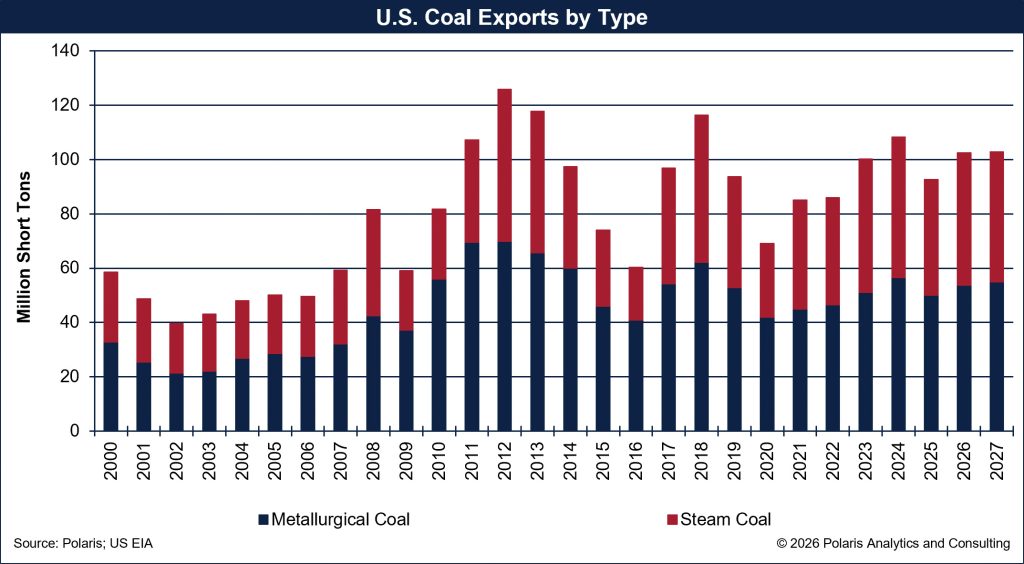
Coal production is down more than one-half from its 2008 peak and has largely plateaued, but exports of both metallurgical and steam coal are sustaining higher levels than the domestic decline might suggest. Those export tons still need open barges.
Crude oil production has incentive to rise, particularly in the Permian Basin, while overall petroleum and other liquids consumption is stagnating. That mix keeps tank demand firm even as growth slows.
Data centers are growing rapidly. More than 5,000 are already operating in the United States, with roughly 2,300 (46 percent) located in states that have access to the Mississippi River System. About 3,000 more are in the pipeline, valued at some $2.3 trillion. They remain a relatively small share of overall U.S. construction, yet the materials and components required for that build-out still need transportation, and some of that tonnage will move by barge.
At The Horizon: Follow The Commodities
The present situation is well understood. Solid export demand for grains and oilseeds is supporting covered-barge activity. The Center Gulf continues to handle the bulk of those flows, and the 2026/27 outlook keeps that volume elevated.
Coal exports are holding even as domestic production has declined sharply from its peak and settled into a lower plateau. That means open-barge demand is no longer driven by the same domestic power-plant coal movements that once dominated the fleet; it is more dependent on export loadings and other bulk commodities. With a change from the mid-term elections, coal faces headwinds from increased regulatory oversight.
Petroleum production is rising against stagnant refined-product consumption, which keeps tank demand firm but limits how much additional growth the segment can expect from domestic consumption alone.
The inland fleet itself is aging in place. The survey of operators on the 2025 fleet put the covered fleet near 12,800 units, the open fleet near 5,100, and the tank fleet near 3,900, for a total around 21,800 barges, as summarized in The Waterways Journal Inland Record Barge Fleet Profile.
Covered and tank fleets have held relatively steady in size while the open fleet continues to shrink. Covered demand is building on the improved grain and oilseed export picture. Open demand is sinking further without meaningful coal growth. Tank demand is firming but may be plateauing.
Operators and shippers can see the commodity numbers; they can also see that the equipment available to move those numbers is not being refreshed at the same pace.
On The Horizon: The Three R’s
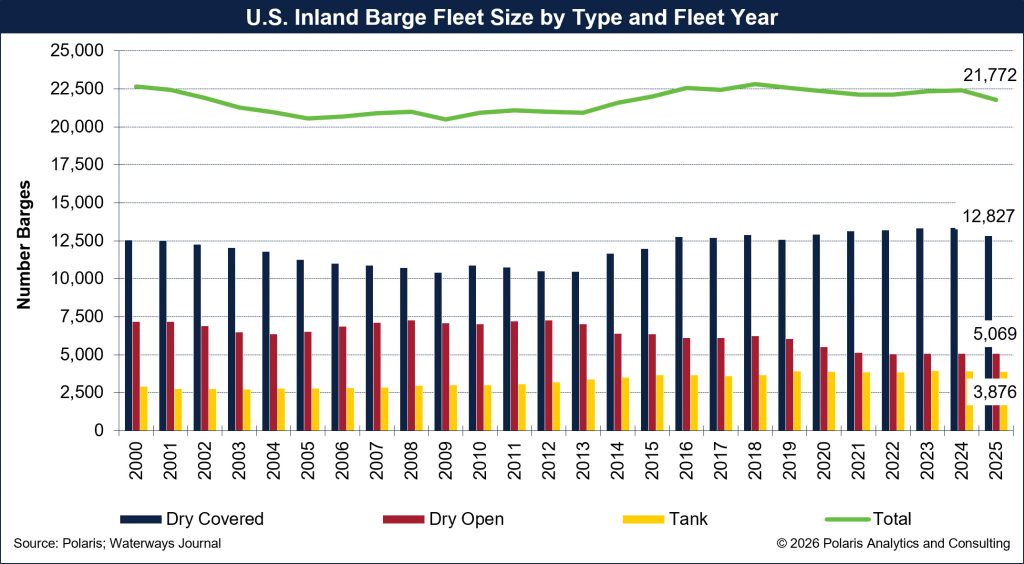
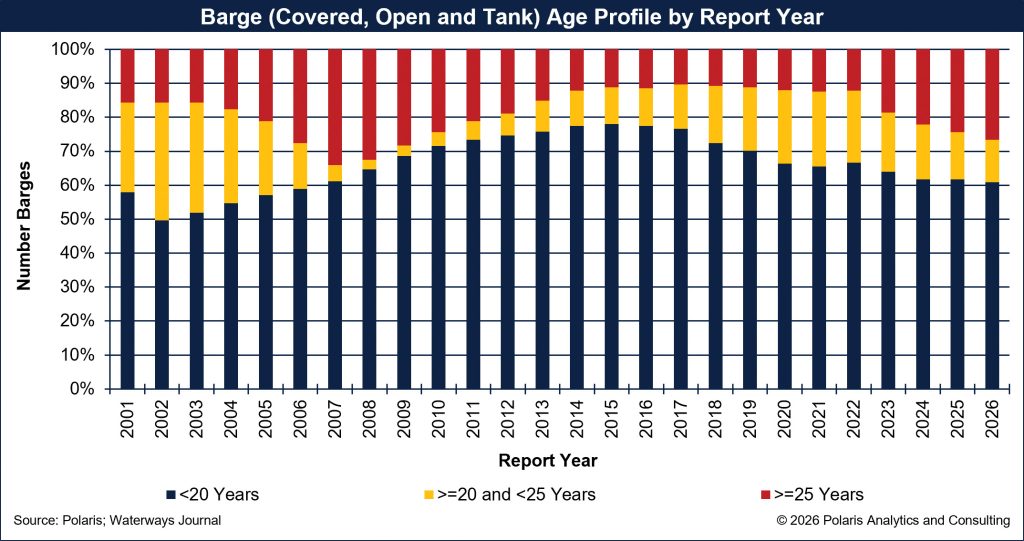
What can be seen is the need to retire aging assets, replace them to keep the fleet size steady and resurge — to rise again or become active once more, especially in the dry covered and tank segments. Covered barges are aging as new builds stagnate, with a robust retirement schedule on the horizon. Roughly 2,700 covered barges are already 25 years or older, and that share is projected to rise toward 3,000.
The open fleet has more than 2,000 units at or past the 25-year mark. The tank fleet has about 700 units in that older cohort even as overall expansion has stalled.
The number of barges built in the last few years remains modest relative to the retirements that are approaching. In all three segments, the pattern is the same: better care can extend life, but it does not replace capacity once the units are retired.
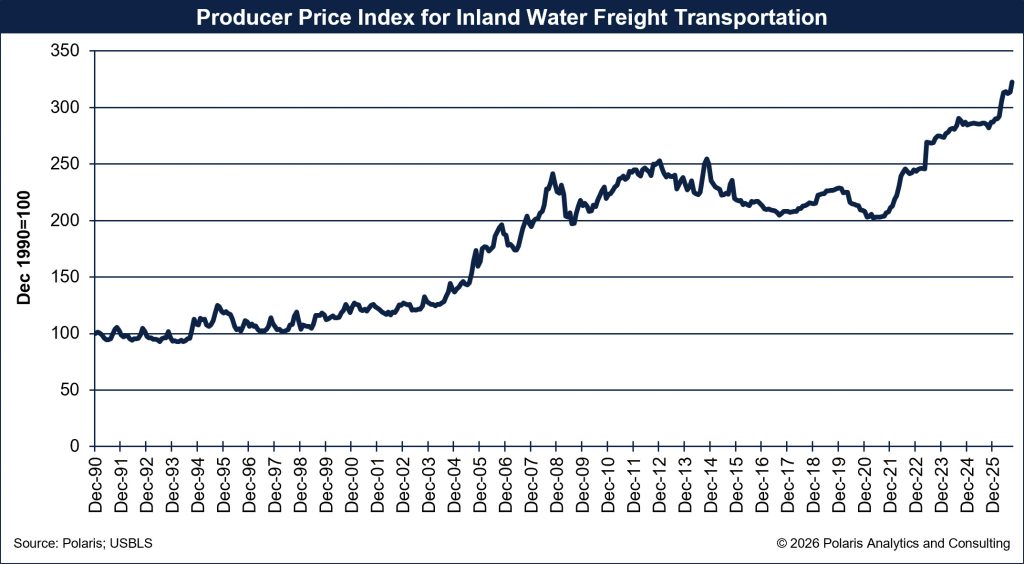
Barge rates and producer-price increases are already attracting attention, and rates are sustaining higher levels. USDA-AMS downbound grain barge rates (percent of the 1976 tariff) have run well above year-ago levels and frequently above the three-year average in recent weeks. On key segments such as the Illinois River and mid-Mississippi, rates have been in the 700–800 percent range, 20 percent or more above the same week a year earlier in several periods.
The Bureau of Labor Statistics Producer Price Index for inland water freight transportation has climbed, with recent readings showing double-digit year-over-year gains in related water-transportation series. Three periods stand out. The first, from the early 2000s through 2008, saw rates rise on improved bulk demand and a shrinking fleet as retirements of 1970s-vintage equipment accelerated. The second, from 2008 through about 2021, saw softer demand — driven largely by lower coal and grain movements — while the fleet expanded, limiting rate gains. The industry is now in a third period, in which rates are rising as demand has improved and fleet growth has stagnated. Unlike the prior expansion cycle, the industry has limited ability to add capacity quickly: Jeffboat closed permanently in 2018, leaving Nabrico as the primary remaining major barge builder, while Heartland Fabrication has been expanding its capability. That constraint acts as a governor on the pace of newbuilds.
That is consistent with a market in which demand for certain commodities remains solid while the supply of equipment is constrained by age and limited newbuilding. Operators who have invested in maintaining or modernizing their fleets are seeing the value of that investment; those who have not are facing a narrower set of options as older units approach the end of their useful life.
Over The Horizon: Capacity That Has To Be There
What is not yet fully seen is how the industry will resurge through better care of existing assets, new construction to replace retiring capacity and adaptation to shifting commodity mixes so that capacity does not constrain the freight the rivers are built to carry.
Grain and oilseed exports can support covered demand for years if the crops and the markets remain available. Coal exports can keep some open demand alive even as domestic burn continues to decline. Petroleum and chemicals can underwrite tank activity. Construction materials associated with data-center and other industrial builds can add incremental bulk and project cargo. None of that works if the fleet cannot answer the call.
The risk is not that the commodities disappear. It is that the equipment needed to move them is retired faster than it is replaced, or that the remaining fleet is too old or too specialized to handle the mix of flows that actually materializes.
Rates that stay elevated can encourage new construction, but only if owners and lenders see a durable enough return. Better maintenance can stretch existing units, but it cannot create new ones.
The over-the-horizon question is whether the industry will treat the three R’s as a standing requirement — retire what must be retired, replace what is needed to keep capacity steady and resurge where demand supports it — or whether capacity will become the binding constraint on the commodity flows the inland system is otherwise well positioned to serve.