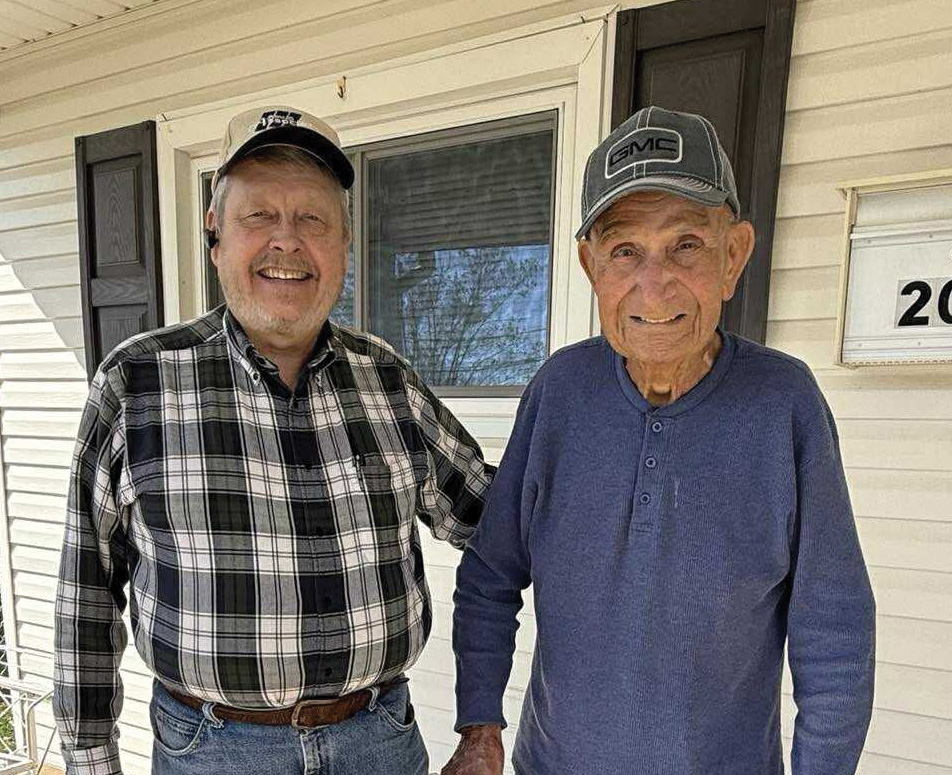
Capt. Lonnie Ryan Turns 96
In early spring 1945, a young man snuck away from his home in Marion, Ky., near old Lock 50, without his parents’ knowledge. His name was Lonnie Ryan, and he had decided that he wanted to work on the river, so he went to Mount Vernon, Ind., to find a job. His intent was to be a deckhand, but the first position he found was as a cabin boy on the towboat Sohioan, owned by Sohio Petroleum. Built in 1943 by St. Louis Ship, the streamlined Sohioan, at that time, was the most powerful on the rivers at 2,415 hp. It was o
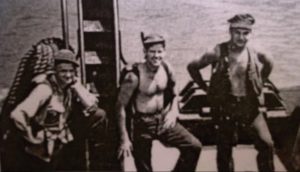
n a regular run towing crude oil into Mount Vernon from Louisiana.
The cabin boy was the lowest member of the nearly 20-person crew and handled menial chores such as cleaning and making beds. Ryan didn’t care for that work but had been promised a deckhand job when one opened. After one trip, he decided to quit when the boat arrived back at Mount Vernon in April, intending to go back home to Marion. On the street, he ran into a friend from home who told him the boat he was working on needed a deckhand.
The friend took Ryan to the Washington Tavern, where Capt. Robert “Bobby” Smith (a veteran of two steamboat explosions) sat nursing a drink. Ryan was introduced, and it was made known that he was looking for work as a deckhand. Smith looked at him over his drink and asked, “Can you be ready to work at midnight?” When Ryan answered that he could, Smith replied, “I’ll hire you.” And with that, 15-year-old Lonnie W. Ryan became an employee of Ashland Oil & Refining Company (AO&R) aboard the DPC steamer Midway Islands.
The Midway Islands was one of 21 identical steam prop towboats built by the government agency known as the Defense Plant Corporation during World War II and turned over to private companies to operate. They each had a steel hull that was 180 by 52 feet, and much of the cabin was of wooden construction. They were powered by two triple expansion steam engines developing 2,000 hp. The new deckhand’s first duty the night he boarded the boat was to clean the forward hold. Due to steam lines running to the capstans, Ryan says he still remembers how horribly hot it was in that space.
Ryan was on the Midway Islands with only a few days off until it was turned back over to the government following the war. The boat was placed in tow of a barge line boat at Catlettsburg, Ky., for delivery to New Orleans, and Ryan stayed aboard until the tow reached Lock 50, where he was laid off and went home, thinking his towboat days could be over. After several months of not finding a job that satisfied him, he sent a letter to Smith, inquiring about the chance of employment. He received a letter from Gene Grannaman, mate on the original Ashland, telling him if he would be at Catlettsburg on a certain date that Smith would hire him on that boat. He made the connection and became a deckhand on the Ashland.
After working for some time, Ryan left the company for a brief period before returning in April 1948. He would remain with the firm for the next 56 years before finally retiring. He was aboard the Ashland boats that had the first radar sets installed on the inland rivers, and he was on and around the triple-screw Aetna-Louisville and Allied-Ashland when they came out in 1951 and1952 as the most powerful on the rivers at 4,800 hp.
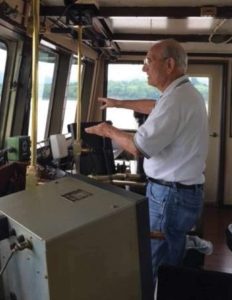
Ryan rose through the ranks at AO&R to the position of mate. The late Robert L. Gray, a marine transportation manager at the company, once related to this writer that he had a difficult time convincing Ryan to consider advancing to the pilothouse. Eventually, Ryan became a steersman aboard the Jim Martin. It was built by Calumet at Chicago in 1940. The Jim Martin was powered with two Fairbanks direct reversing engines, developing 1,150 hp. In 1956, Ryan began standing pilot watches aboard that same vessel, which in later years he would refer to as “the ol’ Martin.”
Ryan would go on to serve as relief captain on various boats in the AO&R fleet. In 1966, a new 5,000 hp. boat was delivered to the firm by St. Louis Ship. Capt. Willard White was aboard as master with CRyan as relief captain. When Capt. Tommy Stevenson retired as master of the Allied-Ashland in the early 1970s, Ryan was assigned to take his place aboard that vessel.
I feel it can be said without contradiction that the Allied-Ashland was Ryan’s favorite towboat. In the years that he was the regular captain of it, the boat was meticulously maintained and cared for. Inside and out, it looked as it had when it came out in 1952. As evidence of this, while serving aboard as pilot once in 1986, the pilot of a passing vessel inquired of me if the Allied was “a new boat built to look old or an old boat kept up well.” In 1988, the Allied was replaced by the 4,200 hp. Superamerica, and Ryan took over that vessel. When the Robert C. Byrd Locks on the Ohio River opened to traffic in 1993, the Superamerica with Ryan on watch was the first boat locked through.
Over the years, Ryan would have a hand in training many others, including his own two sons, Capts. Don and Dwight Ryan. Another person who came up under Ryan, Capt. Bert Slone, himself now retired, recalls that Ryan was “stern, but fair.”
“He was particular in how he wanted things done, and if you did your job, he was satisfied,” Slone said.
Ryan retired from what was then Marathon Ashland Petroleum in 2003 at age 73. He retired from the company where he had worked for 56 years but continued to work as a trip pilot, standing his last watch as pilot at age 87.
Ryan turned 96 years old December 18. He is still active, in good health and enjoys visitors at his home in Princeton, Ky. He still likes talking about his career, which spanned a time of limited communication and navigational aids where one relied on carbon arc searchlights, hand signals from the deck crew and whistle signals through the advent of radar, xenon searchlights, VHF radio and electronic charting. Happy birthday, Cap! May you enjoy many more.